

Nigerian Niger Seed: The Tiny Black Oilseed Whose Two Entirely Separate Commercial Lives — As the Premium Wild Bird Food That Goldfinches, Siskins, and Redpolls Refuse to Share With Any Other Garden Bird, and As the Traditional Edible Oil Whose Omega-6 Rich Linoleic Acid Profile Has Sustained Ethiopian and Indian Highland Communities for Centuries — Exist in Complete Commercial Isolation From Each Other, Creating Two Distinct Buyer Communities Who Purchase the Same Seed Without Ever Knowing the Other Exists
Niger Seed Exporter Nigeria — Whole Niger Seed (Nyjer/Ramtil), Niger Seed Oil (Cold-Pressed and Expeller), Niger Seed Meal, and Bird Food-Grade Nyjer Seed, Direct Northern Highland Sourcing, Bulk Supply to Wild Bird Food Manufacturers, Edible Oil Refineries, Animal Feed Protein Supplement Buyers, and Global Commodity Wholesale Buyers Worldwide
Niger seed exporter Nigeria is a search phrase that immediately requires the most fundamental commercial disambiguation of any product in this entire series: niger seed is not related to Nigeria by name — the similarity between “niger seed” and “Nigeria” is purely coincidental. Guizotia abyssinica takes its common name “niger” from the Latin word for black — niger simply means black, referring to the seed’s characteristic black colour. The plant is native to Ethiopia and the East African highlands, not to West Africa. Nigeria’s production of niger seed reflects the crop’s successful introduction to the northern highland plateaus of Plateau, Nasarawa, and Bauchi states where altitude and rainfall conditions comparable to Ethiopian growing zones make cultivation commercially viable.
This disambiguation matters commercially for two reasons. First, international buyers encountering “niger seed Nigeria” for the first time may assume the naming relationship implies a particularly deep agricultural heritage in Nigeria — it does not. Second — and more commercially important — the disambiguation reveals that the global niger seed market’s dominant origin (Ethiopia, which accounts for approximately 60–70% of internationally traded niger seed according to ITC Trade Map) is the reference point against which Nigerian origin quality is evaluated, and whose supply concentration risk creates the diversification opportunity that Paradise MultiTrade’s niger seed programme addresses.
The two commercial lives of niger seed are genuinely remarkable in their separateness. In European and American wild bird food retail — where niger seed is marketed under the trade name “Nyjer” (a trademark registered by the Wild Bird Feeding Industry (WBFI) specifically to differentiate commercially traded niger seed from the unrelated Canada thistle) — the product is sold as the premium specialist seed whose specific oil content, small size, and thin seed coat make it the preferred food of goldfinches, siskins, lesser redpolls, pine siskins, and American goldfinches — finch species whose fine beaks are specifically adapted to extracting oil-rich small seeds and whose garden presence is the specific goal that drives premium bird food consumer spending. A bag of Nyjer costs 3–5× the price of a bag of mixed bird seed — because wild bird enthusiasts whose primary objective is attracting finches to their garden will pay premium prices for the seed that delivers this specific result. No other commonly traded seed replicates it.
In Ethiopian and Indian traditional food culture — where niger seed is called nug or noug in Ethiopia, ramtil in India — the same seed is cold-pressed into a pungent, dark, strongly flavoured edible oil whose specific fatty acid profile (high linoleic acid, omega-6 dominant) creates the characteristic cooking oil of highland Ethiopian cuisine, and whose traditional use across millennia of continuous cultivation has established niger seed oil as a culturally specific ingredient in injera preparation, fasting food cooking, and traditional medicine application. This is an oil that European and American wild bird food buyers have never heard of — yet it is one of the oldest continuously produced traditional edible oils in East African food culture.
Nigeria’s commercial opportunity sits at the intersection of both markets — producing niger seed in the northern highland zones whose altitude and rainfall conditions create quality parameters competitive with Ethiopian origin, and exporting to both the wild bird food manufacturers of Europe and North America and the edible oil industry buyers of South and East Asia through Paradise MultiTrade’s formally documented export programme.
At Paradise MultiTrade International Limited, niger seed is sourced from highland farming communities across Plateau, Nasarawa, Bauchi, Benue, and Gombe states where altitude between 600–1,400 metres above sea level creates the specific growing conditions that produce commercially acceptable niger seed quality, and exported with full food safety, quality, and phytosanitary documentation to international buyers.
To discuss sourcing immediately, request a quotation here and our export team responds within 48 hours.
History and Origin of Niger Seed — The East African Highland Crop That Travelled West
Guizotia Abyssinica — Ethiopia’s Gift to Bird Feeders and Traditional Oil Presses
Guizotia abyssinica (L.f.) Cass. is a member of the Asteraceae (daisy and sunflower) family — a tall, branching annual herb native to the Ethiopian highlands and East African rift valley zone where it grows wild in disturbed habitats, roadsides, and field margins at altitudes of 1,500–2,800 metres above sea level. Archaeological and botanical evidence documented through NCBI’s plant genetics database and reviewed through Kew Royal Botanic Gardens’ economic botany collection confirms Ethiopia as the primary domestication centre — with cultivation documented across the Ethiopian highlands for approximately 3,000 years.
The crop’s introduction to India — where it became commercially established as ramtil in Madhya Pradesh, Orissa, Chhattisgarh, and Maharashtra — followed the Indian Ocean trade routes that distributed East African botanical resources into South Asia, with Indian cultivation developing its own distinct cultural identity alongside Ethiopian origin. Introduction to West Africa and specifically to Nigeria’s highland plateaus occurred more recently — most likely during the colonial agricultural experimentation period when British agricultural officers introduced high-altitude oilseeds to the Jos Plateau’s highland conditions as potential commercial crops for the northern region.
The Jos Plateau — Nigeria’s most commercially significant niger seed producing zone, whose altitude of 900–1,400 metres above sea level and annual rainfall of 1,200–1,500mm create agro-ecological conditions genuinely comparable to the Ethiopian highland growing zones that define niger seed’s botanical homeland — proved hospitable to Guizotia abyssinica cultivation whose production has been maintained by Plateau State farming communities since colonial introduction. The Nigerian Export Promotion Council (NEPC) has identified niger seed within its non-oil agricultural export development programme — recognising both the wild bird food export market and the edible oil market as viable international destinations for formally documented Nigerian niger seed.
The Nyjer Trade Name — A Commercial Registration That Changed an Industry
The wild bird food industry’s adoption of niger seed created an unexpected commercial nomenclature problem in the 1990s: niger seed’s name resembled ethnic slurs in several languages, creating retail marketing challenges for wild bird food brands whose consumer communication needed to prominently feature the product name. The Wild Bird Feeding Industry (WBFI) — the North American trade association representing wild bird food manufacturers and retailers — registered the trademark “Nyjer” specifically as a commercial marketing name for niger seed that could be used freely in retail environments without linguistic sensitivity concerns.
The Nyjer trademark has been commercially successful beyond its original intent — creating a globally recognised premium bird food brand identity that is now used by wild bird food manufacturers across the USA, UK, Europe, and Australia to communicate the specific premium finch-attracting positioning that niger/nyjer seed’s unique properties deliver. For international buyers in the wild bird food market — “Nyjer” and “niger seed” are completely synonymous; the same Guizotia abyssinica product described by two different names in the same commercial market.
What Is Nigerian Niger Seed? The Botanical Profile, Oil Chemistry, and the Two Commercial Market Specifications
Guizotia Abyssinica — The Small Black Oilseed Whose Size Is a Commercial Specification
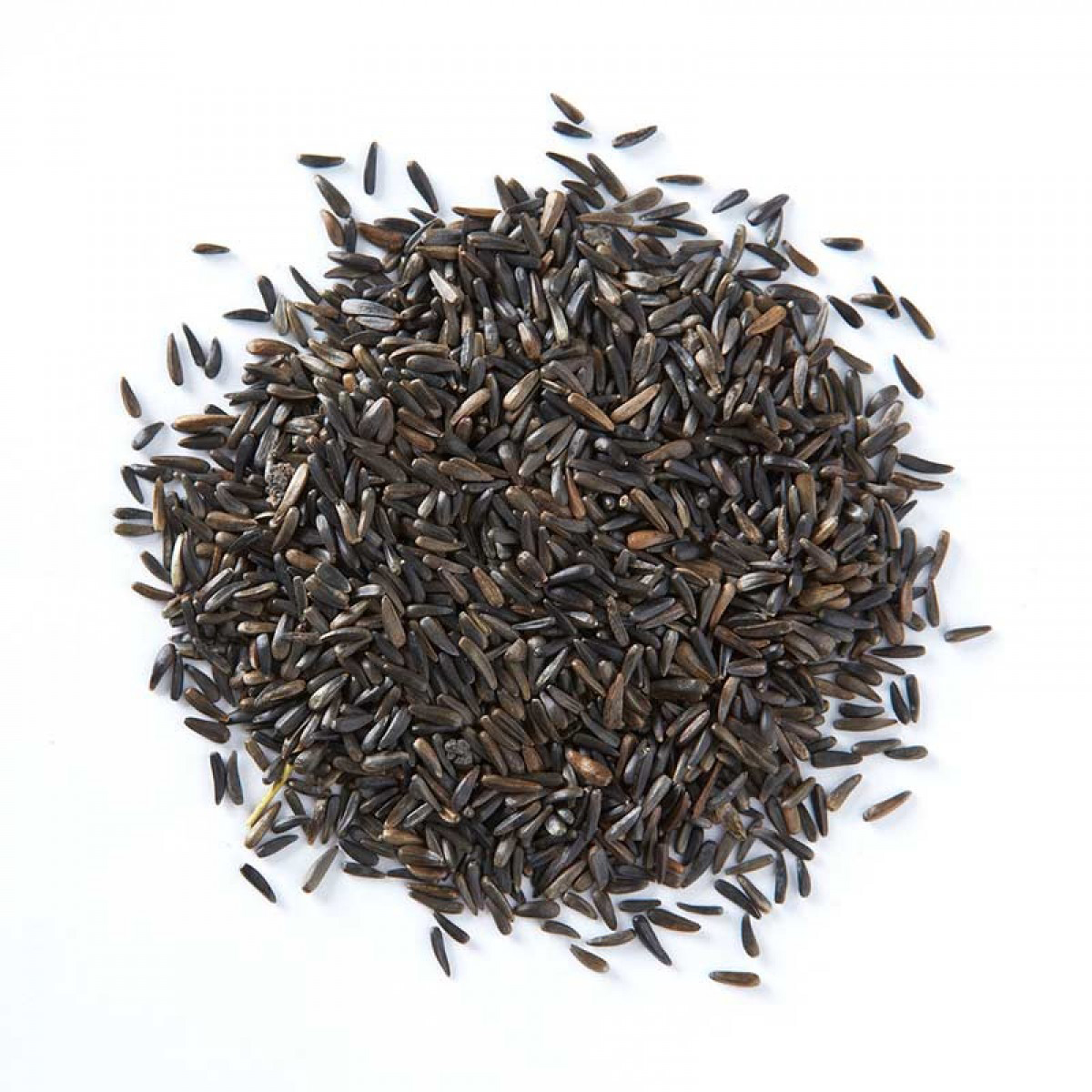
Guizotia abyssinica produces small, narrow, black achene seeds — 4–5mm long, 1–1.5mm wide — whose specific small size is commercially important in both its primary markets: for wild bird food, the small size is precisely matched to the beak morphology of finch species whose seed-extracting efficiency creates their preference for niger over larger seeds; for edible oil production, the high surface-area-to-volume ratio of small seeds creates efficient oil extraction in traditional stone-mill pressing whose small-seed handling is well-adapted.
Oil content — approximately 35–45% of dry seed weight — the primary commercial driver for both bird food and edible oil applications. The seed’s oil richness is what makes it nutritionally attractive to oil-seeking finch species and commercially valuable to oil extractors. Oil content at 38–42% is the commercial sweet spot that most international buyers specify — below 35% indicates poor crop quality or post-harvest deterioration; above 43% represents premium highland-grown material.
Fatty acid profile — the oil’s composition is dominated by linoleic acid (omega-6) at 65–80% of total fatty acids — one of the highest linoleic acid concentrations of any commercially traded vegetable oil. This linoleic acid dominance creates specific commercial properties: the oil’s high polyunsaturated fat content makes it nutritionally valuable as an essential fatty acid source while simultaneously making it susceptible to oxidative rancidity — requiring appropriate storage and packaging management.
Oleic acid — approximately 8–12% of total fatty acids — the monounsaturated fat whose moderate concentration provides partial oxidative stability alongside the dominant linoleic fraction.
Palmitic and stearic acids — the saturated fatty acid fractions at approximately 5–10% combined — providing structural integrity to the seed’s lipid matrix.
Protein content — approximately 20–25% of dry seed weight — creating meaningful protein nutritional value in the residual seed cake after oil extraction whose animal feed application parallels the groundnut cake and soybean meal applications documented in preceding articles.
The heat-sterilisation requirement for US and Australian wild bird food market — a commercially critical processing requirement unique to this product: the US and Australian wild bird food regulatory frameworks — administered through USDA APHIS in the USA and DAFF in Australia — require that niger seed imported for wild bird food use be heat-sterilised to prevent germination — eliminating the risk that niger seed, if spilled from bird feeders into garden soil, could establish as an invasive alien plant species. Standard heat treatment: 120–130°C for a period sufficient to achieve 100% germination kill — confirmed by germination test post-treatment (0% germination required for US and Australian market entry). This sterilisation requirement adds processing cost and must be factored into procurement pricing for US and Australian wild bird food buyers.
Three Commercial Product Forms
Whole Niger Seed (Non-Sterilised) — for edible oil extraction, animal feed, and wild bird food markets where sterilisation is not required (UK, Europe — where plant health risk assessment has not mandated sterilisation as standard, though some buyers specify it voluntarily).
Heat-Sterilised Nyjer Seed — the US and Australian wild bird food market specification — 100% germination kill confirmed by post-treatment germination test, zero contamination with other weed seeds confirmed by visual inspection.
Cold-Pressed Niger Seed Oil — extracted at below 40°C to preserve linoleic acid integrity, vitamin E content, and the characteristic pungent dark flavour of authentic nug oil — the traditional Ethiopian and Indian edible oil form.
Benefits and Industrial Uses of Nigerian Niger Seed
Wild Bird Food Manufacturing — The Goldfinch Premium Market
The global wild bird food market — whose commercial scale we documented in the millet article at over USD 8 billion annually with the UK wild bird food market alone exceeding GBP 200 million per year according to the Royal Society for the Protection of Birds (RSPB) — creates the most commercially significant international procurement market for niger seed by volume:
Goldfinch and finch specialisation — niger seed’s unique appeal to goldfinches, siskins, and redpolls reflects the specific nutritional profile that these species’ metabolism is adapted to seek: high oil content (energy density for small birds in cold weather), small seed size (matched to fine bill morphology), thin seed coat (easy extraction without the hull-removing effort required for larger seeds). Research on wild bird dietary preferences — published through ornithology research accessible via JSTOR’s bird science database and documented through British Trust for Ornithology (BTO) bird feeding studies — confirms niger seed’s unrivalled ability to attract finch species to garden feeders.
Premium pricing and consumer loyalty — wild bird food consumers who discover that niger seed specifically attracts goldfinches become highly loyal repeat purchasers whose price sensitivity to premium niger seed pricing is demonstrably lower than for commodity seed mixes. The RSPB’s bird feeding guidance specifically recommends niger seed as the specialist feed for finch species — creating institutional endorsement that drives consumer purchase decisions in UK retail.
Wild bird food blend formulation — niger seed is incorporated in premium finch-specific seed blends alongside sunflower hearts and small millet — creating formulated product lines whose premium pricing is anchored by niger seed’s commercial value. Major UK wild bird food brands including Vine House Farm, Johnston and Jeff, and major private label manufacturers collectively source hundreds of tonnes of niger seed annually. US manufacturers including Wagner’s, Kaytee, and Pennington collectively source thousands of tonnes.
For wild bird food manufacturing buyers evaluating Nigerian niger seed — contact our export team to discuss germination test sterilisation for US and Australian markets, weed seed contamination specification, and oil content documentation.
Edible Oil Industry — The Traditional Nug Oil Market
Ethiopian and Indian traditional cooking oil — the most culturally authentic application for niger seed oil whose 3,000-year continuous use in Ethiopian highland cuisine and centuries of traditional use in central Indian cooking creates the most deeply documented traditional food use evidence of any oilseed product in this series. Nug oil in Ethiopia — used for frying, cooking injera (the sourdough flatbread base of Ethiopian cuisine), and in fasting food preparation during Orthodox Christian fasting periods — is specifically valued for its compatibility with vegetarian cooking traditions whose absence of animal fat requires vegetable oil of sufficient flavour and nutritional presence.
Linoleic acid-rich functional oil — niger seed oil’s dominant linoleic acid (omega-6) content creates nutraceutical positioning as an essential fatty acid source — particularly relevant for populations whose dietary omega-6 intake is insufficient for optimal immune function, skin health, and cardiovascular system support documented through NCBI’s essential fatty acid research database.
Lamp oil and industrial applications — in traditional communities, niger seed oil’s combustion properties create lamp oil applications whose historical significance in pre-electrification Ethiopian and Indian highland communities established the crop’s importance beyond food use.
For edible oil refinery buyers evaluating Nigerian niger seed for oil extraction — contact our team to discuss oil content specification and fatty acid profile documentation.
Animal Feed — Niger Seed Cake
Niger seed cake — the residual meal after oil extraction, containing approximately 25–35% crude protein and high dietary fibre — creates animal feed protein supplement value whose commercial application in poultry and ruminant rations is documented through agricultural research from IITA’s oil crop nutrition programme. The cake’s specific amino acid profile and digestibility characteristics are reviewed through NCBI’s animal nutrition research — confirming inclusion rates of 5–15% in poultry rations produce acceptable growth performance. For animal feed manufacturers evaluating niger seed cake as a supplementary protein ingredient — contact us.
Nutraceutical and Functional Food
Omega-6 supplement — niger seed oil’s linoleic acid dominance creates omega-6 essential fatty acid supplement positioning for the Natural Products Association (NPA) tracked supplement market whose essential fatty acid products span from evening primrose oil through borage oil through niger seed oil as diverse natural omega-6 sources.
Antioxidant content — niger seed oil’s vitamin E (tocopherol) content — documented through FAO food composition research — provides antioxidant protection that partially moderates the linoleic acid’s inherent oxidative susceptibility and creates nutraceutical antioxidant positioning alongside the essential fatty acid content.
Why Buy Niger Seed From Nigeria?
The Jos Plateau Altitude Advantage
Nigeria’s primary niger seed production zone — the Jos Plateau of Plateau State at 900–1,400m above sea level — creates growing conditions whose altitude-driven temperature moderation, adequate rainfall, and well-drained plateau soils produce Guizotia abyssinica with oil content at the upper commercial range. Research on niger seed quality variation across altitude zones — reviewed through NCBI’s plant agronomy database — confirms that moderate altitude growing conditions maximise lipid biosynthesis in Guizotia abyssinica — the same growing condition quality enhancement mechanism documented throughout this series for Sahel-adjacent highland crops.
Supply Diversification From Ethiopian Dominance
Ethiopia’s approximately 60–70% share of internationally traded niger seed creates supply concentration exposure comparable to the soybean and cassava supply concentration risks documented in earlier articles. Ethiopian political instability — documented through FAO’s Ethiopia country assessment — and harvest variability in the Ethiopian highlands create the supply disruption risk that buyers building long-term Niger seed supply chains must address through origin diversification. Nigerian origin from Paradise MultiTrade provides the West African production geography whose climate exposure, political stability relative to the Horn of Africa, and Atlantic coast logistics access to European markets together provide commercially credible supply diversification from Ethiopian dominance.
The Heat Sterilisation Processing Capability
For US and Australian wild bird food market buyers — the sterilisation processing requirement (120–130°C, 100% germination kill) is the primary technical specification that differentiates capable from incapable export origins. Paradise MultiTrade’s processing network includes heat sterilisation capability with post-treatment germination testing documentation — confirmed through accredited agricultural testing laboratories. This processing capability is commercially essential for US and Australian wild bird food market access and is specifically documented per shipment. Contact us to discuss sterilisation processing and germination test documentation.
Zero Weed Seed Contamination — The Critical Bird Food Quality Standard
Wild bird food niger seed must be free from weed seeds — particularly invasive species whose germination from bird feeder spillage could establish in gardens and natural areas. US APHIS import requirements and UK DEFRA plant health standards both specify maximum weed seed contamination levels. Paradise MultiTrade coordinates rigorous mechanical cleaning and optical sorting achieving below 0.1% weed seed contamination — documented through lot-specific seed purity analysis.
Complete Export Documentation
Every niger seed shipment from Paradise MultiTrade carries phytosanitary certification from NAQS, NEPC export documentation, certificate of origin, commercial invoice, packing list, and bill of lading. For wild bird food buyers, we coordinate oil content (Soxhlet), moisture content, seed purity analysis (weed seed count), germination test (pre-sterilisation to confirm viability, post-sterilisation to confirm 0% germination), and phytosanitary certificate confirming freedom from quarantine weed seeds. For edible oil buyers, we coordinate oil content, fatty acid profile (GC analysis), moisture content, free fatty acid (FFA), acid value, and peroxide value. EU-bound shipments comply with Regulation (EU) 2017/625 on official controls. Our NEPC Export Licence No. 0042385 and CAC Registration No. RC-9284647 are verifiable through NEPC.
Nigeria’s Niger Seed Export Strength and Global Market Demand
The Global Market — Two Completely Separate Demand Streams
The global niger seed market — tracked through Mordor Intelligence’s niger seed market report and Grand View Research’s bird food market analysis — is commercially divided between the wild bird food segment (primary volume, highest per-tonne pricing in premium markets) and the edible oil and traditional food segment (highest volume in Ethiopian and Indian domestic markets, moderate export pricing). The International Niger Seed Association (INSA) provides the institutional framework for global niger seed trade standards whose quality specifications define the commercial benchmarks for both market segments.
Key Export Destination Markets
The United Kingdom — the world’s most bird-feeding-engaged nation per capita, whose wild bird food retail market creates the most commercially immediate and highest-per-tonne-value destination for premium quality niger seed. UK niger seed does not require heat sterilisation — phytosanitary inspection by APHA and freedom from quarantine weed seeds are the primary entry requirements. Major UK wild bird food brands source hundreds of tonnes annually — concentrated purchasing from established importers who service brands including Vine House Farm, RSPB Wildlife, and major supermarket private labels.
Germany and the Netherlands — Europe’s wild bird food manufacturing hubs and natural food distribution centres — creating combined wild bird food and edible oil ingredient procurement demand. EU plant health requirements under EU Plant Health Regulation 2016/2031 govern niger seed import.
The United States — whose wild bird food market creates significant heat-sterilised Nyjer seed procurement demand from manufacturers including Wagner’s, Kaytee, Pennington, and hundreds of regional brands. USDA APHIS administers the sterilisation and weed seed requirements for niger seed import — APHIS Nyjer seed requirements specifically document the processing specifications for US market entry.
Australia — which imposes the strictest niger seed import requirements in the world — requiring heat sterilisation confirmation and comprehensive weed seed freedom documentation administered through DAFF. The Australian wild bird food market’s strict biosecurity creates a premium for suppliers whose sterilisation documentation meets DAFF’s specific standards.
India — whose domestic ramtil edible oil tradition creates import demand during domestic supply shortfalls in the central highland producing states — tracked through APEDA.
Ethiopia — which despite being the dominant producer — imports niger seed during domestic supply shortfalls for urban processing operations distant from producing zones.
UAE and Gulf States — where South Asian and East African expatriate communities create diaspora demand for traditional nug/ramtil oil tracked through ADAFSA.
Why Choose Paradise MultiTrade International Limited?
Heat Sterilisation and Germination Testing for US and Australian Markets. We provide heat sterilisation processing (120–130°C, achieving 100% germination kill) confirmed by post-treatment germination test documentation — the specific processing and documentation requirement that US APHIS and Australian DAFF wild bird food import regulations mandate. For US and Australian wild bird food buyers — this processing capability is non-negotiable and is what distinguishes suppliers who can serve these markets from those who cannot. Contact us to discuss sterilisation processing and germination testing.
Weed Seed Purity Analysis Documentation. Seed purity analysis confirming below 0.1% weed seed contamination — through accredited seed testing laboratory analysis — provided as standard for all wild bird food market shipments. Freedom from specifically listed quarantine weed species (including Striga species, Cuscuta species, and other APHIS/DEFRA-listed quarantine organisms) confirmed per lot. Contact us to discuss weed seed purity specification.
Fatty Acid Profile Documentation for Edible Oil Buyers. GC fatty acid profile analysis confirming linoleic acid percentage, oleic acid, and saturated fat fractions — alongside free fatty acid (FFA), acid value, and peroxide value — coordinated through accredited oil chemistry laboratories for edible oil refinery buyers whose production specifications require documented fatty acid composition. Contact us to discuss oil chemistry documentation.
Dual Market Supply — Bird Food and Edible Oil. Both non-sterilised whole niger seed (edible oil extraction, European bird food markets) and heat-sterilised Nyjer seed (US and Australian bird food markets) from the same documented Nigerian Plateau State highland origin. Contact our team to specify your market requirement.
Multi-Commodity West African Oilseed Sourcing. Niger seed buyers frequently source complementary Nigerian oilseeds and agricultural commodities. Alongside niger seed, Paradise MultiTrade exports white sesame seed, brown sesame seed, black sesame seed, groundnut, soybeans, sesame oil, groundnut oil, moringa seed, shea butter, millet, cashew nut kernel, and raw cashew nuts. Explore our full range of Nigerian export commodities and consolidate your West African oilseed and agricultural sourcing through one verified, licensed export partner.
Product Specifications
| Specification | Details |
|---|---|
| Product | Nigerian Niger Seed (Guizotia abyssinica) |
| Common Names | Niger seed, Nyjer seed (bird food trade name), Nug/Noug (Ethiopian), Ramtil (Indian), Guizotia seed |
| Botanical Species | Guizotia abyssinica (L.f.) Cass. (Asteraceae) |
| Origin | Nigeria (Plateau, Nasarawa, Bauchi, Benue, Gombe States) — Highland plateau zones 600–1,400m altitude |
| Forms Available | Whole niger seed (non-sterilised); Heat-sterilised Nyjer seed (US/Australian bird food market); Cold-pressed niger seed oil; Niger seed cake (feed grade) |
| Oil Content | 35–45% dry weight (Soxhlet extraction) — commercial target 38–42% |
| Protein Content | 20–25% dry weight |
| Moisture Content | ≤8% (whole seed); ≤6% (sterilised bird food grade) |
| Linoleic Acid (C18:2) | 65–80% of total fatty acids (GC analysis) |
| Oleic Acid (C18:1) | 8–12% of total fatty acids |
| Free Fatty Acid (FFA) | ≤3% (edible oil grade); ≤5% (feed grade) |
| Peroxide Value | ≤10 meq/kg (fresh crop) |
| Seed Purity | Minimum 99% pure niger seed; Maximum 1% foreign seeds |
| Weed Seed Contamination | ≤0.1% — including specific quarantine species freedom confirmed by purity analysis |
| Quarantine Organism Freedom | Striga spp., Cuscuta spp., and APHIS/DEFRA/DAFF-listed quarantine organisms: absent |
| Germination Test (Pre-Sterilisation) | ≥85% germination (confirming seed viability before sterilisation) |
| Germination Test (Post-Sterilisation) | 0% germination (confirming complete germination kill for US/Australian markets) |
| Sterilisation Temperature | 120–130°C — documented heat treatment record per lot |
| Aflatoxin | Total ≤10 ppb; B1 ≤2 ppb |
| Pesticide Residue | Multi-residue analysis to EU MRL standards — mandatory all EU-bound lots |
| Microbiological | Salmonella absent/25g; Total plate count ≤100,000 CFU/g |
| Seed Size | 4–5mm length, 1–1.5mm width — small uniform achene |
| Colour | Black to dark grey — characteristic shiny black surface |
| Shelf Life | 12 months whole seed (cool, dry, sealed); 6 months oil (sealed, dark, cool) |
| Packaging Options | 25kg, 50kg polypropylene bags (whole seed); sealed aluminium containers or amber bottles (oil) |
| Supply Capacity | 50–2,000+ MT per season |
| MOQ | Whole seed: 10 MT; Sterilised Nyjer: 10 MT; Oil: 500kg; Cake: 5 MT |
| Export Documentation | Phytosanitary Certificate (NAQS), Certificate of Origin, NEPC Export Licence, Seed Purity Analysis (weed seed count), Oil Content Certificate (Soxhlet), Germination Test Certificate (pre and post sterilisation for US/Australian markets), Sterilisation Temperature Record, Fatty Acid Profile (GC — edible oil buyers), Aflatoxin Certificate, Pesticide Residue Certificate (EU MRL), Microbiological Certificate, Commercial Invoice, Packing List, Bill of Lading |
| Payment Terms | T/T, Letter of Credit (LC at sight), Escrow |
| Loading Port | Lagos (Apapa / Tin Can Island Port), Nigeria |
| Incoterms Available | EXW, FOB Lagos, CNF, CIF |
Packaging and Export Process
Harvest Season. Nigerian niger seed harvest runs October through December following the July–September growing season in the highland plateau producing zones. The Jos Plateau’s altitude creates a slightly cooler growing environment than Nigeria’s lowland zones — with the combination of adequate rainfall (1,200–1,500mm annually) during the growing season and the harmattan’s dry conditions during harvest creating optimal post-harvest drying conditions. Plants are harvested when seed heads turn yellow-brown and before the seed achenes begin to shatter and fall — timing that requires field monitoring because niger seed’s thin seed coat and small size make shattering-related harvest losses commercially significant if timing is delayed.
Threshing and Initial Cleaning. Harvested plants are bundled and threshed by beating over clean surfaces — the small achene seeds separating readily from the flower head. Initial cleaning through air aspiration (winnowing) removes light material, empty seeds, and plant debris. The small seed size creates mechanical handling challenges — equipment gap settings that work for sesame or groundnut require adjustment for niger seed’s smaller dimensions.
Cleaning and Purity Sorting. Mechanical cleaning through combination of sieve separation (removing oversized material and undersized debris), air aspiration (removing light material), and gravity table (density-sorting to remove stones and soil fragments) achieves the seed purity specification. For bird food grade — additional optical sorting targets weed seed removal whose presence must be confirmed by post-sorting seed purity analysis.
Germination Testing (Pre-Sterilisation). For US and Australian market lots — representative samples undergo germination testing before sterilisation to confirm seed viability (target: above 85% germination) and to establish the pre-sterilisation baseline that post-sterilisation results are compared against.
Heat Sterilisation (US and Australian Market). Clean, sorted niger seed is fed through continuous belt or rotary drum heat treatment equipment at 120–130°C inlet temperature — with residence time sufficient to achieve thorough seed heating. Sterilisation parameters (temperature, residence time) are recorded in a continuous log throughout the treatment. Post-sterilisation, samples are taken for germination testing — confirmed 0% germination before sterilisation documentation is prepared.
Oil Extraction (where specified). Whole clean niger seed fed through expeller presses (for hot-pressed oil) or cold-press expellers at below 40°C (for cold-pressed premium oil). Oil yield: approximately 30–38% of seed input weight. Seed cake from oil extraction dried and packed for feed market.
Quality Testing. Moisture content, oil content, seed purity analysis, aflatoxin, pesticide residue — tested before export documentation. Fatty acid GC profile, FFA, peroxide value — tested for edible oil buyers. Germination tests — tested for US/Australian bird food market.
Lead Times. Whole non-sterilised: 14–21 days. Heat-sterilised Nyjer (including sterilisation processing and post-treatment germination test): 21–35 days. Cold-pressed oil: 28–42 days. Contact us to plan your supply schedule.
Frequently Asked Questions
What is the difference between niger seed and thistle seed — and why does the bird food industry sometimes call it both?
Niger seed (Guizotia abyssinica) and thistle seed (Cirsium and Carduus species) are botanically unrelated — completely different plant families (Asteraceae genus Guizotia versus Asteraceae genus Cirsium). The confusion arose in the early North American wild bird food market when niger seed was introduced as a premium finch attractant — marketed informally as “thistle seed” because both seeds attract finch species and niger seed’s small black achene superficially resembles thistle seed. The “thistle seed” label created plant health concerns among US regulators worried about genuine thistle (an invasive weed) being inadvertently distributed through bird food spillage. This concern motivated the Wild Bird Feeding Industry (WBFI) to trademark “Nyjer” as an unambiguous commercial name specifically for Guizotia abyssinica niger seed — and motivated USDA APHIS to require heat sterilisation to prevent any seed — niger or otherwise — from germinating from bird feeder spillage. The commercial consequence: niger seed, nyjer seed, and (informally) thistle seed all refer to the same product — Guizotia abyssinica — in the wild bird food market, while genuine thistle seed is a different botanical product rarely traded commercially. Contact us to discuss niger seed specification for bird food markets.
Why do goldfinches specifically prefer niger seed over all other bird food seeds?
The wild bird research community has documented goldfinch and finch preference for niger seed through field studies accessible via the British Trust for Ornithology (BTO) and ornithological research published through JSTOR’s bird science collection. The preference reflects three specific compatibilities between niger seed’s physical and nutritional properties and finch species’ biological capabilities: (1) Bill morphology match — goldfinch, siskin, and redpoll bills are specifically adapted for extracting small oil-rich seeds whose thin seed coat allows easy opening. Niger seed’s dimensions (4–5mm length, 1–1.5mm width) and thin coat are optimally matched to this bill type — larger seeds require bill manipulation that larger-billed species (sparrows, pigeons) perform more efficiently, while niger seed’s small size specifically advantages finch bill types. (2) Oil content attraction — the seed’s 35–45% oil content creates energy density per unit mass that oil-seeking finch species are specifically motivated to locate and consume, particularly during cold weather when energy requirements increase. (3) Hull-to-seed ratio — niger seed’s thin seed coat maximises edible oil-rich content per seed relative to the hull removal effort — an energetically efficient foraging choice for small birds whose energy balance is sensitive to food processing costs. No other commonly traded seed combines all three properties for finch species. Contact us to discuss bird food grade specification.
What USDA APHIS and Australian DAFF requirements apply to niger seed import and how does Paradise MultiTrade meet them?
US APHIS requirements: Niger seed (Nyjer seed) entering the USA for wild bird food use must be heat-treated to kill viable seed — administered through USDA APHIS Plant Protection and Quarantine (PPQ). The treatment standard requires heating sufficient to achieve 100% germination kill — confirmed by post-treatment germination testing. Additionally, the seed must be free from specifically listed quarantine noxious weed seeds whose presence would trigger import refusal. A phytosanitary certificate from the exporting country’s official plant health authority (NAQS for Nigeria) confirming treatment and freedom from quarantine organisms is required at US port of entry. Australian DAFF requirements: Australia imposes the strictest import biosecurity globally for plant-origin commodities — requiring heat treatment confirmation and comprehensive weed seed purity documentation meeting DAFF’s Biosecurity Import Conditions (BICON) database specifications for niger seed. Paradise MultiTrade meets both requirements through: documented heat sterilisation at 120–130°C with continuous temperature logging per lot; post-treatment germination testing by accredited seed testing laboratories confirming 0% germination; seed purity analysis confirming freedom from quarantine weed seeds; and phytosanitary certification from NAQS incorporating the specific treatment declarations required by both APHIS and DAFF. Contact us to discuss US and Australian market entry documentation.
What is nug oil and how does it differ from conventional vegetable oils?
Nug oil — traditional Ethiopian cold-pressed niger seed oil — is one of the most culturally distinct traditional edible oils in East African food culture, whose specific properties set it apart from conventional culinary oils: (1) Flavour: nug oil has a strongly pungent, nutty, somewhat bitter flavour character that is distinctly recognisable in Ethiopian cuisine — considerably more flavourful than refined sunflower or soybean oil. This intensity is commercially valued in traditional cooking and disliked by consumers unfamiliar with it — making nug oil a culturally specific ingredient rather than a generic cooking oil substitute. (2) Fatty acid profile: nug oil’s dominant linoleic acid (65–80% of fatty acids) makes it one of the most omega-6-rich culinary oils commercially available — nutritionally valuable as an essential fatty acid source but requiring appropriate consumption balance with omega-3 sources. (3) Traditional cultural application: in Ethiopian Orthodox Christianity, nug oil is specifically used during fasting periods (which prohibit animal products) as a permitted plant-based cooking fat — creating a culturally specific religious procurement motivation that sustains consistent demand regardless of conventional cooking oil pricing. (4) Oxidative stability: the high linoleic acid content makes nug oil more susceptible to rancidity than oleic-acid-dominant oils (olive, groundnut) — requiring appropriate dark, cool storage and sealed packaging. For edible oil buyers and food manufacturers targeting Ethiopian diaspora markets — contact us to discuss nug oil specification.
How does Nigerian niger seed quality compare to Ethiopian origin — the global benchmark?
Ethiopian Guizotia abyssinica from the highland producing zones of Oromia, Amhara, and SNNP regions — grown at altitudes of 1,500–2,800m — is the global benchmark for niger seed quality, with oil content typically 38–45% and established commercial documentation infrastructure built through decades of formal export. Nigerian Jos Plateau niger seed — from 900–1,400m altitude — produces comparable oil content in the commercial specification range (35–43%) with the lower altitude creating slightly lower maximum oil content potential versus highest-altitude Ethiopian material. Commercial differentiators for Nigerian origin: Atlantic logistics advantage — Lagos to Rotterdam is 14–18 days versus Djibouti/Ethiopia to Rotterdam at 18–25 days; supply chain political risk — Nigeria’s commercial stability relative to Ethiopia’s ongoing regional conflicts creates more predictable supply chain management; price competitiveness — Nigerian origin at equivalent specification typically prices below Ethiopian benchmark due to developing export infrastructure. For buyers whose Ethiopian supply concentration creates diversification motivation — Nigerian niger seed provides a comparable quality West African alternative at competitive pricing. Comparative seed purity analysis and oil content documentation for direct buyer evaluation is available on request. Contact us to request comparative sample lots.
What is the Nigerian niger seed harvest season and when should I plan procurement?
Nigerian niger seed harvest runs October through December in the highland plateau producing zones — following the July–September growing season whose rainfall adequacy determines yield. Early-planted crops (June–July) on Jos Plateau harvest September–October; main season crops harvest November–December. The harmattan’s onset coincides with harvest — providing optimal low-humidity drying conditions. Procurement planning: (1) For heat-sterilised Nyjer seed for US and Australian market delivery — US and Australian wild bird food demand peaks September through February (northern hemisphere and southern hemisphere winter bird feeding season). For US autumn retail stocking, container shipments must arrive at US ports by August–September — requiring Lagos loading by July at the latest. This means procurement must be initiated by March–April of the current year to coordinate from previous season stock. (2) For European bird food market (no sterilisation required) — year-round procurement from harvest stock is available through approximately July of the following year. (3) For edible oil buyers — post-harvest crop from October–December harvest available from November through June. Contact us to plan your procurement cycle — particularly for US and Australian market timing.
What transit times should I expect from Nigeria?
Niger seed (standard dry container — no temperature control): UK (Tilbury, Felixstowe) — 14–18 days from Lagos. Netherlands (Rotterdam) — 14–18 days. Germany (Hamburg) — 14–20 days. France (Le Havre) — 14–18 days. USA (East Coast — New York, Baltimore, Savannah) — 18–25 days. Australia (Sydney, Melbourne) — 28–38 days. Canada (Halifax, Montreal) — 18–28 days. UAE (Jebel Ali) — 10–14 days. India (Nhava Sheva, Mundra) — 10–15 days. Japan (Yokohama) — 25–32 days. For heat-sterilised Nyjer: add 7–14 days for sterilisation processing and post-treatment germination testing before container loading. Packaging note: Niger seed’s small size and hygroscopic character require sealed moisture-barrier polypropylene bags to prevent clumping and moisture-induced mould during transit. Sterilised Nyjer specifically requires sealed packaging to prevent re-contamination with viable weed seeds after treatment. Contact us to plan your complete logistics programme including seasonal timing for US and Australian wild bird food market delivery.
Ready to Source Premium Nigerian Niger Seed — Whole Non-Sterilised, Heat-Sterilised Nyjer, Cold-Pressed Oil, and Niger Seed Cake With Germination Test Documentation, Weed Seed Purity Analysis, USDA APHIS and Australian DAFF Compliance, Fatty Acid Profile for Edible Oil Buyers, and Full Phytosanitary Documentation for Wild Bird Food Manufacturers, Edible Oil Refineries, and Global Wholesale Buyers?
If you are a UK, European, or North American wild bird food manufacturer building supply diversification from Ethiopian-dominant niger seed procurement to include West African origin Nyjer seed with documented weed seed purity and competitive FOB pricing, a US or Australian wild bird food brand whose APHIS and DAFF sterilisation requirements for Nyjer seed import need a West African origin supplier with documented heat treatment capability, post-treatment germination test confirmation, and comprehensive weed seed freedom certification, an Ethiopian or Indian traditional food edible oil refinery evaluating Nigerian niger seed as a supplementary raw material source whose linoleic acid oil content meets your processing specifications during Ethiopian domestic supply shortfalls, a wild bird food blend formulator building finch-specific seed products incorporating premium quality Nyjer whose small seed size, oil content specification, and weed seed cleanliness create the goldfinch attraction that premium retail bird food consumers specifically purchase, a nutraceutical brand developing omega-6 linoleic acid supplement products from cold-pressed niger seed oil as a botanical essential fatty acid source, or a global agricultural commodity trader building Nigerian niger seed supply positions for wild bird food market distribution in advance of the market’s progressive development of West African origin procurement — Paradise MultiTrade International Limited is the licensed Nigerian exporter your niger seed supply programme needs.
We supply Nigerian Guizotia abyssinica niger seed — whole non-sterilised, heat-sterilised Nyjer (100% germination kill confirmed), cold-pressed oil, and niger seed cake — from Jos Plateau, Nasarawa, and Bauchi highland producing communities, weed seed purity analysis as standard per lot, sterilisation temperature log and post-treatment germination test for US and Australian market shipments, oil content Soxhlet-documented for edible oil buyers, fatty acid profile GC analysis available, aflatoxin screened, EU pesticide residue compliant, and exported with full phytosanitary and regulatory documentation to buyers in every major regulated destination market.
Request a Quotation — share your required form (non-sterilised whole, heat-sterilised Nyjer, oil, or cake), sterilisation requirement (US APHIS, Australian DAFF, or non-sterilised), weed seed purity specification, oil content minimum, volume, application (wild bird food, edible oil, animal feed, nutraceutical), destination market, and preferred incoterms. We respond within 48 hours.
Contact Our Export Team — speak directly about sterilisation processing capability and temperature documentation, post-treatment germination test protocol, APHIS and DAFF compliance documentation, weed seed purity analysis, fatty acid GC profile for edible oil buyers, Jos Plateau highland origin quality documentation, seasonal procurement timing for US and Australian bird food market delivery, and long-term supply programme structuring.
Explore Our Full Product Range — alongside niger seed, Paradise MultiTrade exports white sesame seed, brown sesame seed, black sesame seed, groundnut, soybeans, millet, sorghum, sesame oil, groundnut oil, shea butter, cashew nut kernel, and raw cashew nuts. One licensed Nigerian exporter. One consolidated West African oilseed, grain, and agricultural commodity sourcing relationship — from the tiny black seed that goldfinches refuse to share to the ancient Ethiopian edible oil whose linoleic acid richness has sustained highland communities for three thousand years.
Paradise MultiTrade International Limited | NEPC Export Licence No. 0042385 | CAC No. RC-9284647 | Lagos, Nigeria | www.paradisemultitrade.com
Reviews
There are no reviews yet.