

Nigerian Groundnut: The Crop That Built the Kano Pyramids — The Most Visually Dramatic Symbol of West African Agricultural Commercial Dominance Ever Constructed — and Whose Collapse From World Leadership to Export Obscurity Is the Most Instructive Agricultural Supply Chain Failure Story in Nigeria’s Post-Independence Economic History
Groundnut Exporter Nigeria — HPS Groundnut Kernels, Blanched Groundnuts, Groundnut Flour, Groundnut Paste, Groundnut Cake, and Runner/Virginia Variety Whole Groundnuts, Direct Northern Savanna Belt Sourcing, Bulk Supply to Peanut Butter Manufacturers, Confectionery Companies, Snack Food Producers, Edible Oil Refineries, Animal Feed Manufacturers, and Global Commodity Wholesale Buyers Worldwide
Groundnut exporter Nigeria is a search phrase that carries more historical weight than any other agricultural search term in the West African export landscape — because Nigeria’s groundnut export story is not merely a commodity supply chain narrative. It is one of the most dramatic arcs in the entire history of tropical agricultural trade: from undisputed global dominance through catastrophic collapse to the current rehabilitation whose documentary evidence, production scale, and quality infrastructure development are more commercially advanced than any other Nigerian agricultural export recovery programme.
The Kano Groundnut Pyramids — the extraordinary structures that Nigerian groundnut farmers, traders, and the Northern Nigerian Marketing Board built in the 1950s and 1960s by stacking hundreds of thousands of bagged groundnuts into pyramidal formations up to 40 metres high outside Kano’s groundnut processing and export facilities — are among the most commercially evocative images in African agricultural history. At their peak, these pyramids represented Nigeria’s position as the world’s single largest groundnut exporter — supplying approximately 30–40% of globally traded groundnuts from the northern Sahel and Sudan savanna zones where Arachis hypogaea had been cultivated since its 19th-century introduction and had adapted to Nigerian growing conditions with extraordinary commercial success. The pyramids were not merely logistics infrastructure. They were a visual declaration of commercial dominance whose scale made Nigeria’s agricultural export capability physically visible to any observer.
The collapse of that dominance — triggered by the oil boom of the 1970s, the collapse of the Northern Nigeria Marketing Board’s cooperative export infrastructure, the progressive diversion of agricultural investment toward petroleum revenues, and the devastating groundnut rosette virus epidemic that swept through northern Nigerian groundnut farms from the late 1970s onward — is documented in extraordinary historical detail through FAO’s Nigerian agricultural sector assessments and through economic history research accessible via JSTOR’s African studies database. From world leadership to commercial obscurity in under two decades — the speed of the decline makes it one of the most cautionary agricultural supply chain stories in development economics.
What makes this history commercially relevant to international buyers in 2026 is the recovery trajectory: Nigeria’s groundnut production has been rebuilding consistently since the early 2000s — with improved disease-resistant varieties developed through IITA’s groundnut improvement programme, progressive rebuilding of post-harvest processing infrastructure, and the development of aflatoxin management programmes whose documentation standards increasingly meet the requirements of regulated European and American food import markets. The Kano Pyramids are gone — physically demolished when the groundnut buying stations that justified their construction were abandoned during the oil boom years. But the agro-ecological conditions that made them possible — Nigeria’s northern Sahel and Sudan savanna’s extraordinary groundnut-growing conditions — have not changed. Nigeria is rebuilding, methodically and documentably, the commercial position that the pyramids symbolised.
At Paradise MultiTrade International Limited, groundnut is one of our most strategically significant commodity categories — sourced from established farming communities across Kano, Kaduna, Zamfara, Sokoto, Kebbi, Jigawa, Katsina, Borno, Yobe, Gombe, Bauchi, Niger, Plateau, and Kwara states whose combined cultivation represents the production geography of Nigeria’s historic groundnut dominance, processed into HPS (Hand Picked Selected) kernels, blanched groundnuts, groundnut flour, groundnut paste, and groundnut cake appropriate to the full range of international food manufacturing, confectionery, peanut butter, and commodity buyer requirements.
To discuss sourcing immediately, request a quotation here and our export team responds within 48 hours.
History and Origin — The Crop That Built an Empire, Lost It, and Is Building It Again
Arachis Hypogaea — South American Origin, West African Adoption, Nigerian Dominance
Arachis hypogaea — the groundnut, peanut, or earthnut — is native to South America, specifically to the Andean foothills of Bolivia and Argentina where archaeological evidence documented through NCBI’s botanical genetics research confirms cultivation beginning approximately 7,000–9,000 years ago. Like cassava and maize, groundnut arrived in West Africa through the Portuguese maritime trade networks of the 16th century — introduced to West African coastal communities and progressively adopted inland through trading routes that brought this unusually productive, protein-rich legume to the attention of Sahel farming communities whose sandy soils and semi-arid conditions proved exceptionally suited to groundnut cultivation.
The crop’s adaptation to Nigeria’s northern zones was extraordinarily successful — driven by a combination of botanical compatibility between Arachis hypogaea‘s agronomic requirements (well-drained sandy soils, warm temperatures, moderate moisture) and the specific characteristics of the Sahel and Sudan savanna agricultural landscape, and by cultural adoption within Hausa, Fulani, and Kanuri farming communities whose food traditions incorporated groundnut as both a cooking ingredient and a commercially traded crop within a generation of introduction.
By the colonial period, Nigerian groundnut production had become commercially significant enough to attract the institutional investment of the British colonial administration — establishing the groundnut buying stations, cooperative marketing boards, and export infrastructure whose systematic development drove the production expansion that culminated in the postwar pyramids era. The Northern Nigeria Marketing Board — the colonial-era institution that purchased groundnuts from farmers, processed and graded them for export, and sold them on international commodity markets — created the commercial infrastructure that made Nigerian groundnut export viable at scale, managing quality, aggregating volume, and maintaining the buyer relationships that kept Nigerian groundnuts competitive in the global market.
At independence in 1960, Nigeria was exporting approximately 400,000–600,000 metric tonnes of groundnuts annually — a volume that made it the world’s dominant groundnut exporter. The Kano Pyramids whose visual power made them a symbol of post-independence Nigerian agricultural confidence were the physical expression of this commercial reality.
The Collapse — A Cautionary Tale in Commodity Dependency
The mechanisms of Nigeria’s groundnut export collapse are worth understanding commercially — not for historical interest but because they identify exactly what the current recovery programme must address to avoid repeating the same vulnerabilities:
The oil boom displacement — petroleum revenues from the Niger Delta’s commercial oil production from the 1970s progressively displaced agricultural investment across Nigeria, with both public sector investment and private sector attention shifting away from agricultural commodity development toward oil revenue extraction. The relative price of agricultural investment versus oil industry returns made groundnut farming and processing financially unattractive to investors who had alternatives.
The groundnut rosette virus epidemic — a devastating viral disease transmitted by the aphid Aphis craccivora that swept through northern Nigerian groundnut farms in the late 1970s and early 1980s, destroying yields across the primary producing zones and accelerating production decline that economic pressures had already begun. IITA’s subsequent development of rosette-resistant varieties — including varieties that maintain acceptable yields under rosette pressure — represents the primary agronomic response whose progressive adoption has rebuilt production viability.
The collapse of the Marketing Board system — the Northern Nigeria Marketing Board’s abolition in the 1980s under structural adjustment programme conditionalities removed the cooperative quality management, aggregation, and export marketing infrastructure that had made Nigerian groundnut commercially accessible to international buyers. The resulting fragmentation of the supply chain into small-scale, undocumented, informal trade reduced the volume and quality consistency that export buyers require.
The Recovery — What Has Changed and Why It Matters Now
IITA’s rosette-resistant groundnut variety programme — accessible through IITA’s groundnut research publications — has progressively restored production viability across the northern producing zones. Nigerian groundnut production has rebuilt to approximately 3–4 million metric tonnes annually according to FAO production statistics — still well below the historic peak but representing a production base whose commercial export formalisation creates the opportunity that Paradise MultiTrade’s groundnut programme is specifically building.
What Is Nigerian Groundnut? The Botanical Profile, Critical Aflatoxin Management Framework, and Commercial Product Range
Arachis Hypogaea — The Legume That Grows Its Pods Underground
Arachis hypogaea is a member of the Fabaceae (legume) family — an annual herbaceous plant whose specific botanical characteristic is the geocarpic (underground pod-developing) reproductive system that gives it the common names “groundnut” and “earthnut.” After flowering above ground, the fertilised flower stalk (peg) grows downward into the soil where the pod develops underground — creating the unique harvesting requirement of uprooting the entire plant and extracting pods from the soil.
Two primary commercial subspecies:
- Arachis hypogaea subsp. hypogaea (Virginia and Runner types) — large-seeded varieties with 2 seeds per pod, longer growing season (120–150 days), primarily used for confectionery, snack food, and in-shell roasted groundnut applications
- Arachis hypogaea subsp. fastigiata (Spanish and Valencia types) — smaller-seeded varieties with 2–4 seeds per pod, shorter growing season (90–120 days), higher oil content, primarily used for oil extraction and peanut butter manufacturing
Nigeria’s Sahel producing zones grow predominantly Spanish and Valencia type varieties — whose shorter growing season is compatible with the single-season rainfall pattern of the Sudan savanna zone and whose higher oil content (48–55% dry weight) creates strong extraction economics for edible oil production.
The Nutritional Profile — The Most Nutritionally Complete Legume-Oilseed
Oil content — approximately 44–55% of dry seed weight — the highest of any commonly traded food legume and comparable to sunflower seed and rapeseed as a commercial oilseed. The oil’s fatty acid profile — oleic acid 40–60%, linoleic acid 20–35%, palmitic acid 8–14% — creates the moderate-unsaturated fat profile that positions groundnut oil as a nutritionally acceptable culinary oil, documented through FAO’s food composition programme.
Protein — approximately 25–30% of dry seed weight — a complete essential amino acid profile making groundnut the most protein-rich legume that is also simultaneously an oilseed — a dual nutritional credential that no other commonly traded legume-oilseed replicates. The protein content creates groundnut meal (the defatted by-product after oil extraction) as one of the most valuable animal feed protein ingredients traded in African markets.
Resveratrol — the stilbene antioxidant famous for its documented presence in red wine — is present in groundnuts at concentrations documented through NCBI’s phytochemistry research to be comparable to grape skins per unit weight. Groundnut’s resveratrol content creates nutraceutical positioning that the mainstream snack food market has not yet fully exploited but that functional food brands are progressively incorporating into premium groundnut product communication.
Niacin (Vitamin B3) — groundnut is one of the most niacin-dense commonly traded foods — approximately 14mg per 100g dry weight — whose historical significance in pellagra prevention (niacin deficiency disease) across populations whose diets depended heavily on groundnut confirms the nutritional role that has sustained groundnut cultivation across cultures.
Biotin, folate, and vitamin E — at concentrations documented through FAO food composition data confirming groundnut as a nutritionally comprehensive food beyond its oil and protein headline credentials.
The Critical Commercial Parameter — Aflatoxin Management
Aflatoxin is the single most commercially consequential quality parameter in international groundnut trade — more important than variety, more important than oil content, more important than any other specification. The reason is food safety severity: aflatoxins B1, B2, G1, and G2 — produced by Aspergillus flavus and Aspergillus parasiticus mould species that infect groundnut pods in the soil and during post-harvest drying and storage — are among the most potent naturally occurring carcinogens documented in food safety science. Research on aflatoxin’s health impacts published through NCBI’s toxicology research database confirms liver cancer risk, immunosuppression, and child growth stunting as the primary documented health consequences of chronic dietary aflatoxin exposure.
The EU maximum limits for aflatoxin in groundnuts — among the most stringent in the world — are administered through Commission Regulation (EC) 1881/2006: Aflatoxin B1 ≤2 ppb in groundnuts intended for direct human consumption; Total aflatoxins (B1+B2+G1+G2) ≤4 ppb for direct consumption; B1 ≤8 ppb and total ≤15 ppb for groundnuts for further processing. The USA’s FDA action level for aflatoxin in peanuts is 20 ppb total aflatoxins for human food — somewhat more permissive than EU but still requiring active management.
Aflatoxin management in Nigerian groundnut requires systematic intervention at every stage:
- Variety selection: rosette-resistant varieties with some drought tolerance to prevent the late-season moisture stress that maximises aflatoxin risk
- Harvest timing: harvesting at correct maturity — neither too early (immature pods are more susceptible) nor too late (over-mature pods left in soil accumulate aflatoxin from soil contact)
- Rapid drying: pods dried to below 8% moisture within 3–5 days of harvest — preventing the high-humidity conditions that aflatoxin-producing moulds require
- Sorting: physical sorting removing damaged, shrivelled, and discoloured kernels whose visible damage correlates with higher aflatoxin contamination
- Pre-export testing: ELISA or HPLC aflatoxin testing on every export lot before shipping confirmation
Paradise MultiTrade’s aflatoxin management programme — coordinated through accredited food safety laboratories — is the most commercially differentiating aspect of our groundnut export service. Contact us to discuss our aflatoxin management programme.
Commercial Grade Definitions
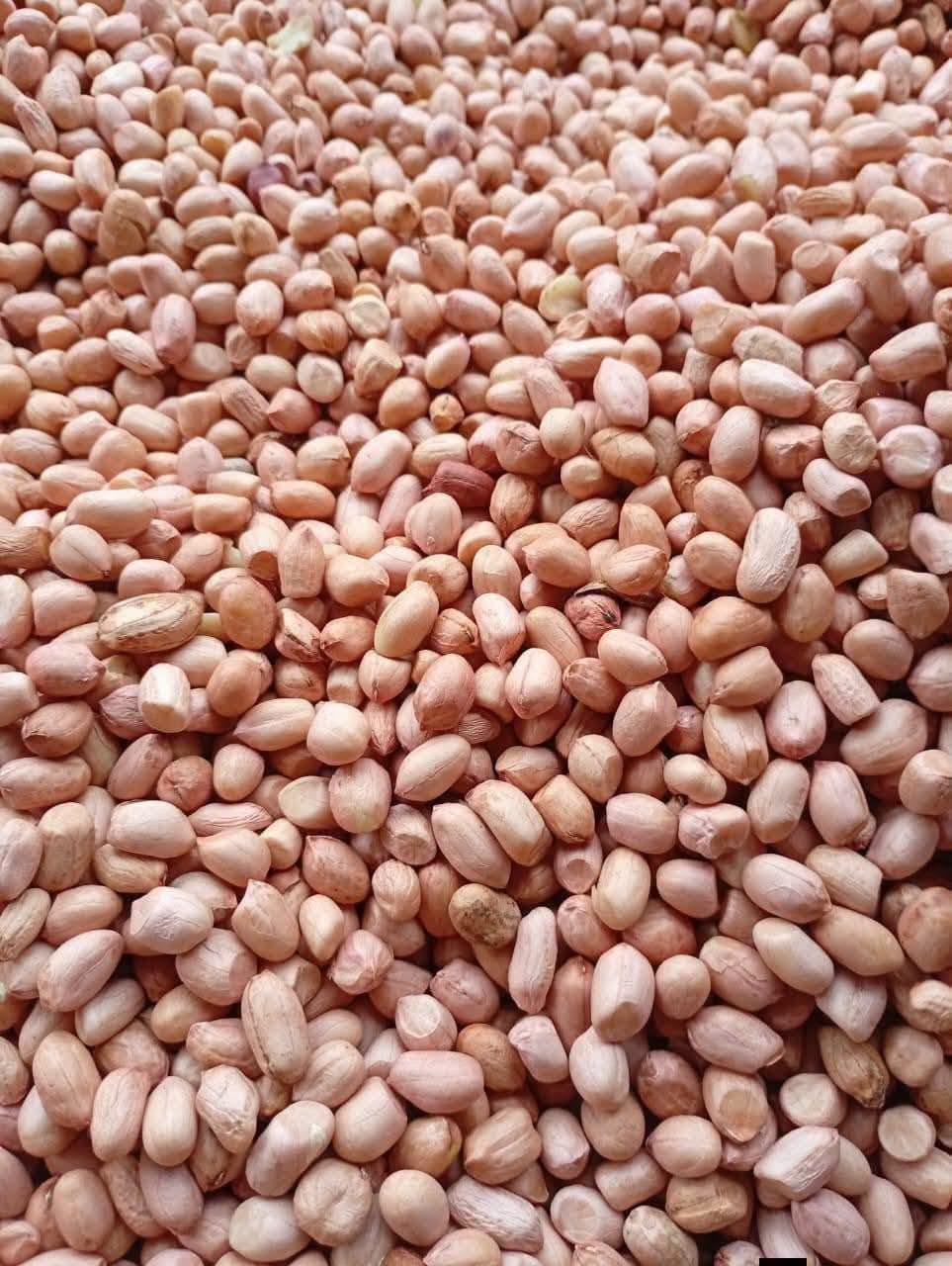
HPS (Hand Picked Selected) Groundnut Kernels — the premium export grade produced by removing pods, shelling, then hand-picking to remove all damaged, shrivelled, discoloured, and visually defective kernels. HPS represents the cleanest, most uniform, lowest-aflatoxin-risk commercial grade — the specification for confectionery, roasted snack, and premium peanut butter manufacturing.
Machine Cleaned (Sound Split) — mechanically cleaned and split kernels whose oil extraction economics benefit from the increased surface area of split halves — the standard grade for industrial peanut butter and edible oil extraction.
Blanched Groundnuts — HPS kernels with the inner red skin (testa) removed by blanching (brief hot water or dry heat treatment) and mechanical skin removal — producing clean white kernels for confectionery coating, roasted salted snack production, and peanut flour manufacture.
Groundnut Flour (Defatted) — partially or fully defatted groundnut milled to flour — used in food fortification, bakery protein enrichment, and as an animal feed protein supplement.
Groundnut Paste — whole or blanched roasted groundnuts ground to smooth paste — the base material for peanut butter manufacturing.
Groundnut Cake (Expeller) — the solid by-product after mechanical oil extraction — high protein (45–50% crude protein) animal feed ingredient used in poultry and livestock rations.
Benefits and Industrial Uses of Nigerian Groundnut
Peanut Butter and Groundnut Paste Manufacturing
The global peanut butter market — tracked through Grand View Research’s peanut butter market analysis at over USD 4 billion annually with consistent growth driven by plant-based protein adoption, natural food trends, and expanding Asian market consumption — is the most commercially significant premium food manufacturing application for groundnut kernels:
Commercial peanut butter production — using HPS or blanched groundnut kernels roasted at 160–180°C, coarsely ground, and processed with stabilisers (partially hydrogenated oil to prevent oil separation in conventional peanut butter; palm oil or no additional oil in natural peanut butter) — creates the world’s most consumed nut butter whose annual production volume in the USA alone exceeds 800,000 metric tonnes according to USDA peanut production data.
Natural and organic peanut butter — the fastest-growing peanut butter market segment, tracked through Innova Market Insights’ natural food product launch database — uses blanched groundnut kernels ground to paste without stabilisers or additives, relying on consumers’ acceptance of natural oil separation as a quality authenticity signal. For natural peanut butter manufacturers whose product positioning specifically communicates “100% peanuts” — clean, well-sorted, aflatoxin-documented Nigerian HPS kernels provide the raw material foundation that product integrity requires.
African peanut paste for traditional food manufacturing — West African groundnut-based foods including Nigerian groundnut soup (miyan gyada), Ghanaian groundnut stew, and Senegalese mafé create consistent groundnut paste procurement demand from African food manufacturers serving both domestic and diaspora markets. Contact our team to discuss paste specification.
Confectionery and Snack Food Industry
The global confectionery industry’s use of groundnut kernels — in chocolate-coated peanuts, peanut brittle, halva, nougat, and the enormous category of roasted and salted peanut snacks — creates one of the most volume-significant commercial procurement streams for blanched and HPS groundnut:
Chocolate-coated peanuts — the confectionery application requiring the cleanest, most uniform, lowest-aflatoxin HPS kernels whose visual appearance, uniform roasting behaviour, and flavour character directly influence the finished confectionery product quality. Cadbury, Nestlé, Mars, Ferrero, and hundreds of smaller confectionery manufacturers collectively create enormous annual procurement volumes tracked through Euromonitor International’s confectionery market intelligence.
Roasted and salted snacks — the global savoury snack market’s groundnut segment — tracked through Grand View Research’s snack food market analysis — creates commercial demand for roasting-grade HPS kernels whose consistent moisture, uniform size, and clean sorting produce even roasting colour and consistent texture in finished snack products.
Groundnut flour for high-protein baking — defatted groundnut flour (50–55% protein) incorporated in high-protein bread, biscuit, and snack formulations creates food manufacturing demand from the protein-fortification market whose clean-label protein enrichment applications specifically value plant-based protein flour alternatives to soy. The American Peanut Council (APC) documents groundnut flour’s growing adoption in food manufacturing protein enrichment applications.
Animal Feed Manufacturing — Groundnut Cake
Groundnut cake — the high-protein solid by-product of mechanical oil extraction from whole groundnuts — is one of the most commercially valuable animal feed protein ingredients in African and Asian feed manufacturing:
Protein content — approximately 45–50% crude protein on a dry matter basis — comparable to soybean meal as a high-protein feed ingredient, with the specific advantage that groundnut cake’s higher methionine and lysine balance creates better amino acid complementarity with cereal grain-based feed formulations than some alternative protein sources.
Poultry and swine feed — groundnut cake incorporation at 10–20% of ration provides high-quality plant protein whose amino acid profile supports growth performance documented through NCBI’s veterinary nutrition database and tracked through FEFAC European compound feed ingredient statistics. Critical aflatoxin note for feed-grade cake: EU Commission Regulation (EC) 574/2011 specifies maximum aflatoxin B1 of 20 ppb in groundnut products destined for animal feed — more permissive than human food limits but still requiring management. High-aflatoxin groundnut cake must be segregated from human food supply chains and documented for feed-only use.
Edible Oil Refining
Nigerian groundnut oil extraction from whole groundnuts (rather than the cold-pressed process that produces premium groundnut oil) creates industrial-scale edible oil whose refining produces the neutral-flavoured cooking oil that African domestic food manufacturing and export markets consume. The full-pressing industrial groundnut oil supply chain — from groundnut farmer through commercial oil mill through refinery — represents one of Nigeria’s most commercially established food processing sectors, creating consistent domestic procurement demand for shelling-grade groundnuts from the primary producing zones. Contact us to discuss oil extraction-grade groundnut supply.
Nutraceutical and Functional Food Industry
Resveratrol supplement from groundnut — groundnut’s documented resveratrol content — comparable to grape skin per unit weight — creates nutraceutical positioning for groundnut extract as a natural resveratrol source whose food-matrix delivery may provide bioavailability advantages over isolated resveratrol supplements. The Natural Products Association (NPA) tracks resveratrol supplement development across natural food-matrix sources.
High-protein plant-based food formulation — groundnut protein isolate (produced by aqueous extraction from defatted groundnut flour) — whose functional properties (emulsification, gelation, water absorption) documented through LWT Food Science and Technology food science research create plant-based food formulation applications in meat analogues, high-protein beverages, and functional snack products.
Why Buy Groundnut From Nigeria?
The Historical Commercial Pedigree — The World’s Former Largest Producer
Nigeria’s historical dominance of global groundnut trade — confirmed through FAO historical production and trade data — is not merely a point of national pride. It is commercial evidence that the agro-ecological conditions of northern Nigeria’s Sahel and Sudan savanna produce Arachis hypogaea at commercial scale and quality sufficient to supply a significant fraction of global demand. The growing conditions that created the Kano Pyramids have not changed — the sandy, well-drained soils, warm temperatures, and seasonal rainfall pattern that made northern Nigeria the world’s groundnut powerhouse in the 1960s are identical to the conditions that IITA-improved variety cultivation is exploiting today.
The Aflatoxin Management Programme — The Critical Commercial Differentiator
The most commercially distinguishing feature of Paradise MultiTrade’s groundnut export programme — and the one that most clearly separates professional export-grade Nigerian groundnut supply from the informal trade channels that have historically characterised Nigerian groundnut commerce — is our systematic aflatoxin management programme whose every-lot testing and documented results provide the food safety assurance that EU, UK, USA, and Japanese food import compliance requires.
For EU buyers specifically — whose Commission Regulation (EC) 1881/2006 limits and enforcement through EFSA’s food safety monitoring programme create the most stringent groundnut aflatoxin compliance framework in the world — our pre-export ELISA and HPLC aflatoxin testing provides the documented food safety foundation that EU import acceptance requires. We reject any lot whose testing indicates exceedance of EU food-grade limits before export documentation is prepared. Contact us to discuss our aflatoxin management programme in detail.
The IITA Improved Variety Advantage
IITA’s groundnut improvement programme — headquartered in Ibadan, Nigeria — has developed rosette virus-resistant, drought-tolerant, aflatoxin-resistant groundnut varieties specifically adapted to Nigerian Sahel growing conditions. Research on IITA improved groundnut varieties — published through CGIAR’s groundnut improvement programme documentation — confirms yield improvements of 30–60% over traditional varieties alongside significantly reduced disease susceptibility. Progressive adoption of these varieties across the primary northern producing zones is rebuilding the yield per hectare economics that made Nigerian groundnut commercially dominant in the 1960s.
Supply Diversification From US and Indian Dominance
The global groundnut export market is currently dominated by the USA, Argentina, China, and India — whose combined export volumes account for approximately 70–80% of internationally traded groundnuts according to ITC Trade Map trade flow data. For European and Middle Eastern groundnut importers whose supply chain resilience programmes require geographic diversification — Nigerian origin provides West African supply diversification whose production calendar (September–December harvest) and climate exposure are entirely uncorrelated with US, Argentine, or Indian production disruption events.
Complete Export Documentation
Every groundnut shipment from Paradise MultiTrade carries phytosanitary certification from NAQS, NEPC export documentation, certificate of origin, commercial invoice, packing list, and bill of lading. For food-grade buyers, we coordinate aflatoxin B1 and total aflatoxin (ELISA and HPLC, EU limits confirmed), moisture content, purity, grade specification (HPS, blanched, or flour grade), pesticide residue multi-residue analysis to EU MRL standards, and microbiological safety testing following AOAC International validated procedures. EU-bound shipments comply with Regulation (EU) 2017/625 on official controls and Commission Regulation (EC) 1881/2006 aflatoxin limits. Our NEPC Export Licence No. 0042385 and CAC Registration No. RC-9284647 are verifiable through NEPC.
Nigeria’s Groundnut Export Strength and Global Market Demand
The Global Market
The global groundnut market — tracked through Grand View Research’s groundnut market analysis at over USD 9 billion annually — is driven by peanut butter consumption in North America and Europe, confectionery and snack food manufacturing globally, edible oil production across Asia and Africa, and animal feed manufacturing. The American Peanut Council (APC) and the International Peanut Forum provide the institutional market development frameworks within which global groundnut trade standards and procurement practices are defined.
Key Export Destination Markets
Germany and the Netherlands — Europe’s primary confectionery manufacturing and food ingredient distribution hubs — creating consistent HPS and blanched groundnut procurement demand from confectionery manufacturers and food ingredient distributors whose EU aflatoxin compliance requirements make documented aflatoxin management essential. EU food import requirements administered through BVL and EFSA.
The United Kingdom — whose large confectionery sector (Cadbury/Mondelez UK, Mars UK), peanut butter retail market, and natural food ingredient procurement community create multi-channel demand for both HPS and blanched grades. UK food safety requirements administered by FSA.
The United States — whose USD 2+ billion annual peanut butter manufacturing industry and substantial snack food manufacturing sector create enormous procurement volumes. US FDA peanut import requirements through FDA food import programme. Important allergen note: Peanut is among the nine major food allergens under US FDA regulation — all US food products containing Nigerian groundnut require peanut allergen declaration. Paradise MultiTrade provides peanut allergen declaration documentation as standard for all US-bound shipments.
Israel and Turkey — major groundnut processing and tahini-adjacent confectionery manufacturing markets whose groundnut procurement creates consistent demand for HPS and blanched grades. Transit: Lagos to Ashdod/Haifa — 10–14 days.
UAE and Gulf States — where snack food manufacturing, confectionery production, and the large South Asian expatriate community’s groundnut consumption create consistent procurement demand tracked through ADAFSA.
Japan and South Korea — whose confectionery and snack food industries create quality-demanding procurement for blanched and HPS grades tracked through JETRO and KATI.
India — a major groundnut producing AND importing country whose specific demand for Nigerian varieties during domestic supply shortfalls creates seasonal export windows tracked through APEDA.
Why Choose Paradise MultiTrade International Limited?
Aflatoxin Management as Programme — Not as Afterthought. Our aflatoxin management programme covers harvest timing coordination, post-harvest drying protocol documentation, physical sorting to HPS standard, and ELISA/HPLC aflatoxin testing through GAFTA-approved accredited laboratories on every export lot — providing the documented food safety foundation that EU, UK, and US import compliance requires. We do not ship lots that test above EU food-grade limits to EU food markets. Period. Contact us to discuss our aflatoxin management programme.
HPS, Blanched, and Flour Grades All Available. Hand Picked Selected kernels (premium confectionery and peanut butter grade), blanched kernels (skin-off, for coated confectionery and premium snack), groundnut flour (defatted, for food fortification and high-protein baking), and groundnut paste (for peanut butter manufacturing) — from the same documented Nigerian origin supply network. Contact our team to specify your required grade.
IITA Improved Variety Sourcing. We coordinate sourcing specifically from farming communities whose IITA improved rosette-resistant variety adoption is documented — providing buyers with the agronomic quality foundation that underpins consistent aflatoxin management success. Contact us to discuss improved variety sourcing.
Peanut Allergen Declaration as Standard. Written peanut allergen declaration confirming groundnut presence — required under EU Regulation 1169/2011 and US FDA food allergen labelling regulations — provided as standard on every export lot for downstream food manufacturer label compliance. Contact us to discuss allergen documentation.
Multi-Commodity West African Agricultural Sourcing. Groundnut buyers frequently source complementary Nigerian commodities. Alongside groundnuts, Paradise MultiTrade exports groundnut oil, sesame seeds, soybeans, shea butter, moringa oil, sorghum, millet, cowpeas, hibiscus flower, gum arabic, cashew nut kernel, and raw cashew nuts. Explore our full range of Nigerian export commodities and consolidate your West African agricultural sourcing through one verified, licensed export partner.
Product Specifications
| Specification | Details |
|---|---|
| Product | Nigerian Groundnut / Peanut (Arachis hypogaea) |
| Common Names | Groundnut, Peanut, Earthnut, Gyada (Hausa), Epa (Yoruba), Osisi (Igbo) |
| Botanical Species | Arachis hypogaea L. (Fabaceae) — primarily subsp. fastigiata (Spanish/Valencia types) |
| Varieties | Spanish and Valencia types (primary); Runner type (available on request) |
| Origin | Nigeria (Kano, Kaduna, Zamfara, Sokoto, Kebbi, Jigawa, Katsina, Borno, Yobe, Plateau, Niger States) |
| Grades Available | HPS Kernels; Machine Cleaned Sound Split; Blanched (skin-off); Groundnut Flour (defatted); Groundnut Paste; Groundnut Cake (feed grade) |
| Moisture Content | ≤7% (HPS kernels); ≤8% (whole pods) |
| Oil Content | 44–55% dry weight (Soxhlet extraction) |
| Protein Content | 25–30% dry weight (Kjeldahl) |
| Purity — HPS | Minimum 99% pure sound kernels; maximum 1% defects |
| Aflatoxin — Human Food | B1 ≤2 ppb; Total ≤4 ppb (EU direct consumption limits, Commission Regulation (EC) 1881/2006) |
| Aflatoxin — Processing Grade | B1 ≤8 ppb; Total ≤15 ppb (EU further processing limits) |
| Aflatoxin — Feed Grade | B1 ≤20 ppb (EU feed material limits, Commission Regulation (EC) 574/2011) |
| Pesticide Residue | Multi-residue analysis to EU MRL standards — mandatory all EU-bound lots |
| Foreign Matter | ≤1% (HPS grade); ≤2% (commercial grade) |
| Damaged and Shrivelled Kernels | ≤1% (HPS); ≤3% (commercial) |
| Microbiological | Salmonella absent/25g; Total plate count ≤100,000 CFU/g |
| Allergen Status | Contains peanut (groundnut) — major food allergen declared per EU 1169/2011 and FDA regulations |
| Colour | Uniform cream to light pink (HPS); cream-white (blanched) |
| Resveratrol | Present — documented phytochemical; quantification on request |
| Shelf Life | 12 months (HPS kernels, sealed cool storage); 6 months (flour and paste) |
| Packaging Options | 25kg, 50kg polypropylene bags (kernels); 20kg, 25kg paper bags (flour); drums (paste) |
| Supply Capacity | 500–20,000+ MT per season |
| MOQ | HPS Kernels: 25 MT; Blanched: 10 MT; Flour: 5 MT; Paste: 5 MT |
| Export Documentation | Phytosanitary Certificate (NAQS), Certificate of Origin, NEPC Export Licence, Aflatoxin Certificate (ELISA/HPLC — EU limits confirmed), Moisture and Purity Certificate, Pesticide Residue Certificate (EU MRL), Peanut Allergen Declaration, Microbiological Certificate, Commercial Invoice, Packing List, Bill of Lading |
| Payment Terms | T/T, Letter of Credit (LC at sight), Escrow |
| Loading Port | Lagos (Apapa / Tin Can Island Port), Nigeria |
| Incoterms Available | EXW, FOB Lagos, CNF, CIF |
Packaging and Export Process
Harvest Season. Nigeria’s primary groundnut harvest runs September through November — following the July–August growing season in the Sudan and Guinea savanna producing zones. Early-maturing Spanish varieties (90–100 days) planted in June harvest by September; standard varieties planted in June–July harvest October–November. The coincidence of harvest with the onset of the harmattan’s low-humidity conditions in October–November provides optimal natural drying conditions for rapid pod moisture reduction — the critical aflatoxin prevention window.
Harvesting and Initial Drying. Groundnut plants are uprooted when leaf yellowing and pod skin darkening confirm maturity — too early harvesting produces immature pods vulnerable to aflatoxin infection; too late harvesting leaves pods in soil contact beyond optimal maturity, increasing both physical damage and aflatoxin exposure. Uprooted plants are inverted (pods upward) and field-stacked for 7–14 days of windrow drying — reducing pod moisture from approximately 45–50% at harvest to below 15% before threshing.
Shelling and Sorting. Dried pods are mechanically shelled — removing the outer pod shell to expose kernels. Shelled kernels pass through aspiration (air separation of light material), vibration sieving (size separation), and colour sorting (optical or manual removal of discoloured, shrivelled, and damaged kernels). For HPS grade — hand-picking supplements mechanical sorting to achieve the maximum 1% defect specification.
Blanching (where specified). Clean HPS kernels are blanched — either by dry heat at 150°C for 8–12 minutes or steam blanching — to loosen the inner red skin (testa), which is then removed by mechanical rubber roll blanchers and air aspiration. Blanched kernels undergo secondary visual inspection to remove incompletely blanched or damaged kernels.
Aflatoxin Testing. Representative samples from every production lot — taken systematically across the full lot volume at multiple sampling points — are tested for aflatoxin B1, B2, G1, and G2 by ELISA screening (rapid, cost-effective) with HPLC confirmation for all lots approaching or below specification limits. Lots are segregated by test results: below EU food limits → food-grade export; between food and feed limits → processing or feed grade; above feed limits → destroyed. No lot above EU food limits is exported as food-grade product under any circumstances.
Packaging. HPS and blanched kernels packed in 25–50kg polypropylene bags with inner polyethylene moisture-barrier liner. Moisture content confirmed at final packaging stage. Bags sealed and palletised for container loading.
Lead Times. HPS kernels from harvest season stock: 14–21 days. Blanched: 21–28 days (blanching processing scheduling). Flour and paste: 28–42 days. Aflatoxin HPLC documentation: add 5–7 days. Contact us early — particularly for large-volume HPS orders where aflatoxin testing across multiple lot samples adds to standard lead time.
Frequently Asked Questions
Why is aflatoxin the most commercially important quality parameter in groundnut procurement and how does Paradise MultiTrade manage it?
Aflatoxin — specifically aflatoxin B1 — is the most potent naturally occurring hepatocarcinogen in food science, classified as Group 1 human carcinogen by the International Agency for Research on Cancer (IARC). Groundnut is one of the most aflatoxin-susceptible food crops because Aspergillus flavus specifically colonises groundnut pods in the soil during late-season drought stress and during post-harvest drying under humid conditions. EU maximum limits (B1 ≤2 ppb for direct human consumption) are among the most stringent in the world — regularly enforced through EFSA’s mycotoxin monitoring programme and EU Border Inspection Post testing. Paradise MultiTrade’s aflatoxin management programme addresses five critical control points: (1) sourcing from improved drought-tolerant variety cultivation that reduces late-season stress-induced infection; (2) harvest timing coordination ensuring pods are removed from soil at correct maturity; (3) rapid post-harvest windrow drying documented at below 8% pod moisture within 14 days; (4) physical sorting removing visually damaged kernels whose contamination rate is 10–20× higher than sound kernels; (5) mandatory ELISA/HPLC lot testing through GAFTA-accredited laboratories before every export documentation is prepared. We reject and do not export any EU-food-bound lot whose test results exceed EU B1 limits. Contact us to discuss our aflatoxin management protocol documentation.
What is HPS groundnut and what makes it different from regular commercial grade?
HPS — Hand Picked Selected — is the premium groundnut export grade produced by combining mechanical cleaning and sorting with hand-picking inspection to remove all visually defective kernels. Specifically, HPS grade excludes: shrivelled and immature kernels (highest aflatoxin risk — typically 100–1,000× higher contamination than sound kernels), discoloured kernels (yellow, brown, or black discolouration indicating mould or damage), split or broken kernels (increased surface area creates oxidation risk), and foreign matter exceeding 1%. The commercial significance of HPS is dual: (1) Food safety — by removing the highest-risk kernel categories, HPS sorting dramatically reduces the probability of aflatoxin contamination in the remaining lot; (2) Sensory quality — uniform sound kernels produce uniform roasting behaviour (consistent colour, texture, and flavour development) in confectionery and snack applications. HPS commands a premium of 20–40% over commercial grade — justified by both the labour cost of hand-picking and the food safety and quality value it delivers. For confectionery, peanut butter, and roasted snack applications — specify HPS. For oil extraction and animal feed — commercial grade is appropriate. Contact us to discuss HPS grade specification.
What is the story of the Kano Groundnut Pyramids and why does it matter commercially today?
The Kano Groundnut Pyramids were extraordinary structures built by the Northern Nigeria Marketing Board from the 1940s through the 1960s — stacking hundreds of thousands of 200-pound jute bags of cleaned groundnuts into geometric pyramid formations outside Kano’s railway terminus and groundnut buying stations. At their peak, the pyramids reached heights of 40+ metres and contained enough groundnuts to represent hundreds of millions of USD of agricultural commodity value. They served a practical logistics function — storing the groundnut harvest awaiting shipment — but became symbols of Nigeria’s agricultural commercial dominance that attracted international press attention and visitors. Their commercial significance today is as evidence: if Nigeria could produce enough groundnuts to build those structures in the 1960s with the agronomic technology of that era, the potential for IITA improved variety cultivation to rebuild meaningful export volumes with modern agronomy is not speculative — it is historically validated. The infrastructure challenge is not production capacity but the formal export documentation, aflatoxin management, and buyer relationship development that Paradise MultiTrade’s programme is systematically building. Contact us to discuss how Nigeria’s groundnut export recovery creates sourcing opportunities.
Is Nigerian groundnut a peanut allergen and what labelling documentation is required?
Yes — Nigerian groundnut (Arachis hypogaea) is botanically identical to the peanut that is among the most commercially significant food allergens globally. EU requirements: EU Regulation 1169/2011 on food information to consumers requires mandatory peanut (groundnut) allergen declaration on all food products containing peanut as an ingredient — in the ingredients list using bold, underlined, or otherwise distinctive text. US requirements: Peanut is one of the nine major allergens requiring mandatory declaration under the Food Allergy Labeling and Consumer Protection Act (FALCPA) administered through FDA. For food manufacturers using Nigerian groundnut as an ingredient — allergen declaration is a legal label requirement whose non-compliance creates product recall and regulatory enforcement risk. Paradise MultiTrade provides written peanut allergen declaration documentation — confirming the presence of peanut (groundnut) as a declared allergen — as standard on every export shipment to enable downstream food manufacturer label compliance. This declaration does not affect the product’s food safety status; it confirms its allergen identity for label compliance purposes. Contact us to discuss allergen documentation.
How does Nigerian groundnut compare to US, Argentine, or Indian origin on quality and specification?
Nigerian Spanish/Valencia type groundnuts share agronomic characteristics with Spanish-type groundnuts from Argentina and India — comparable oil content (44–55%), similar protein content (25–30%), and equivalent kernel size range. Commercial differentiators: (1) Aflatoxin management maturity — US groundnut exports are produced under the most developed aflatoxin management programme in the world, with USDA’s aflatoxin sampling and testing protocol creating the benchmark that all origins are measured against. Nigerian export-grade groundnut from Paradise MultiTrade’s programme is tested against EU limits per lot — approaching US documentation standards. (2) Price competitiveness — Nigerian groundnut FOB pricing typically offers meaningful discount to US and Argentine origin at equivalent grade, reflecting lower production cost structures and developing export infrastructure. (3) Supply chain traceability — US and Argentine origins have deeper traceability infrastructure; Nigerian origin is developing lot-level traceability through our cooperative sourcing programme. For buyers seeking the lowest total cost of specification-compliant groundnut procurement — Nigerian origin from Paradise MultiTrade provides the most competitive pricing available among documented, aflatoxin-tested origins. Contact us to discuss comparative specification and pricing.
What is the Nigerian groundnut harvest season and when should I plan procurement?
Nigeria’s primary groundnut harvest runs September through November — with early Spanish variety plots harvesting September–October and standard varieties completing harvest by November. Post-harvest pod drying and shelling extend commercial availability of fresh crop kernels from approximately October through January. Procurement planning: (1) For HPS kernels requiring full sorting and aflatoxin documentation — initiate discussions by July–August to coordinate harvest monitoring, sorting capacity scheduling, and laboratory testing slot allocation for October–November harvest material. (2) For large-volume buyers (above 1,000 MT) — advance booking before harvest is commercially important because HPS sorting capacity is limited in peak processing season. (3) From February through July — previous season stored groundnut is available from controlled-atmosphere warehousing, though aflatoxin risk slightly increases with storage duration, making re-testing mandatory before shipping. Best quality: October–January fresh crop material. Contact us to plan your procurement cycle.
What transit times should I expect from Nigeria?
HPS kernels, blanched groundnuts, flour, and paste (standard dry container — no temperature control required for properly dried kernels below 7% moisture): UK (Tilbury, Felixstowe) — 14–18 days from Lagos. Netherlands (Rotterdam) — 14–18 days. Germany (Hamburg) — 14–20 days. France (Le Havre) — 14–18 days. Italy (Genoa, Naples) — 12–16 days. Israel (Ashdod, Haifa) — 10–14 days. Turkey (Mersin) — 10–14 days. USA (East Coast — New York, Baltimore, Savannah) — 18–25 days. Canada (Halifax, Montreal) — 18–28 days. UAE (Jebel Ali) — 10–14 days. India (Nhava Sheva, Mundra) — 10–15 days. Japan (Yokohama) — 25–32 days. South Korea (Busan) — 30–38 days. Packaging note: Groundnut kernels are hygroscopic and aflatoxin-sensitive — sealed moisture-barrier polypropylene bags with desiccant sachets inside containers are mandatory for all export shipments to prevent moisture gain during transit that could trigger in-transit aflatoxin development. Contact us to plan your complete logistics programme.
Ready to Source Premium Nigerian Groundnut — HPS Kernels, Blanched, Flour, Paste, and Feed-Grade Cake With Comprehensive Aflatoxin ELISA/HPLC Documentation, EU MRL Pesticide Compliance, Peanut Allergen Declaration, and Full Food Safety Certification for Peanut Butter Manufacturers, Confectionery Companies, Snack Food Producers, Animal Feed Manufacturers, and Global Wholesale Buyers?
If you are a European or American peanut butter manufacturer building supply diversification from US and Argentine dominant positions seeking aflatoxin-documented Nigerian HPS and blanched kernels at competitive FOB pricing with full EU food safety compliance documentation, a confectionery manufacturer requiring HPS blanched groundnut kernels with aflatoxin B1 below EU direct human consumption limits and uniform kernel size for consistent chocolate coating and roasting performance, a natural food brand developing clean-label peanut butter, groundnut paste, or high-protein groundnut flour products whose ingredient sourcing requires documented aflatoxin management and pesticide compliance from West African origin, a European animal feed compound manufacturer evaluating Nigerian groundnut cake as a high-protein alternative to soybean meal in poultry and swine rations at competitive pricing, a food ingredient trader building Nigerian groundnut supply positions as Europe’s demand for supply-diversified, aflatoxin-documented groundnut from West African origins grows alongside its established South American and US procurement, or a food security programme buyer developing groundnut fortified food products for nutrition intervention programmes serving African populations whose iron and protein deficiency requires locally authenticated, cost-effective protein-dense ingredients — Paradise MultiTrade International Limited is the licensed Nigerian exporter your groundnut supply programme needs.
We supply Nigerian Arachis hypogaea groundnut — HPS kernels, machine cleaned, blanched, flour, paste, and feed-grade cake — from Kano, Kaduna, Sokoto, and Jigawa Sahel-zone producing communities, comprehensive aflatoxin ELISA/HPLC certification as standard for all food-grade lots, EU pesticide residue MRL compliant, peanut allergen declaration as standard, IITA improved rosette-resistant variety sourcing, and exported at commercial scale with full food safety documentation to buyers in every major regulated destination market.
Request a Quotation — share your required grade (HPS, blanched, flour, paste, or feed cake), aflatoxin limit specification (EU food grade, EU processing grade, or US FDA action level), volume, application (peanut butter, confectionery, snack food, animal feed, food fortification), destination market, and preferred incoterms. We respond within 48 hours.
Contact Our Export Team — speak directly about our aflatoxin management programme and GAFTA-approved laboratory testing, HPS sorting standard and defect specification, IITA improved variety sourcing documentation, EU food safety compliance, blanching specification and skin-off confirmation, peanut allergen declaration for downstream label compliance, harvest season procurement planning, and long-term supply programme structuring.
Explore Our Full Product Range — alongside groundnuts, Paradise MultiTrade exports groundnut oil, sesame seeds, soybeans, shea butter, sorghum, millet, cowpeas, moringa oil, hibiscus flower, gum arabic, cashew nut kernel, and raw cashew nuts. One licensed Nigerian exporter. One consolidated West African oilseed, legume, grain, and natural food sourcing relationship — from the crop that built the Kano Pyramids to the commercial rehabilitation that is rebuilding Nigeria’s agricultural export legacy.
Paradise MultiTrade International Limited | NEPC Export Licence No. 0042385 | CAC No. RC-9284647 | Lagos, Nigeria | www.paradisemultitrade.com
Reviews
There are no reviews yet.