
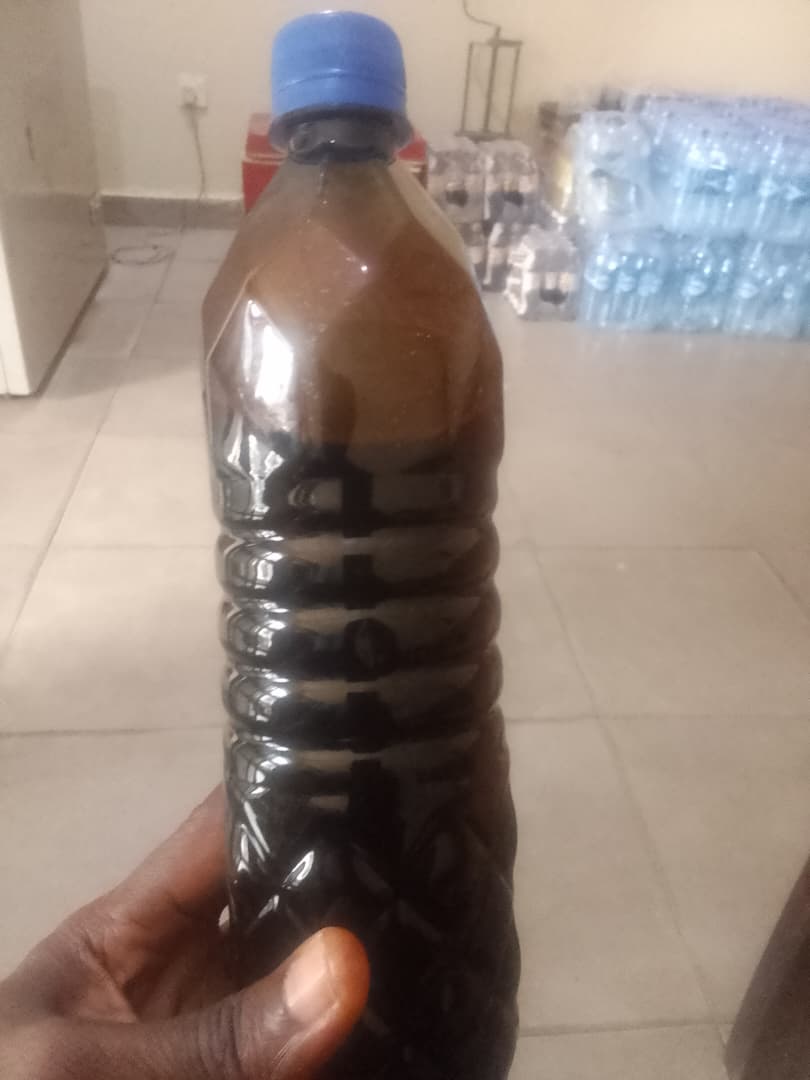

Nigerian Cashew Nut Shell Liquid (CNSL): The Agricultural Processing By-Product Whose Industrial Applications in Brake Pad Manufacturing, Phenolic Resin Production, and Polymer Synthesis Make It One of the Most Commercially Significant Natural Phenolic Compounds in Industrial Chemistry — and Whose Demand Is Structurally Guaranteed by Every Vehicle Manufactured on Earth
Cashew Nut Shell Liquid Exporter Nigeria — Natural CNSL, Technical CNSL, Distilled CNSL, Cardanol, Whole Cashew Nut Shell, and Cashew Shell Cake, Direct Southern Belt Sourcing, Bulk Supply to Friction Material Manufacturers, Phenolic Resin Producers, Polymer and Adhesive Companies, Varnish and Coating Manufacturers, Surfactant Producers, Pharmaceutical Raw Material Buyers, and Global Industrial Wholesale Buyers Worldwide
Cashew nut shell liquid exporter Nigeria is a search phrase that arrives at one of the most commercially consequential industrial chemistry intersections in the entire tropical agricultural processing value chain — the point where a tropical food crop’s processing by-product becomes a safety-critical component in the automotive braking systems that every motor vehicle on earth depends upon.
The commercial relationship between Nigerian cashew farming and global automotive safety is less improbable than it initially appears: cashew nut shell liquid (CNSL) — the dark, viscous, phenolic liquid contained in the honeycomb-structured shell of the cashew nut (Anacardium occidentale) — contains anacardic acid, cardanol, cardol, and 2-methyl cardol whose combined phenolic compound profile creates, after industrial processing, a reactive polymer precursor whose heat resistance, mechanical strength, and chemical stability under friction-induced temperature extremes makes it the preferred binder system for friction materials — the technical classification that encompasses brake pads, brake linings, clutch facings, and transmission linings in automotive, commercial vehicle, railway, and industrial machinery applications worldwide.
The global automotive brake pad market — tracked through Grand View Research’s brake pad market analysis at over USD 15 billion annually with continued growth driven by vehicle fleet expansion and regulatory phase-out of asbestos-based friction materials — creates a structurally guaranteed, growth-assured demand for CNSL-derived phenolic resin binders whose replacement of the asbestos-phenolic resins that dominated friction material manufacturing for most of the 20th century has been specifically driven by the same environmental and occupational health regulatory forces that eliminated asbestos from virtually every other industrial application.
Every brake pad manufactured using CNSL-based resin binders contains Nigerian, Indian, Vietnamese, or Brazilian cashew shell liquid. The geographic origins of global CNSL supply — India (approximately 50–60% of world CNSL production), Vietnam (15–20%), Nigeria (8–12%), and Brazil (5–8%) — are the origins whose cashew processing industries simultaneously produce the cashew kernels that global food markets consume and the cashew shells whose CNSL content feeds the friction material and resin manufacturing industries whose products are present in every vehicle, every industrial machine, and every piece of rotating equipment on earth.
Nigeria’s position in this industrial chemistry supply chain is commercially significant: as one of Africa’s most significant cashew producers — documented in our raw cashew nut and cashew nut kernel articles — Nigeria’s cashew processing industry generates cashew shells as the inevitable by-product of every kernel extracted from every nut. The CNSL contained in those shells represents commercial value whose formal export development creates industrial revenue from a by-product that less commercially developed supply chains leave uncaptured.
At Paradise MultiTrade International Limited, CNSL and cashew shell is one of our most industrially consequential export categories — sourced from cashew processing operations across Nigeria’s primary cashew producing states of Ogun, Ondo, Osun, Oyo, Edo, Delta, Kogi, Kwara, Anambra, Enugu, Cross River, and Kebbi, processed into natural CNSL, technical CNSL, distilled CNSL, and whole cashew shells appropriate to the full range of industrial buyer requirements, and exported with full chemical analysis, safety data, and industrial specification documentation.
To discuss sourcing immediately, request a quotation here and our export team responds within 48 hours.
History and Origin — The Tropical Tree Whose Shell Liquid Revolutionised Industrial Polymer Chemistry
Anacardium Occidentale — The Cashew’s Industrial Legacy Beyond the Nut
As documented in our raw cashew nut and cashew nut kernel articles, Anacardium occidentale is native to northeastern Brazil — whose Portuguese colonial introduction to West Africa, India, and Southeast Asia created the global cashew production geography whose Nigerian, Indian, and Vietnamese origins dominate world cashew trade. What neither article addressed — because the focus was the kernel’s food applications — is the industrial chemistry significance of the shell fraction that constitutes approximately 30–35% of the raw cashew nut’s fresh weight.
The cashew nut’s shell is architecturally unique among commercially traded tree nuts: it is not a simple hard seed coat but a complex bi-layered structure — outer shell (epicarp), middle honeycomb layer (mesocarp), and inner shell (endocarp) — whose honeycomb mesocarp layer is saturated with CNSL at concentrations of 20–35% of the shell’s wet weight. This extraordinary liquid content — whose presence gives the shell its characteristic dark, oily appearance and creates the handling hazard whose caustic anacardic acid content can cause severe skin irritation — is simultaneously the source of the processing challenge that traditional cashew workers manage and the source of the industrial value whose commercial development the CNSL trade captures.
The industrial chemistry significance of CNSL was first systematically investigated by European and American chemists in the 1930s and 1940s — when the search for natural phenolic resin precursors to replace coal tar-derived phenol in phenolic resin manufacturing identified CNSL’s unique chemistry. Unlike petroleum-derived phenol whose simple aromatic ring structure creates phenolic resins with limited flexibility, CNSL’s cardanol fraction contains an aromatic phenol ring attached to a C15 unsaturated aliphatic side chain — whose specific structural feature creates phenolic polymers with dramatically improved flexibility, impact resistance, and thermal stability compared to conventional phenol-formaldehyde resins. This structural advantage whose commercial expression is superior friction material performance and more durable coating systems drove CNSL’s progressive adoption across the 20th century industrial chemical landscape.
The CNSL industry’s history — documented through industrial chemistry publications accessible via the American Chemical Society and Royal Society of Chemistry — records the progressive commercialisation from 1930s experimental phenolic resin investigation through 1950s–1970s friction material industry adoption through the 1990s environmental regulatory push that eliminated asbestos from friction materials (creating structural CNSL demand growth) through the current green chemistry movement’s specific interest in CNSL as a bio-based renewable phenolic compound whose plant origin creates sustainability positioning advantages over petroleum-derived phenol.
What Is CNSL? The Chemistry, Processing Routes, and Commercial Product Range
The CNSL Chemistry — Four Compounds Whose Relative Proportions Determine Commercial Grade
CNSL is a naturally occurring mixture of four structurally related phenolic compounds — all sharing a resorcinol or phenol ring with a C15 aliphatic side chain — whose specific relative proportions change dramatically depending on whether the CNSL is extracted cold (natural CNSL) or at high temperature (technical CNSL):
Anacardic Acid — approximately 60–65% of natural (cold-pressed) CNSL — the dominant compound in unprocessed CNSL, a 6-pentadecyl salicylic acid derivative whose carboxyl group creates acidic character and whose specific antimicrobial properties have attracted pharmaceutical research. During thermal processing (roasting), anacardic acid undergoes decarboxylation — losing its carboxyl group as CO₂ — to produce cardanol. This thermal conversion is the key chemistry step that distinguishes natural CNSL from technical CNSL.
Cardanol — approximately 10–15% of natural CNSL but 60–75% of technical CNSL (after thermal decarboxylation of anacardic acid during cashew roasting) — the primary industrial value compound whose phenolic ring and C15 unsaturated side chain (monoene, diene, and triene isomers present in approximately 5:3:2 ratio) creates the reactive monomer for phenolic resin synthesis. Cardanol’s unsaturated side chain double bonds create both the flexibility advantage of CNSL-based polymers versus conventional phenol-formaldehyde resins and the reactive sites for polymer cross-linking whose controlled exploitation creates resin systems with optimised mechanical properties.
Cardol — approximately 15–20% of natural CNSL, 15–20% of technical CNSL — a resorcinol derivative whose bifunctional phenolic structure (two hydroxyl groups) creates higher reactivity than cardanol in resin formation, contributing to resin cross-link density.
2-Methyl Cardol — approximately 2–5% of both natural and technical CNSL — the minor component whose specific structural role in resin property optimisation is documented through polymer chemistry research accessible via Journal of Applied Polymer Science.
The Side Chain Unsaturation — The Critical Industrial Distinction:
The C15 aliphatic side chain of all four CNSL compounds contains double bonds at positions 8, 11, and 14 — creating monoene (one double bond, approximately 5% of side chains), diene (two double bonds, approximately 30% of side chains), and triene (three double bonds, approximately 55% of side chains) components alongside saturated (no double bonds, approximately 10%) side chains. This unsaturation creates: (a) the reactive sites for polymer cross-linking through oxidative, thermal, or catalytic polymerisation; (b) the flexibility contribution to CNSL-based polymer systems through the long, mobile aliphatic chain; and (c) the distinctive drying oil character of CNSL that creates its varnish and coating applications.
Processing Routes and Commercial Grades
Natural CNSL (Cold-Pressed / Solvent-Extracted):
Produced by cold mechanical pressing or hexane solvent extraction of the cashew shell at ambient or near-ambient temperature — preserving anacardic acid without thermal decarboxylation. Natural CNSL is darker, more viscous, and contains high anacardic acid whose properties differ from technical CNSL. Pharmaceutical interest in anacardic acid’s specific antimicrobial and antiparasitic activity documented through NCBI’s pharmacology research database creates specific procurement for natural CNSL as a pharmaceutical raw material.
Technical CNSL (Roasting Process):
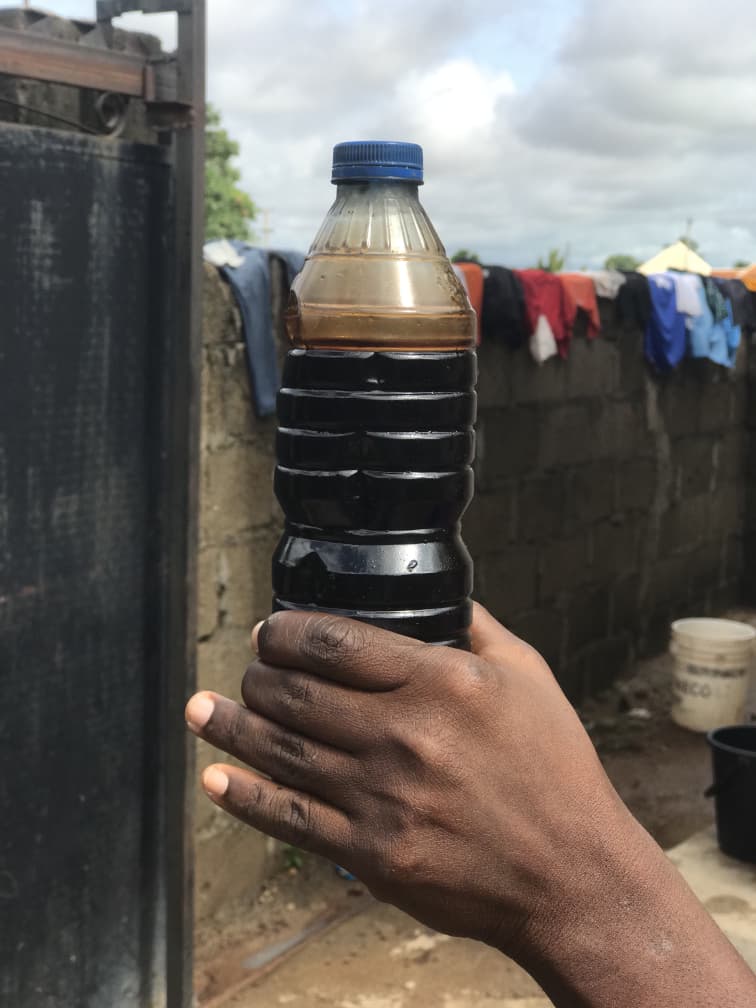
The dominant commercial form — produced as a by-product of the drum roasting process used in cashew kernel extraction. During roasting at 180–200°C, the shell’s anacardic acid decarboxylates to cardanol — creating a cardanol-rich CNSL whose industrial resin chemistry applications are the primary commercial driver. Technical CNSL is collected from roasting drum drainage — containing cardanol (60–75%), cardol (15–20%), 2-methyl cardol (2–5%), and residual anacardic acid (5–15%). This is the most commercially significant CNSL grade by volume.
Distilled CNSL:
Technical CNSL subjected to vacuum fractional distillation — separating the lower-boiling cardanol fraction (approximately 80–90% purity) from higher-boiling cardol and 2-methyl cardol fractions. Distilled CNSL provides higher cardanol purity for specific resin formulations requiring controlled composition.
Cardanol (Purified):
The cardanol fraction isolated by distillation and purification to above 90% cardanol purity — the highest-value, highest-specification industrial chemical grade whose cardanol content, colour (Gardner scale), viscosity, and water content are specified to industrial chemical standards.
Whole Cashew Nut Shell (CNS):
The dried cashew shell (after kernel extraction) — containing residual CNSL and providing biomass energy value (calorific value approximately 20 MJ/kg) alongside activated carbon manufacturing potential. Whole shell supply to industrial buyers who extract CNSL on-site or use shell biomass for energy.
Cashew Shell Cake (CNSL-Extracted Shell):
The residual shell solid after CNSL extraction — lower energy content, used as biomass fuel and as activated carbon raw material.
Benefits and Industrial Uses of Nigerian CNSL
Friction Material Manufacturing — The Most Commercially Significant Application
The global friction material market — whose brake pad, brake lining, clutch facing, and transmission lining products collectively consume hundreds of thousands of tonnes of CNSL-derived phenolic resin annually — is the single most commercially significant application for CNSL worldwide:
The asbestos replacement story: Until the 1980s–1990s, the dominant friction material binder was asbestos-phenolic resin — whose chrysotile and amphibole asbestos fibres provided the thermal stability, mechanical strength, and heat dissipation properties that high-performance braking required. The progressive regulatory elimination of asbestos across EU, US, and global markets — following the documentation of mesothelioma and lung cancer risk from asbestos fibre inhalation through WHO’s International Agency for Research on Cancer (IARC) research — created the material engineering challenge of replacing asbestos with alternative high-temperature-stable reinforcement systems. CNSL-based phenolic resins emerged as the most technically successful binder system for asbestos-free friction materials — creating the structural demand shift that has driven CNSL consumption growth since the 1990s.
Why CNSL resin specifically: The technical performance requirements of automotive brake pads — which reach temperatures of 300–600°C during heavy braking, must maintain consistent coefficient of friction across this temperature range, must resist mechanical fatigue under millions of brake application cycles, and must not generate toxic pyrolysis products during normal operation — create a demanding material specification that CNSL-based phenolic resins specifically address:
Heat resistance: CNSL-cardanol’s aromatic ring structure creates a char-forming thermal decomposition pathway — when heated, CNSL resin carbonises progressively rather than melting suddenly, maintaining friction material structural integrity at temperatures where conventional organic polymers fail catastrophically.
Fade resistance: The gradual, progressive char formation creates consistent friction coefficient across broad temperature ranges — preventing the “brake fade” (sudden friction loss at high temperature) that has caused road accidents and whose prevention is a primary friction material engineering objective.
Flexibility at ambient temperature: The C15 aliphatic side chain’s contribution to CNSL resin flexibility reduces brittleness in cold ambient conditions — preventing brake pad cracking during low-temperature operation that rigid conventional phenolic resins create.
Non-asbestos organic (NAO) compatibility: CNSL resins’ specific chemistry creates excellent bonding to the aramid, steel, ceramic, and mineral fibres that replace asbestos in modern NAO friction material formulations — creating a binder-reinforcement compatibility that alternative binder systems do not replicate as effectively.
For friction material manufacturers evaluating Nigerian CNSL — contact our export team to discuss cardanol content, viscosity specification, and technical CNSL grade.
Phenolic Resin Manufacturing
The global phenolic resin market — tracked through Grand View Research’s phenolic resin market analysis at over USD 20 billion annually — creates the second most commercially significant application for CNSL as a phenol substitute and modifier:
CNSL-modified phenolic resins — incorporation of CNSL cardanol as a partial phenol substitute in conventional phenol-formaldehyde resin synthesis creates modified resins whose improved flexibility, impact resistance, and water resistance create specific performance advantages in plywood binder, particleboard resin, and wood adhesive applications. The American Plywood Association and European Panel Federation document bio-based resin modifier adoption in structural wood composite manufacturing — confirming CNSL’s growing commercial presence in construction material manufacturing.
Cardanol-formaldehyde resins — pure cardanol polymerised with formaldehyde creates a class of CNSL resins whose specific properties (improved cure speed, better water resistance than conventional phenol-formaldehyde, excellent electrical insulation) create applications in electrical laminates, printed circuit board substrates, and industrial flooring coatings.
Green chemistry positioning — CNSL’s plant-based origin creates bio-based resin positioning whose commercial value in EU and North American markets whose bio-based product procurement preferences create premium pricing for bio-derived alternatives to petroleum-derived phenol. The European Bioplastics Association tracks bio-based phenolic resin development — confirming CNSL’s commercial position within the bio-based polymer transition.
Varnishes, Coatings, and Paint Manufacturing
CNSL-based varnishes — the drying oil character of CNSL’s unsaturated side chains creates air-oxidative polymerisation whose film-forming properties parallel traditional linseed oil varnishes but with superior chemical resistance, heat resistance, and water resistance:
Marine and industrial coatings — CNSL-based anti-corrosion coatings for steel structures, marine vessels, and industrial equipment whose chemical resistance to acids, alkalis, and salt water — documented through polymer chemistry research in Journal of Applied Polymer Science — creates specific performance advantages in aggressive chemical environments where conventional coatings fail.
Electrical insulating varnishes — CNSL resins’ excellent electrical insulation properties create applications in transformer oil, electrical winding insulation, and circuit board coating whose thermal stability requirements benefit from CNSL’s char-forming degradation chemistry.
Floor and industrial surface coatings — CNSL-based floor coatings for industrial facilities whose abrasion resistance, chemical resistance, and thermal stability create performance advantages over conventional epoxy or polyurethane floor systems in high-wear industrial environments.
Adhesives and Polymer Synthesis
Cashew-based adhesives — CNSL resins’ excellent bonding to wood, metal, and fibre substrates creates commercial adhesive applications in brake lining assembly, plywood manufacturing, and composite material fabrication whose bio-based resin positioning creates green procurement value for manufacturers.
Polymer modifier and plasticiser — cardanol’s long aliphatic chain creates plasticising properties when incorporated in conventional polymer systems — modifying the glass transition temperature, flexibility, and impact resistance of PVC, polypropylene, and other commercial polymers whose brittleness CNSL modification specifically addresses.
Epoxy resin modifier — cardanol glycidyl ether (produced by reacting cardanol with epichlorohydrin) creates a bio-based epoxy reactive diluent and flexibiliser whose commercial development is tracked through Green Chemistry journal as one of the most commercially developed bio-based epoxy modifier systems.
Pharmaceutical and Agricultural Chemistry Applications
Anacardic acid pharmaceutical interest — natural CNSL’s dominant compound anacardic acid has attracted specific pharmaceutical research interest documented through NCBI’s pharmacology database for: antibacterial activity against Mycobacterium tuberculosis and drug-resistant bacterial strains; antiparasitic activity against Plasmodium falciparum (malaria parasite); histone acetyltransferase (HAT) inhibitory activity creating specific cancer research interest; and anti-inflammatory activity through prostaglandin synthesis inhibition. For pharmaceutical research buyers sourcing natural CNSL for anacardic acid isolation — Paradise MultiTrade’s natural cold-pressed CNSL provides the high-anacardic-acid raw material whose processing preserves the compound that technical CNSL’s thermal processing destroys.
Surfactant manufacturing — cardanol’s amphiphilic molecular structure (phenolic hydrophilic head + C15 aliphatic hydrophobic tail) creates natural surfactant activity whose commercial development into CNSL-based surfactants for detergent, emulsifier, and wetting agent applications is documented through green chemistry research at ACS Sustainable Chemistry & Engineering.
Agricultural chemical applications — anacardic acid’s herbicidal and insecticidal activity documented through Journal of Agricultural and Food Chemistry creates agrochemical research interest for bio-based pesticide development — a growing research area whose commercial development parallels the neem-based biopesticide development documented in our neem products articles.
Why Buy CNSL From Nigeria?
The Cashew Processing By-Product Economics — Value From Existing Infrastructure
Nigeria’s cashew processing industry — whose raw cashew nut processing infrastructure we documented in the raw cashew and cashew kernel articles — generates cashew shells as the inevitable by-product of every kernel extraction. The commercial arithmetic is straightforward: every tonne of cashew kernels processed generates approximately 1.5 tonnes of shell whose CNSL content at 20–35% of shell weight creates 300–500 litres of technical CNSL per tonne of kernel processed.
For Nigerian cashew processors — this shell was previously a disposal problem (shells accumulate faster than domestic industrial use can absorb, creating storage and disposal costs) rather than a commercial asset. Paradise MultiTrade’s CNSL programme transforms this disposal cost into export revenue — creating the value chain integration that captures industrial value from the entire cashew nut rather than only from the kernel fraction.
For international CNSL buyers — this by-product pricing dynamic creates Nigerian CNSL’s competitive commercial positioning: production economics whose raw material cost is shared with the primary kernel business rather than carried entirely by the CNSL production, creating FOB pricing competitive with Indian dominant supply.
Nigeria’s Growing Cashew Processing Capacity
Nigeria’s progressive investment in domestic cashew processing — moving from raw cashew nut export toward kernel export (as documented in our RCN and kernel articles) — simultaneously creates growing CNSL supply as more nuts are processed domestically rather than exported as raw nuts for processing in India and Vietnam. Every additional tonne of Nigerian cashew processed domestically creates Nigerian CNSL rather than Indian or Vietnamese CNSL from the same nut — progressively building Nigerian CNSL supply at rates that correlate directly with Nigeria’s cashew processing industry investment trajectory.
The Atlantic Logistics Advantage for European Buyers
Lagos to Rotterdam: 14–18 days. Indian ports to Rotterdam: 20–25 days. For European friction material manufacturers, resin producers, and industrial chemical buyers whose CNSL procurement has historically come from Indian origin — Nigerian CNSL’s Atlantic logistics advantage creates supply chain resilience and freight economics whose value increases with each year of post-COVID-19 global shipping disruption awareness.
Complete Industrial Export Documentation
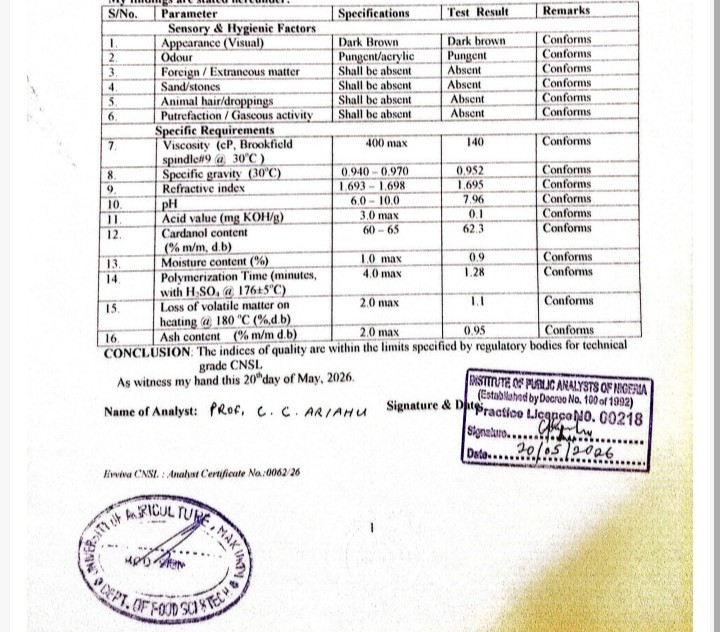
Every CNSL shipment carries NEPC export documentation, certificate of origin, commercial invoice, packing list, and bill of lading. We coordinate: Chemical analysis — cardanol content (%), anacardic acid content (%), cardol content (%), water content (Karl Fischer method), viscosity (rotational viscometer at 25°C), density, colour (Gardner scale or ASTM D1544), acid value, refractive index, and flash point. Safety documentation — Safety Data Sheet (SDS/MSDS) in compliance with EU Regulation (EC) 1272/2008 (CLP) on classification, labelling, and packaging of chemical substances, confirming CNSL’s classification, hazard communication, and safe handling guidance. Packaging compliance — UN packaging certification for dangerous goods shipping where CNSL’s skin-irritant properties trigger specific ADR/IMDG classification requirements. Our NEPC Export Licence No. 0042385 and CAC Registration No. RC-9284647 are verifiable through NEPC.
Nigeria’s CNSL Export Strength and Global Market Demand
The Global Market
The global CNSL market — tracked through Grand View Research’s CNSL market analysis at over USD 400 million annually with consistent growth driven by friction material demand, bio-based resin adoption, and green chemistry polymer development — creates industrial procurement demand whose structural guarantee (every vehicle manufactured globally requires brake pads) creates supply stability that purely discretionary specialty chemical markets lack.
The Cashew Export Promotion Council of India (CEPCI) — whose member operations produce approximately 50–60% of world CNSL — and Tridge’s CNSL market intelligence provide the most comprehensive global CNSL trade flow data confirming Nigeria’s growing formal export position.
Key Export Destination Markets
Germany — Europe’s largest automotive manufacturing nation and primary brake pad/friction material producing hub — creating the most commercially significant European CNSL procurement market. German friction material manufacturers including Brembo (Italian, major European market), TMD Friction, and hundreds of Tier 1 automotive supplier operations create consistent CNSL technical grade procurement. Chemical industry requirements administered through German Chemical Industry Association (VCI).
Japan — the world’s most sophisticated automotive brake system and friction material manufacturing nation — whose Toyota, Honda, Nissan, and Tier 1 supplier operations create quality-demanding CNSL procurement for Japanese safety-critical automotive component standards. Japanese chemical import requirements administered through METI.
United States — whose automotive manufacturing sector, industrial friction material producers, and phenolic resin manufacturers create consistent CNSL procurement demand. US chemical import requirements through EPA TSCA (Toxic Substances Control Act) registration for industrial chemical substances.
South Korea — whose Hyundai, Kia, and automotive supplier manufacturing creates friction material CNSL demand tracked through KATI.
Netherlands and Belgium — European specialty chemical distribution hubs whose CNSL trading and resin manufacturing operations create import demand for technical CNSL and cardanol.
Brazil — whose own cashew processing creates domestic CNSL supply but whose specific industrial chemical quality requirements create import demand for Nigerian origin during supply-demand imbalances.
India — the world’s largest CNSL producer and consumer — paradoxically imports CNSL during peak friction material manufacturing demand periods when domestic supply is absorbed by India’s own automotive industry growth.
Why Choose Paradise MultiTrade International Limited?
Complete Chemical Analysis Documentation — Industrial Grade Specification. Cardanol percentage (by GC-FID), anacardic acid, cardol, water content (Karl Fischer), viscosity (cP at 25°C), density (g/ml), colour (Gardner scale), acid value, refractive index, and flash point — all documented through accredited industrial chemistry laboratories. For friction material and resin manufacturers whose industrial quality systems require documented incoming raw material chemical specification — our complete analysis package provides the chemical credential that replaces subjective supplier quality assessment. Contact us to discuss chemical specification.
Technical CNSL and Natural CNSL Both Available. Technical CNSL (roasting process, high cardanol) for friction material and resin applications; natural CNSL (cold-pressed, high anacardic acid) for pharmaceutical and agricultural chemistry applications — from the same documented Nigerian cashew processing supply network. Contact our team to specify your required grade.
Safety Data Sheet Compliance — EU CLP and GHS. Complete SDS in compliance with EU Regulation (EC) 1272/2008 (CLP) and GHS (Globally Harmonised System) classification — confirming CNSL’s chemical hazard classification (skin irritant category 2, eye irritant category 2), handling requirements, personal protective equipment specification, and emergency response information. Essential for customs clearance and receiving facility chemical management compliance in all regulated markets. Contact us to discuss SDS documentation.
Bulk Vessel Capability for Large Volume Industrial Buyers. CNSL for industrial buyers whose annual procurement exceeds 500 MT — bulk liquid shipping in ISO tanks or flexibags provides dramatically lower per-tonne freight economics than drummed product. Contact us to discuss bulk liquid logistics.
Whole Cashew Shell for Buyers with On-Site Extraction. Dried whole cashew shell (CNSL content 20–30% of shell weight) for industrial buyers whose on-site CNSL extraction operations process shell directly — creating procurement economics that buy CNSL extraction feedstock rather than extracted liquid. Contact our team to discuss whole shell supply.
Multi-Commodity Cashew Value Chain Sourcing. CNSL buyers frequently source complementary cashew products. Alongside CNSL, Paradise MultiTrade exports raw cashew nuts (RCN), cashew nut kernel (W320, W240, W180), sesame seeds, groundnut, shea butter, soybeans, hibiscus flower, moringa leaf powder, palm kernel, gum arabic, and bitter kola. Explore our full range of Nigerian export commodities and consolidate your West African industrial and agricultural commodity sourcing through one verified, licensed export partner.
Product Specifications
| Specification | Details |
|---|---|
| Product | Nigerian Cashew Nut Shell Liquid (CNSL) — Anacardium occidentale shell |
| CAS Number | 8007-24-7 (CNSL natural); 57486-43-4 (cardanol) |
| Botanical Source | Anacardium occidentale L. (Anacardiaceae) — cashew nut shell |
| Origin | Nigeria (Ogun, Ondo, Osun, Oyo, Edo, Delta, Kogi, Kwara, Cross River States) |
| Grades Available | Natural CNSL (cold-pressed — high anacardic acid); Technical CNSL (roasting process — high cardanol); Distilled CNSL; Purified Cardanol; Whole Cashew Nut Shell (CNS); CNSL-extracted Shell Cake |
| Technical CNSL — Cardanol Content | ≥60% (standard grade); ≥70% (premium grade) — GC-FID analysis |
| Technical CNSL — Anacardic Acid | ≤15% |
| Technical CNSL — Cardol Content | 15–20% |
| Natural CNSL — Anacardic Acid | ≥55% |
| Natural CNSL — Cardanol | ≤15% |
| Water Content | ≤1.0% (Karl Fischer titration) |
| Viscosity | 100–500 cP at 25°C (rotational viscometer) — specify target range |
| Density | 0.93–0.97 g/ml at 25°C |
| Colour | Gardner Scale 12–18 (dark amber to dark brown) |
| Acid Value | 20–100 mg KOH/g (technical CNSL); 100–250 mg KOH/g (natural CNSL) |
| Refractive Index | 1.502–1.510 at 25°C |
| Flash Point | Above 120°C (closed cup) |
| Iodine Value | 240–280 g I₂/100g (reflecting side chain unsaturation) |
| Saponification Value | 90–120 mg KOH/g |
| Moisture and Volatile Matter | ≤1.5% |
| Cashew Shell (CNS) — CNSL Content | 20–30% of shell weight (residual post-kernel extraction) |
| Cashew Shell — Calorific Value | 18–20 MJ/kg (biomass energy grade) |
| Cashew Shell Cake — CNSL Content | ≤5% (post-extraction residual) |
| Regulatory Classification | EU CLP Regulation (EC) 1272/2008: Skin Irritant Category 2 (H315); Eye Irritant Category 2 (H319). GHS-compliant SDS provided with every shipment |
| Packaging — Liquid CNSL | 210-litre steel drums (net 200L); IBC (1,000L); ISO tank (20,000–25,000L) for bulk |
| Packaging — Whole Shell | 50kg polypropylene bags; bulk container loading |
| Supply Capacity | CNSL liquid: 500–5,000+ MT per year; Whole shell: 1,000–20,000+ MT per year |
| MOQ | Technical CNSL: 20 MT (100 drums); Natural CNSL: 10 MT; Cardanol: 5 MT; Whole shell: 25 MT |
| Export Documentation | Certificate of Origin, NEPC Export Licence, Chemical Analysis Certificate (GC-FID: cardanol, anacardic acid, cardol; Karl Fischer: water; viscosity; density; colour; acid value; refractive index; flash point), Safety Data Sheet (SDS/MSDS — EU CLP and GHS compliant), UN packaging certification (where applicable — IMDG code compliance), Commercial Invoice, Packing List, Bill of Lading |
| Payment Terms | T/T, Letter of Credit (LC at sight), Escrow |
| Loading Port | Lagos (Apapa / Tin Can Island Port), Nigeria |
| Incoterms Available | EXW, FOB Lagos, CNF, CIF |
Processing and Export Process
Cashew Nut Shell Collection. Raw cashew nut shells are generated at cashew processing facilities during kernel extraction — either from the boiling/steaming process (traditional Indian method) or, more commonly in Nigerian processing, from the drum roasting process. Shells accumulate at processing facilities at rates proportional to nut throughput — whose aggregation from multiple processing facilities creates the bulk volumes required for commercial CNSL export.
Technical CNSL Extraction — Roasting Process:
During drum roasting (temperature 180–200°C, residence time 15–30 minutes), the cashew shell’s CNSL undergoes simultaneous physical and chemical change — the heat drives anacardic acid decarboxylation to cardanol while the reduced viscosity of the heated liquid allows it to drain from the shell honeycomb structure. Rotary drum roasters (the commercial standard for large-scale cashew processing) incorporate CNSL drainage collection systems — channels and collectors capturing the expelled CNSL whose temperature-lowering to ambient creates the viscous technical CNSL product.
Natural CNSL Extraction:
Cold mechanical pressing of shells through hydraulic or screw press at ambient temperature — extracting CNSL without thermal decarboxylation, preserving high anacardic acid content. Solvent extraction (hexane) provides higher yield than mechanical pressing but requires solvent recovery infrastructure.
Degumming and Settling. Raw collected CNSL — containing water, shell fines, and residual solid particles from the roasting process — settled in holding tanks for 24–48 hours whose gravity separation allows solid particle settling and water layer separation. Top-decanted CNSL transferred to storage after filtration through coarse screens removing shell particle contamination.
Chemical Analysis and Grade Confirmation. Representative samples from every production batch analysed by GC-FID (cardanol and anacardic acid quantification), Karl Fischer titration (water content), rotational viscometer (viscosity), and physical property measurement (density, colour, acid value) before commercial grade classification.
Drumming and Packaging. Technical CNSL filled into 210-litre new or reconditioned steel drums — whose chemical resistance to CNSL’s phenolic compounds is confirmed before use. Drum weight documented (net 200L, approximately 190–195kg per drum depending on density). Drum labelling includes: chemical name, CAS number, grade, batch number, production date, net weight, gross weight, UN number (where applicable), and hazard pictograms per GHS/CLP requirements.
ISO Tank Loading for Bulk Orders. For orders above 20 MT — ISO tank loading provides freight economics approximately 30–40% better per tonne than drummed product. CNSL’s viscosity at ambient temperature (100–500 cP) requires confirmation of ISO tank heating capability for cold climate destination ports where temperature drop during transit increases viscosity — trace heating or insulated tank specification recommended for destinations above 45°N latitude in winter shipment.
Whole Shell Preparation. Cashew shells post-CNSL drainage dried on concrete pads or through mechanical drying to below 12% moisture — reducing weight and mould risk during container shipping. Shells bagged in 50kg polypropylene bags or bulk-loaded into containers (approximately 7–8 MT per 20-foot container for whole shell).
Lead Times. Technical CNSL from processing facility aggregation: 14–28 days from order confirmation. Natural CNSL (cold-press scheduling): 21–35 days. Purified cardanol (distillation scheduling): 35–56 days. Whole shell: 14–21 days. ISO tank logistics: add 7–14 days for tank sourcing and coordination. Contact us to plan your procurement schedule.
Frequently Asked Questions
What is CNSL and why is it specifically used in brake pad manufacturing?
Cashew Nut Shell Liquid (CNSL) is the phenolic liquid extracted from the honeycomb layer of the cashew nut shell — containing primarily cardanol (in technical CNSL), anacardic acid, cardol, and 2-methyl cardol. Its brake pad application reflects a specific performance match between CNSL-based phenolic resin chemistry and friction material engineering requirements: (1) Thermal stability: When heated above 400°C — the temperature reached inside brake pads during heavy braking — CNSL-based phenolic resins undergo progressive carbonisation (char formation) rather than sudden softening or melting. This char maintains structural integrity at temperatures where conventional organic polymers fail, preventing the brake pad from literally disintegrating under extreme braking conditions. (2) Consistent friction coefficient: CNSL resin’s gradual char formation maintains a consistent surface character — and therefore a consistent coefficient of friction between brake pad and rotor — across the temperature range from cold morning start to heavy downhill braking. Inconsistent friction (brake fade) is a road safety hazard whose elimination is the primary friction material engineering objective. (3) Flexibility advantage: The C15 aliphatic side chain of cardanol — which survives cross-linking into the resin polymer network — creates a degree of chain flexibility that prevents brittle fracture of brake pads at low ambient temperatures. Cold brake pads that shatter on first application (a failure mode of overly rigid binder systems) create catastrophic brake failure. (4) Asbestos replacement compatibility: CNSL resins bond excellently to the aramid fibres, steel fibres, and ceramic fibres that replaced asbestos as friction material reinforcement — creating a complete NAO (Non-Asbestos Organic) friction material system whose performance equals or exceeds the asbestos-phenolic systems it replaced. Contact us to discuss technical CNSL specification for friction material application.
What is the difference between natural CNSL and technical CNSL and when should I specify each?
The fundamental difference is the decarboxylation of anacardic acid to cardanol during thermal processing: Natural CNSL (cold-pressed): Produced without significant heating — preserving anacardic acid as the dominant compound (55–65% of CNSL). Dark, highly viscous, strongly acidic (high acid value). Applications: pharmaceutical raw material for anacardic acid isolation (antimicrobial, antiparasitic, anticancer research); agricultural biopesticide research; natural antifouling coating research. Not appropriate for standard friction material or resin applications due to high acid value and low cardanol content. Technical CNSL (roasting process): Produced as a by-product of drum roasting (180–200°C) whose heat drives anacardic acid decarboxylation to cardanol — creating cardanol-dominant CNSL (60–75% cardanol). Lower acid value, better resin-forming properties, more predictable polymer chemistry. Applications: friction material binder resin, phenolic resin modifier, varnishes, coatings, adhesives. This is the dominant commercial grade — approximately 85–90% of internationally traded CNSL is technical grade. Distilled CNSL/Cardanol: Further processed — cardanol-enriched (>80% cardanol) by vacuum distillation. Highest value, most consistent chemical composition. Applications: high-specification friction material binders, electrical laminates, green chemistry monomer synthesis. Specification guidance: Friction material, resin, and varnish buyers: specify technical CNSL (minimum cardanol 60%, water below 1%). Pharmaceutical and agricultural research buyers: specify natural CNSL (minimum anacardic acid 55%). Electrical laminate and high-specification applications: specify distilled CNSL or cardanol. Contact us to confirm which grade fits your application.
What are the skin irritation hazards of CNSL and what handling precautions are required?
CNSL’s primary hazard is contact dermatitis — caused by anacardic acid and cardol whose urushiol-like chemistry (related to the poison ivy / poison oak allergen Toxicodendron urushiol, as all are Anacardiaceae family compounds) creates delayed-type hypersensitivity reaction in sensitised individuals and primary irritant contact dermatitis on first exposure. This hazard — which has historically caused significant occupational dermatitis among cashew shell workers in India, Vietnam, and Nigeria — requires specific handling protocols documented in the GHS-compliant Safety Data Sheet provided with every Paradise MultiTrade CNSL shipment: (1) Personal protective equipment: Chemical-resistant gloves (nitrile, minimum 0.2mm thickness, or neoprene); chemical splash goggles (not safety glasses — goggles required for splash protection); chemical-resistant apron or full body protection for large-scale handling; adequate ventilation in handling areas. (2) Skin contact management: Immediate washing with soap and water for minimum 15 minutes if skin contact occurs — do not scrub (scrubbing spreads the irritant); soap-and-water washing removes CNSL before skin penetration significantly reduces reaction severity. (3) Sensitisation management: Once sensitised (first contact dermatitis), subsequent exposures trigger progressively stronger reactions — sensitised workers must be removed from CNSL handling and permanently reassigned. (4) Industrial handling: ISO tank and drum transfers performed with closed-loop liquid handling systems eliminating open-surface exposure; pump systems with appropriate seal materials (PTFE or Viton seals — nitrile rubber may swell in CNSL contact). Paradise MultiTrade provides complete EU CLP Regulation (EC) 1272/2008-compliant SDS with every CNSL shipment. Contact us to request SDS documentation before procurement commitment.
What is cardanol and how does it differ from CNSL — and when do buyers need purified cardanol rather than technical CNSL?
Cardanol is the specific phenolic compound (3-(8Z,11Z,14Z)-pentadecatrienylphenol and its saturated and mono/diene analogues) that constitutes 60–75% of technical CNSL — whose isolation from the CNSL mixture through vacuum fractional distillation creates the higher-purity cardanol product. Why some buyers need purified cardanol rather than technical CNSL: (1) Polymer chemistry reproducibility: Cardanol’s specific reactivity with formaldehyde, epichlorohydrin, and other polymer co-reactants depends on cardanol concentration — technical CNSL’s variable cardanol percentage (60–75%) creates variable resin molecular weight and cross-link density from batch to batch. Purified cardanol (above 85% purity) creates more reproducible polymer synthesis whose product consistency is critical for regulated applications including automotive friction materials. (2) Colour specification: Technical CNSL’s Gardner colour 12–18 (dark amber-brown) creates coloured resins and coatings whose dark colour is acceptable in brake pads but unacceptable in light-coloured decorative coatings and electrical laminates. Distilled cardanol’s improved colour (Gardner 5–10, lighter amber) creates lighter-coloured resin products. (3) Regulatory purity: Some pharmaceutical and fine chemical applications specify cardanol purity above 90% whose achievement requires distillation beyond what technical CNSL processing achieves. When technical CNSL is sufficient: Friction material binders, industrial coatings, marine anti-corrosion coatings, and wood adhesive resins whose applications tolerate technical CNSL’s compositional variation and colour. Contact us to discuss whether technical CNSL or purified cardanol is appropriate for your application.
What UN and IMDG classification applies to CNSL shipping and how does it affect logistics?
CNSL’s hazardous material shipping classification affects packaging, documentation, and carrier acceptance: IMDG (International Maritime Dangerous Goods) Code classification: Technical CNSL with flash point above 60°C — classified as Non-Dangerous Goods for shipping purposes (flash point above the IMDG flammable liquid threshold of 60°C). Natural CNSL’s typical flash point above 120°C also clears the flammable liquid threshold. ADR (European Road Transport) classification: Similarly non-dangerous goods for most CNSL grades whose flash point exceeds the flammable liquid trigger. Skin/Eye irritant shipping requirement: The CNSL GHS classification as Skin Irritant Category 2 and Eye Irritant Category 2 — while triggering workplace hazard communication requirements — does not automatically require dangerous goods classification for shipping under IMDG or ADR. Practical documentation: Despite non-dangerous goods shipping classification for most CNSL grades, best practice requires: Safety Data Sheet (SDS) available to carrier on request; Emergency Contact information on shipment documentation; drum/IBC labelling with GHS hazard pictograms (health hazard exclamation mark) and signal word (“Warning”). For drum shipments: UN-approved 210L steel drums with adequate closure torque preventing leakage during transit. For ISO tank shipments: tank cleaning and inspection certification confirming chemical compatibility and seal integrity. Paradise MultiTrade coordinates complete shipping documentation compliance for all destination markets. Contact us to discuss logistics compliance documentation.
How does the global automotive brake pad market create structural demand for CNSL?
The structural demand relationship between automotive brake pad manufacturing and CNSL is perhaps the most commercially stable demand driver of any tropical agricultural by-product in global industrial chemistry: (1) Vehicle fleet growth: Global vehicle fleet — approximately 1.4 billion registered vehicles in 2024 according to International Organisation of Motor Vehicle Manufacturers (OICA) data — grows consistently with economic development, urbanisation, and rising per-capita income in developing markets. More vehicles = more brake pads = more CNSL demand. (2) Mandatory replacement cycles: Brake pads are safety-critical consumables requiring replacement every 25,000–70,000 km depending on driving conditions and pad material. Every vehicle on earth requires regular brake pad replacement — creating replacement demand independent of new vehicle sales fluctuation. (3) Regulatory brake pad standards: Automotive safety regulations in EU, USA, Japan, and progressively China and India mandate specific brake performance standards whose engineering requires high-quality binder resin — creating demand quality floor below which friction material manufacturers cannot cut. (4) Asbestos phase-out completed: The regulatory transition from asbestos-containing to NAO (Non-Asbestos Organic) friction materials is now complete in virtually all major markets — creating permanent structural CNSL demand from asbestos replacement adoption. There is no comparable alternative binder system whose commercial availability and performance matches CNSL-based phenolic resins for friction material applications. Contact us to discuss CNSL supply programme for friction material manufacturing.
What transit times should I expect from Nigeria for CNSL shipments?
CNSL liquid in steel drums or ISO tank (standard dry/liquid container — temperature management recommended for cold climate destinations): UK (Tilbury, Felixstowe) — 14–18 days from Lagos. Netherlands (Rotterdam) — 14–18 days. Germany (Hamburg) — 14–20 days. Belgium (Antwerp) — 14–18 days. Japan (Yokohama) — 25–32 days. South Korea (Busan) — 30–38 days. USA (East Coast — New York, Baltimore) — 18–25 days. USA (Gulf Coast — Houston, New Orleans) — 18–22 days. Brazil (São Paulo via Santos) — 12–16 days. India (Nhava Sheva, Mundra) — 10–15 days. Canada (Halifax, Montreal) — 18–28 days. Temperature considerations: CNSL viscosity increases significantly at temperatures below 10°C — for destinations in northern Europe or North America during winter months, insulated ISO tanks or trace-heated drum storage at destination are recommended to maintain pumpability. Whole cashew shell transit: Same container transit times — standard dry container, no temperature management required. ISO tank vs drums: ISO tank (20,000–25,000L) provides approximately 30–40% lower freight cost per tonne versus equivalent volume in 210L drums — the economic justification for ISO tank investment at volumes above 20 MT per shipment. Contact us to plan your complete logistics programme including temperature management specification.
Ready to Source Nigerian CNSL — Technical CNSL, Natural CNSL, Distilled CNSL, Purified Cardanol, and Whole Cashew Shell — With Complete Chemical Analysis Documentation, GHS/CLP-Compliant Safety Data Sheet, UN/IMDG Shipping Compliance, and Full Industrial Specification for Friction Material Manufacturers, Phenolic Resin Producers, Varnish and Coating Companies, Pharmaceutical Raw Material Buyers, and Global Industrial Wholesale Buyers?
If you are a European, Japanese, or American friction material manufacturer whose brake pad and clutch lining binder resin programme requires documented cardanol content, viscosity specification, and consistent supply of technical CNSL from West African origin as supply chain diversification from Indian dominant procurement, a phenolic resin or polymer manufacturer building bio-based resin programmes whose CNSL cardanol content creates green chemistry positioning for bio-derived phenol substitution in wood adhesive, plywood binder, or industrial coating resin formulations, a specialty chemical distributor building West African CNSL supply positions for European and Asian industrial chemical markets as Nigeria’s growing cashew processing capacity creates increasing technical CNSL availability from domestic kernel processing operations, a pharmaceutical research institution or fine chemical manufacturer sourcing natural CNSL for anacardic acid isolation whose antimicrobial, antiparasitic, and histone acetyltransferase inhibitory research applications require high-anacardic-acid natural CNSL from authenticated botanical origin, a varnish, marine coating, or industrial surface treatment manufacturer evaluating CNSL-based drying oil and resin systems for chemical-resistant and thermally stable coating applications whose bio-based origin creates sustainability positioning advantages over petroleum-derived phenol alternatives, a whole cashew shell buyer whose on-site CNSL extraction operations source shell directly from West African cashew processing facilities rather than purchasing pre-extracted liquid, or a global industrial agricultural by-product commodity trader building Nigerian CNSL and cashew shell supply positions for friction material, resin, and industrial chemical markets as Nigeria’s cashew processing industry investment creates growing formal CNSL export supply — Paradise MultiTrade International Limited is the licensed Nigerian exporter your CNSL supply programme needs.
We supply Nigerian Anacardium occidentale cashew nut shell liquid — technical CNSL (high cardanol), natural CNSL (high anacardic acid), distilled CNSL, purified cardanol, and whole cashew shell — from Ogun, Ondo, Oyo, Edo, and Cross River cashew processing operations, complete GC-FID chemical analysis certified per lot, Karl Fischer water content documented, viscosity and density specified, GHS/CLP EU CLP Regulation 1272/2008-compliant Safety Data Sheet provided with every shipment, IMDG shipping compliance documented, drummed (210L steel drum) or ISO tank bulk loading options, and exported under NEPC Licence No. 0042385 with full industrial documentation to buyers in every major regulated destination market.
Request a Quotation — share your required grade (technical CNSL, natural CNSL, distilled CNSL, purified cardanol, or whole shell), cardanol minimum specification (%), water content maximum, viscosity target range, packaging preference (drums or ISO tank), volume, application (friction material, phenolic resin, varnish/coating, pharmaceutical, shell biomass, industrial chemical), destination market, and preferred incoterms. We respond within 48 hours.
Contact Our Export Team — speak directly about technical CNSL cardanol content documentation by GC-FID, natural CNSL anacardic acid content for pharmaceutical research applications, distilled CNSL and purified cardanol specification for high-performance friction material and electrical laminate applications, GHS/CLP Safety Data Sheet provision, IMDG shipping compliance, ISO tank bulk logistics including temperature management for cold climate destinations, whole cashew shell pricing and container loading, and long-term integrated cashew value chain supply programme combining RCN, kernel, and CNSL from one Nigerian source.
Explore Our Full Product Range — alongside CNSL, Paradise MultiTrade exports raw cashew nuts (RCN), cashew nut kernel (W320, W240, W180), palm kernel shell (PKS), charcoal (hardwood), sesame seeds, groundnut, shea butter, gum arabic, hibiscus flower, moringa leaf powder, and bitter kola. One licensed Nigerian exporter. One consolidated West African cashew value chain, industrial by-product, agricultural commodity, and natural food sourcing relationship — from the kernel that feeds the global nut snack market to the shell liquid that keeps every vehicle on earth’s brakes working.
Paradise MultiTrade International Limited | NEPC Export Licence No. 0042385 | CAC No. RC-9284647 | Lagos, Nigeria | www.paradisemultitrade.com
Reviews
There are no reviews yet.