
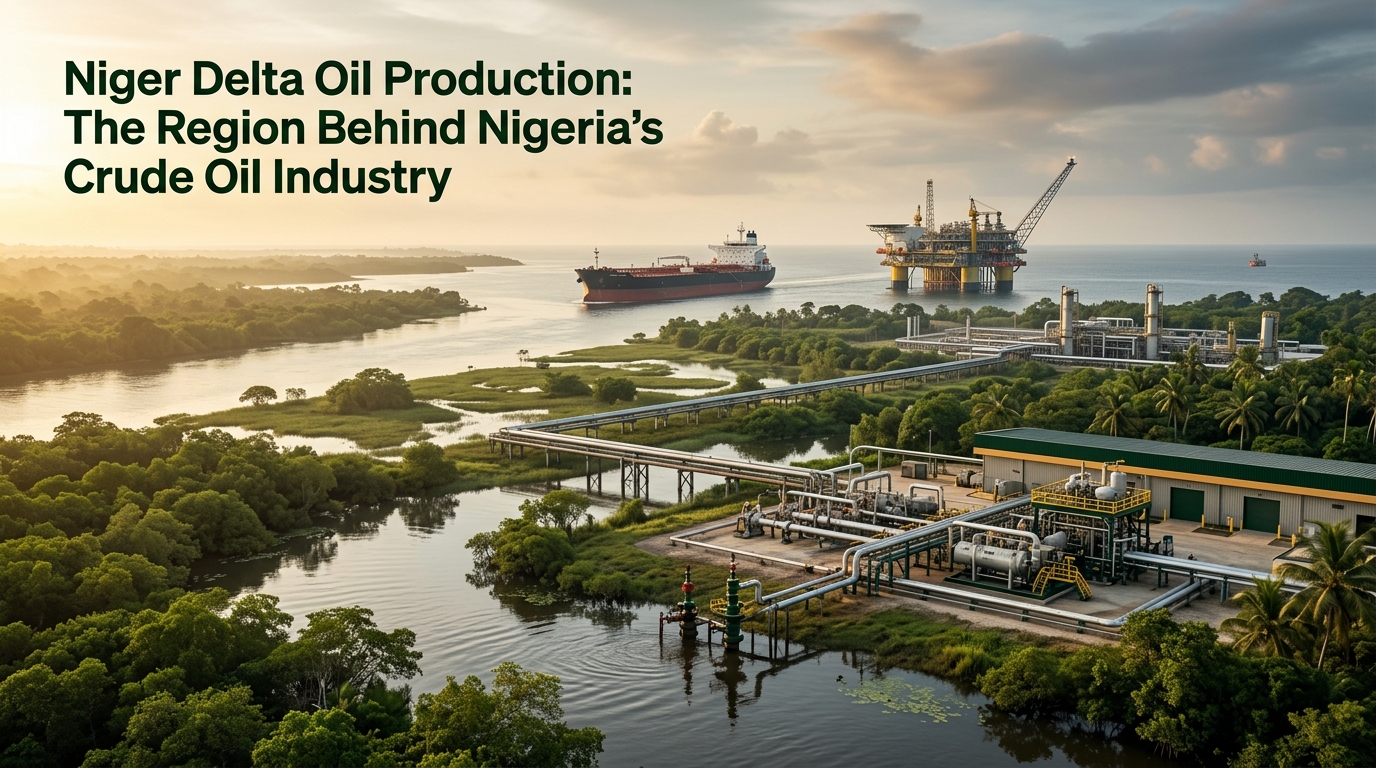
Niger Delta Oil Production: The Region Behind Nigeria’s Crude Oil Industry
The Niger Delta oil production region is at the centre of Nigeria’s petroleum story.
For decades, the Niger Delta has been one of the most important areas for crude oil and natural gas production in Nigeria. The region’s extensive petroleum resources, oil fields, pipelines, flow stations, export terminals, service infrastructure and coastal waterways have connected Nigerian hydrocarbons to domestic and international energy markets.
When people search for information about where Nigerian crude oil comes from, the Niger Delta is one of the first places they encounter.
However, understanding the region requires more than simply identifying it as an oil-producing area.
The Niger Delta is a complex petroleum ecosystem involving producing fields, operators, regulators, host communities, transportation infrastructure, crude evacuation systems, terminals, environmental-management institutions and international buyers.
NUPRC’s research on hydrocarbons attribution explains that Nigeria’s petroleum resources are located within sedimentary basins both onshore and offshore, with hydrocarbon-producing states concentrated in the country’s southern petroleum-producing areas.
Recent production data also demonstrates the continuing importance of Nigerian crude production. NUPRC reported that Nigeria produced an average of 1.56 million barrels per day of crude oil in June 2026, excluding condensates.
This article explains Niger Delta oil production, the states and petroleum systems involved, how crude moves from oil fields to export terminals, the region’s importance to Nigerian crude exports, major operational challenges and what international buyers should understand when sourcing Nigerian crude.
What Is the Niger Delta?
The Niger Delta is a large deltaic region in southern Nigeria formed around the Niger River and its distributaries as they reach the Gulf of Guinea.
It contains extensive wetlands, rivers, creeks, mangrove forests, swamps and coastal environments.
More importantly for the petroleum industry, the region contains significant hydrocarbon-bearing formations.
Nigeria’s petroleum activities have historically been concentrated in the Niger Delta, although exploration and production also extend into offshore areas and other sedimentary basins.
Nigeria’s National Oil Spill Contingency Plan notes that petroleum activities are concentrated in the Niger Delta and that the region contains ecologically sensitive environments where oil-pollution incidents can have significant consequences.
This combination of substantial petroleum resources and environmentally sensitive geography has made the Niger Delta one of the most important and closely watched oil-producing regions in Africa.
Why Is the Niger Delta Important to Nigeria’s Oil Industry?
The importance of the Niger Delta comes from several interconnected factors.
1. Petroleum resources
The region contains numerous oil and gas fields.
2. Long production history
Commercial petroleum production in the region has operated for decades.
3. Extensive infrastructure
Production has created networks of pipelines, flow stations, gathering systems, terminals and support facilities.
4. Export connectivity
Several Nigerian crude streams are connected to export terminals serving international markets.
5. Oilfield services
The region supports a large ecosystem of technical, engineering, marine, logistics and petroleum-support companies.
6. Host communities
Many communities are located close to petroleum-producing infrastructure and therefore have an important relationship with the industry.
7. National economic importance
Nigeria’s oil and gas sector remains strategically important to government revenues, exports and foreign exchange.
The U.S. Energy Information Administration notes that oil and natural gas production remains a mainstay of Nigeria’s economy and that crude oil production disruptions have significant implications for the country’s petroleum supply.
Which States Are Part of Nigeria’s Niger Delta Oil-Producing Region?
When discussing the Niger Delta oil industry, several states are commonly associated with petroleum production.
These include:
- Delta State
- Rivers State
- Bayelsa State
- Akwa Ibom State
- Edo State
- Ondo State
- Imo State
- Abia State
Some broader definitions of the Niger Delta also include other areas depending on whether the discussion concerns geography, ecology, petroleum production or government development programmes.
NUPRC’s analysis of hydrocarbons attribution identifies Niger Delta-producing areas and discusses petroleum resources distributed across producing states.
For commercial purposes, however, it is more useful to identify the specific field, crude stream and terminal rather than relying only on the name of a state.
Major Niger Delta Oil-Producing States
Delta State
Delta State is one of Nigeria’s most important petroleum-producing states.
NUPRC’s 2024 state-level production data attributed approximately 99.90 million barrels of crude oil and condensate to Delta State during that reporting period.
Delta is associated with important petroleum infrastructure and production systems, including the Escravos area.
NUPRC’s recent production monitoring data continues to identify Escravos as one of Nigeria’s significant producing terminals.
The state’s petroleum ecosystem includes onshore and coastal production areas, pipelines, processing infrastructure and marine facilities.
For international crude buyers, Delta State is therefore relevant not simply because oil is produced there but because production is connected to established petroleum transportation and export systems.
Rivers State
Rivers State is another major centre of Nigeria’s petroleum industry.
Port Harcourt and the surrounding petroleum-producing areas have historically developed into a major hub for:
- crude oil production
- oilfield services
- petroleum engineering
- marine logistics
- pipelines
- storage
- refining
- petroleum transportation
The state is closely connected to the broader Niger Delta petroleum network.
Rivers also illustrates an important characteristic of Nigerian crude production: petroleum activity is not confined to isolated oil wells.
A functioning oil industry requires an entire ecosystem connecting the producing field to processing, transportation, storage and markets.
Bayelsa State
Bayelsa is located in the heart of the Niger Delta and is strongly associated with Nigeria’s petroleum industry.
The state’s landscape includes extensive waterways, creeks, mangroves and wetlands alongside petroleum infrastructure.
Bayelsa is associated with several oil-producing areas and crude streams, including Nembe.
Its geography creates both opportunities and logistical challenges for petroleum operations.
Moving personnel, equipment and crude through a water-dominated environment can require specialized marine and logistical infrastructure.
For this reason, the Niger Delta’s petroleum industry is closely connected to marine transportation and support services.
Akwa Ibom State
Akwa Ibom is another major Nigerian petroleum-producing state.
It is particularly important in discussions of offshore and coastal petroleum production and is associated with the Qua Iboe crude stream.
The Qua Iboe stream is recognized in international crude markets and has specific quality characteristics.
The U.S. Energy Information Administration lists Qua Iboe at approximately 38° API gravity and 0.12% sulfur, illustrating why individual Nigerian crude streams should be treated according to their specific properties rather than simply being grouped together as “Nigerian oil.”
International buyers interested specifically in this type of Nigerian crude should consider the actual crude specification, availability and loading arrangements before entering into a transaction.
How Is Crude Oil Produced in the Niger Delta?
Niger Delta oil production involves several stages.
A simplified process looks like this:
Exploration
↓
Field Development
↓
Drilling and Completion
↓
Crude Oil Production
↓
Gathering
↓
Processing / Separation
↓
Evacuation
↓
Storage / Export Terminal
↓
Tanker Loading
↓
International Market
Each field has its own technical configuration, so the exact process varies.
Onshore fields may rely heavily on pipelines and flow stations.
Swamp and coastal fields may require extensive marine transportation.
Offshore fields can require platforms, subsea systems, floating production facilities and specialized vessels.
This is why the Niger Delta oil industry should be viewed as a complete supply chain rather than simply a collection of oil wells.
Oil Fields and Crude Oil Streams
One of the most important concepts for anyone studying Nigerian petroleum is the difference between an oil field and a crude oil stream.
An oil field is a petroleum-producing asset or group of reservoirs.
A crude stream refers to a commercially identified stream of crude produced from one or more associated production systems and handled through the relevant infrastructure.
Nigeria has several internationally recognized crude streams, including:
- Bonny Light
- Forcados
- Qua Iboe
- Escravos
- Brass River
- Bonga
- Agbami
- Akpo
- Erha
- Usan
- Egina
- Utapate
These streams are not identical.
The EIA’s Nigeria country analysis lists different API gravities and sulfur levels for Nigerian crude grades. For example, Bonny Light is listed at approximately 35° API and 0.15% sulfur, while Forcados is listed at approximately 32° API and 0.20% sulfur.
This is extremely important for refineries.
A refinery’s crude requirement may depend on its configuration, processing units and desired petroleum-product output.
International buyers interested in specific Nigerian crude grades can review Bonny Light crude oil from Nigeria or Forcados crude oil from Nigeria.
How Crude Moves Through the Niger Delta
The geography of the Niger Delta makes crude transportation especially important.
A typical production system can involve:
Oil well
Crude is produced from the reservoir.
Flowline
Production moves from the well toward gathering infrastructure.
Flow station
Production from multiple wells can be collected and processed.
Pipeline
Crude may be transported through pipelines toward storage or export infrastructure.
Terminal
Crude enters a system for storage, measurement and loading.
Tanker
The crude is loaded onto an ocean-going vessel.
International refinery
The cargo is transported to its destination.
The precise arrangement differs from one petroleum asset to another.
NUPRC operates a National Production Monitoring System designed to monitor national crude production and exports using direct data acquisition from petroleum facilities and export terminals.
This type of monitoring is important because accurate production and export data is essential for regulation, royalties, commercial accounting and national petroleum planning.
Major Nigerian Export Terminals Connected to the Delta
The Niger Delta petroleum system is connected to several important export terminals and crude streams.
Examples include:
- Bonny
- Forcados
- Escravos
- Qua Iboe
- Brass
- Bonga and other offshore loading systems
These terminals and offshore systems allow Nigerian crude to reach international markets.
NUPRC’s production reports regularly track production associated with these systems.
For example, NUPRC’s August 2026 production report recorded approximately 92,500 barrels per day of crude oil at Bonga, while also reporting significant production through other major terminal systems.
The terminal is therefore not merely a geographical point.
It is part of the commercial chain connecting petroleum production with physical crude exports.
Niger Delta Oil Production and International Exports
The Niger Delta is ultimately connected to the global crude oil market.
Nigeria exports crude oil to refineries and trading markets in different regions, including Europe and Asia.
The EIA reported that Nigeria exported approximately 1.3 million barrels per day of crude oil and condensate in 2024.
The crude can travel thousands of kilometres by tanker before reaching the refinery that processes it.
This creates an international supply chain:
Niger Delta Production
→
Crude Gathering
→
Export Terminal
→
Ocean Tanker
→
International Port
→
Refinery
→
Petroleum Products
The crude produced in Nigeria can therefore eventually become products such as gasoline, diesel, aviation fuel, marine fuel, petrochemical feedstocks and other refinery outputs.
Why Niger Delta Oil Production Matters to Global Refineries
The importance of Niger Delta crude to international refineries is partly related to the properties of the crude streams produced in the region.
Different grades offer different combinations of:
- API gravity
- sulfur content
- distillation characteristics
- acidity
- metals
- yield potential
A refinery’s ability to process a particular crude depends on its technical configuration.
This means that an international refinery should not simply request “Nigerian crude.”
It should identify the crude characteristics it needs.
For example, a refinery may specify:
- minimum API gravity
- maximum sulfur
- maximum water and sediment
- required volume
- preferred crude stream
- loading window
- discharge location
This allows the procurement process to become more precise.
Companies seeking Nigerian crude procurement support can explore refinery procurement support.
Challenges Affecting Niger Delta Oil Production
The Niger Delta petroleum industry has faced a range of operational and security challenges over the years.
These include:
- crude oil theft
- pipeline vandalism
- infrastructure damage
- ageing infrastructure
- production disruptions
- environmental incidents
- illegal refining
- difficult terrain
- community-related issues
- maintenance requirements
The EIA identifies crude oil theft and pipeline vandalism as significant causes of disruption to Nigerian crude production. It also notes that aging infrastructure and mature fields have contributed to production challenges.
These issues can have a direct commercial impact.
When a pipeline is damaged or an evacuation route becomes unavailable, production may have to be reduced or temporarily shut in.
That can affect the volume of crude reaching export terminals.
Crude Oil Theft and Pipeline Vandalism
Crude oil theft has been a significant issue in Nigeria’s petroleum industry.
Oil can be illegally removed from pipelines or other parts of the petroleum supply chain.
Pipeline vandalism can also damage infrastructure and create environmental and safety risks.
The EIA reported that Nigerian crude production fell below one million barrels per day in the third quarter of 2022, with extended disruptions associated with crude oil theft and pipeline vandalism.
However, production has subsequently recovered from the lows experienced during that period.
NUPRC reported that June 2026 crude production reached approximately 1.56 million barrels per day, the highest monthly crude-only average since April 2020 according to the Commission.
This illustrates how improvements in operational conditions and restoration of production capacity can affect national output.
Environmental Issues in the Niger Delta
Environmental considerations are an important part of any serious discussion about the Niger Delta oil industry.
The region contains highly sensitive wetlands, rivers, mangroves, agricultural land and communities whose livelihoods can depend on environmental resources.
Oil spills can occur for different reasons, including:
- equipment failure
- pipeline corrosion
- operational incidents
- sabotage
- crude oil theft
- illegal refining
The exact cause of an individual spill needs to be established through investigation rather than assumed.
Nigeria’s National Oil Spill Detection and Response Agency (NOSDRA) is responsible for oil-spill surveillance, receiving reports and coordinating oil-spill response activities under its statutory framework.
NOSDRA also operates an Oil Spill Monitor and other environmental monitoring systems.
For businesses operating around Nigerian petroleum activities, environmental compliance and responsible handling are therefore important components of the broader petroleum supply chain.
How Oil Spills Affect the Region
The environmental impact of petroleum incidents can extend beyond the immediate production facility.
Potential effects can involve:
- waterways
- fishing areas
- agricultural land
- wetlands
- wildlife habitats
- community infrastructure
The EIA’s background assessment notes that oil spills and other petroleum-related pollution have affected land, water and livelihoods in parts of the Niger Delta. It also cites the United Nations Environment Programme’s assessment of Ogoniland and the long-term nature of some environmental remediation requirements.
This is one reason why modern petroleum regulation increasingly emphasizes environmental management, remediation and operational standards.
NUPRC’s current regulatory framework includes Nigerian Upstream Petroleum Environmental Remediation Regulations 2024.
The Role of Host Communities
Oil production does not occur in an empty geographical space.
People live and work throughout the Niger Delta.
Communities can be located near:
- oil wells
- flow stations
- pipelines
- roads
- terminals
- waterways
- industrial facilities
The Petroleum Industry Act introduced a framework for host-community development within the Nigerian petroleum sector.
The relationship between petroleum operators and host communities is therefore an important component of the industry’s social and operational environment.
For international buyers, this is relevant because responsible crude sourcing involves understanding not only the commercial aspects of petroleum but also the regulatory and operational environment surrounding production.
Why Infrastructure Is Critical to Niger Delta Oil Production
A crude oil field cannot deliver its full commercial value if production cannot be evacuated.
This makes infrastructure one of the most important elements of the Niger Delta oil supply chain.
Important infrastructure includes:
- gathering systems
- flow stations
- pipelines
- storage tanks
- export terminals
- marine loading systems
- roads
- bridges
- power systems
- communications
- offshore support facilities
Nigerian production has historically been affected by disruptions to pipelines and other infrastructure.
The EIA identifies aging infrastructure and poorly maintained crude oil infrastructure as contributing factors to Nigeria’s production challenges.
For this reason, investments in infrastructure reliability can have a direct impact on the country’s ability to sustain crude production and exports.
Deepwater Production and the Changing Niger Delta Oil Industry
Although the traditional Niger Delta remains extremely important, Nigeria’s petroleum industry has increasingly incorporated offshore and deepwater developments.
Deepwater production can involve fields located far offshore and requires specialized technology.
Examples of major Nigerian offshore fields include:
- Bonga
- Egina
- Akpo
- Erha
- Usan
- Agbami
These projects demonstrate that Nigerian crude production is no longer limited to traditional onshore and swamp environments.
The EIA notes that newer projects such as Akpo West, Ikike and Utapate have helped offset some declines from mature fields.
NUPRC’s production monitoring also tracks offshore production systems as part of national crude output.
Is All Nigerian Crude Produced in the Niger Delta?
No.
This is an important distinction.
The Niger Delta is the historical centre of Nigeria’s petroleum industry, but Nigeria also produces crude offshore.
The country’s petroleum resources are distributed across sedimentary basins, including offshore areas.
NUPRC’s analysis specifically describes Nigeria’s hydrocarbon reserves as being located in sedimentary basins both onshore and offshore.
Therefore, “Niger Delta crude” and “Nigerian crude oil” should not automatically be treated as identical terms.
A Nigerian crude cargo could be associated with an onshore field, swamp production system, offshore field or another petroleum asset.
How International Buyers Can Source Crude From the Niger Delta
For an international refinery or trading company, the first step should be defining the exact requirement.
A professional crude procurement enquiry should ideally contain:
Product
Specify the desired Nigerian crude grade or acceptable specifications.
Quantity
State the required volume.
Delivery
Identify the destination port or refinery.
Timing
Provide the preferred loading or delivery period.
Technical requirements
Include API gravity, sulfur and other relevant refinery specifications.
Commercial requirements
Specify any important transaction or payment requirements.
Buyer information
Provide sufficient corporate information to establish the buyer’s identity and genuine commercial interest.
Buyers can submit a Nigerian crude oil supplier enquiry to begin the commercial discussion.
Buyer Verification and Crude Oil Due Diligence
The Niger Delta’s importance to global oil markets also means that crude oil procurement requires proper due diligence.
An international buyer should avoid assuming that every person claiming to represent Nigerian crude has authority to sell a cargo.
Depending on the transaction, due diligence can involve reviewing:
- corporate identity
- seller authority
- product specification
- cargo availability
- loading terminal
- contractual documentation
- inspection arrangements
- commercial terms
- shipping arrangements
- applicable regulatory requirements
A buyer may also need to provide appropriate corporate documentation.
For companies ready to enter the procurement process, crude oil buyer registration provides a structured starting point.
LOI, ICPO and Commercial Enquiries
International crude transactions may involve commercial documents such as a Letter of Intent or ICPO, depending on the transaction structure.
These documents can help communicate:
- buyer identity
- requested crude
- quantity
- destination
- commercial requirements
- purchasing intentions
However, submitting an LOI or ICPO should not replace due diligence.
A professional buyer should still establish whether the proposed supplier has legitimate authority and whether the cargo and transaction structure are commercially verifiable.
Where appropriate, buyers can submit an LOI or ICPO for Nigerian crude oil.
FCO Requests for Nigerian Crude
A Full Corporate Offer, commonly referred to as an FCO, may be used in commodity transactions to present proposed commercial terms.
An FCO may contain information such as:
- crude grade
- quantity
- price
- loading location
- delivery terms
- payment terms
- transaction procedure
- offer validity
However, an FCO by itself does not establish that a physical cargo exists.
Buyers should evaluate the complete transaction structure, including the counterparty, authority, cargo documentation, terminal arrangements and inspection process.
Qualified buyers can request an FCO for Nigerian crude oil.
Shipping Nigerian Crude From the Niger Delta
Once a legitimate crude cargo is established, transportation becomes another major component of the transaction.
Crude oil is generally transported internationally using specialized tankers.
Shipping arrangements can involve:
- vessel selection
- chartering
- loading window
- terminal compatibility
- voyage planning
- insurance
- port requirements
- marine documentation
- discharge arrangements
The shipping requirement depends on cargo size, loading terminal, destination and other commercial factors.
International buyers planning physical Nigerian crude transactions can explore crude oil shipping and tanker charter assistance as part of their logistics planning.
Crude Oil Quality Verification
The physical quality of Nigerian crude matters because refinery compatibility depends on the actual properties of the cargo.
Quality considerations can include:
- API gravity
- sulfur
- water and sediment
- viscosity
- acidity
- metals
- distillation characteristics
Laboratory analysis and inspection can help establish whether the physical crude meets the required specification.
For appropriate transactions, buyers can consider commodity analysis and laboratory testing as part of the broader verification process.
Recent Niger Delta and Nigerian Production Trends
Nigeria’s national production has experienced significant fluctuations over the past decade.
The EIA reported that Nigeria produced approximately 1.5 million barrels per day of crude oil and lease condensate in 2024, while noting that production had declined from earlier levels because of mature fields, disruptions, infrastructure problems and security-related incidents.
NUPRC’s more recent data shows an improvement in 2026.
In June 2026, Nigeria recorded approximately 1.56 million barrels per day of crude oil production, excluding condensates.
Production later changed again.
NUPRC reported that July production declined approximately 4% month-on-month, partly because of operational challenges affecting the Erha and Akpo fields.
In August 2026, crude production increased slightly again, with NUPRC reporting approximately 1.50 million barrels per day of crude oil production.
These fluctuations demonstrate why buyers, traders and analysts should use current production information when evaluating the Nigerian crude market.
The Future of Niger Delta Oil Production
The future of the Niger Delta oil industry will depend on several interconnected factors.
These include:
Production optimization
Improving output from existing fields can help sustain national production.
Infrastructure reliability
Pipelines, terminals and other evacuation systems need to operate reliably.
New field development
New projects can help offset declines from mature assets.
Security
Reducing crude theft and infrastructure damage can improve operational reliability.
Environmental management
Effective spill prevention, monitoring and remediation remain important.
Regulatory certainty
Clear petroleum regulations can help companies plan investments.
Community relations
Stable relationships between operators and host communities can support long-term operations.
NUPRC’s 2026 upstream-sector strategy places emphasis on production optimization, regulatory predictability, operational safety and sustainability.
The broader direction of the industry therefore involves both maintaining existing production and developing new opportunities.
Why the Niger Delta Will Remain Important to Nigerian Crude Oil
The Niger Delta has an established petroleum ecosystem that cannot easily be replicated overnight.
It contains:
- decades of geological knowledge
- producing fields
- pipelines
- flow stations
- export infrastructure
- marine logistics
- technical expertise
- oilfield service companies
- established crude streams
This infrastructure creates a strong connection between Nigerian petroleum resources and international markets.
Even as Nigeria develops more offshore assets and explores other basins, the Niger Delta remains a foundational part of the country’s petroleum industry.
Frequently Asked Questions About Niger Delta Oil Production
What is Niger Delta oil production?
Niger Delta oil production refers to the extraction of crude oil and associated petroleum resources from oil fields and production systems located within the Niger Delta region of southern Nigeria.
Which states produce oil in the Niger Delta?
Major petroleum-producing states associated with the Niger Delta include Delta, Rivers, Bayelsa and Akwa Ibom, with petroleum production also associated with areas of Edo, Ondo, Imo and Abia.
Why is the Niger Delta important to Nigeria’s oil industry?
The region contains significant petroleum resources and extensive production, transportation and export infrastructure connecting Nigerian crude to domestic and international markets.
Does all Nigerian crude oil come from the Niger Delta?
No. Nigeria also has substantial offshore petroleum production, including deepwater fields such as Bonga, Egina, Akpo, Erha and Usan.
What are some major Nigerian crude oil grades?
Major Nigerian crude streams include Bonny Light, Forcados, Qua Iboe, Escravos, Brass River, Bonga, Egina, Akpo, Erha, Usan and Utapate.
Does the Niger Delta export crude oil internationally?
Yes. Nigerian crude produced through various onshore and offshore systems enters international markets through export terminals and offshore loading systems.
What problems affect Niger Delta oil production?
Challenges have included crude oil theft, pipeline vandalism, ageing infrastructure, operational disruptions, environmental incidents and the technical challenges associated with producing in complex swamp, coastal and offshore environments.
Who monitors oil spills in Nigeria?
The National Oil Spill Detection and Response Agency (NOSDRA) is responsible for oil-spill surveillance, receiving spill reports and coordinating oil-spill response activities under its statutory framework.
Can an international refinery buy crude from the Niger Delta?
International buyers can explore Nigerian crude procurement opportunities, but the specific transaction depends on crude availability, grade, seller authority, commercial terms, documentation, inspection, shipping and applicable regulatory requirements.
How can I enquire about Nigerian crude oil?
International buyers can submit a Nigerian crude oil supplier enquiry with information about the required crude grade, quantity, destination and purchasing requirements.
Conclusion
The Niger Delta oil production system is one of the foundations of Nigeria’s petroleum industry.
The region’s oil fields, pipelines, flow stations, terminals, marine infrastructure, technical services and established crude streams have connected Nigerian petroleum resources with international energy markets for decades.
However, the Niger Delta should not be viewed simply as a place where oil is extracted.
It is a complete petroleum ecosystem.
Crude must move from the reservoir through production facilities, gathering systems, evacuation infrastructure and terminals before it can become an export cargo.
The region has also faced significant challenges, including infrastructure disruptions, crude oil theft, pipeline vandalism and environmental incidents. The EIA identifies these issues as important factors affecting Nigeria’s production performance.
At the same time, Nigeria’s production has shown signs of recovery. NUPRC reported crude production of approximately 1.56 million barrels per day in June 2026 and approximately 1.50 million barrels per day in August 2026, excluding condensates.
For international buyers, understanding the Niger Delta is valuable because it provides context for where many Nigerian crude streams originate and how they enter the international supply chain.
But knowledge of the region is only the first step.
A serious crude buyer must ultimately establish the specific crude grade, quantity, availability, loading point, seller authority, quality specifications, documentation, inspection arrangements and shipping requirements.
Companies interested in Nigerian crude can buy Nigerian crude oil, register as a crude oil buyer, or contact the Paradise MultiTrade Oil & Gas Desk to discuss a specific procurement requirement.
The Niger Delta remains deeply connected to Nigeria’s petroleum identity and will continue to be an important part of understanding Nigerian crude oil production, exports and international petroleum trade.