
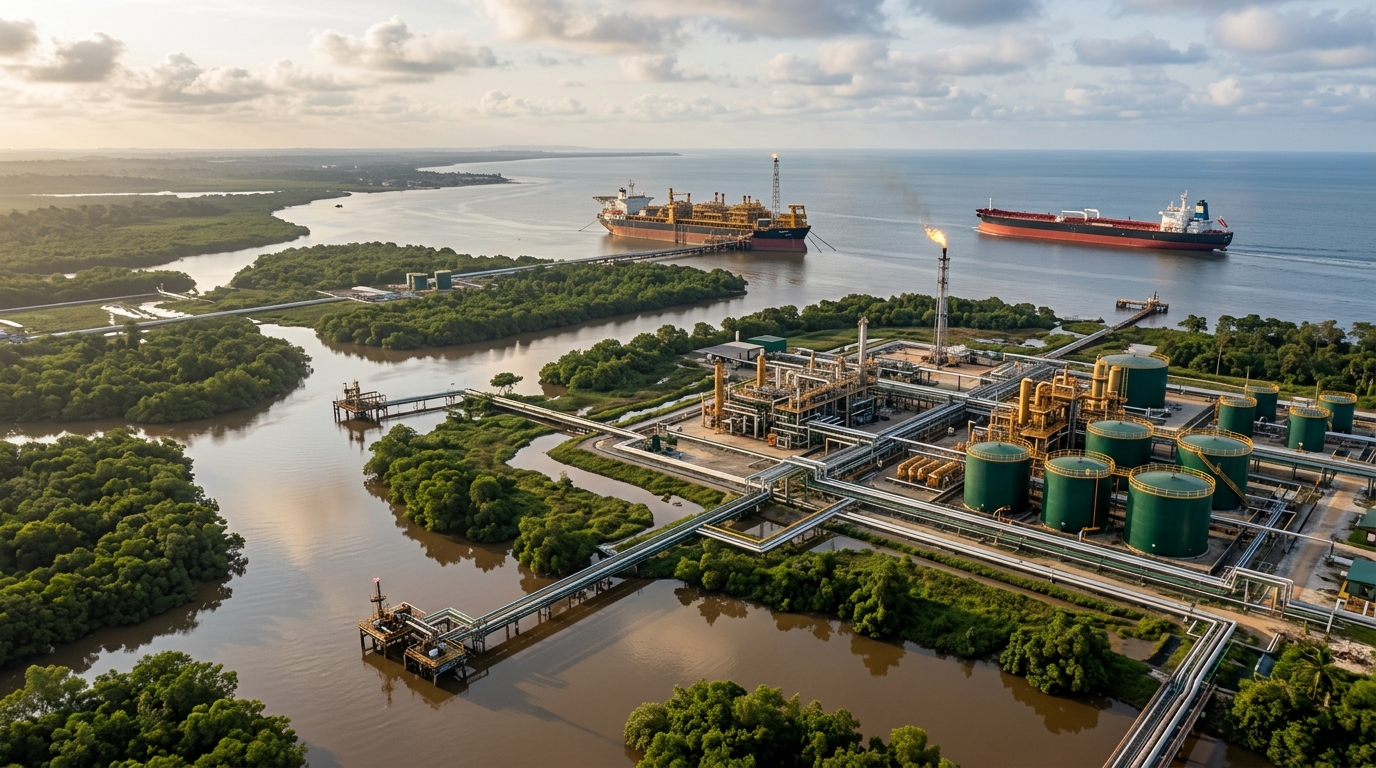
Major Oil Producing States in Nigeria: Where Nigeria’s Crude Oil Comes From
Nigeria is one of Africa’s major petroleum-producing countries, and crude oil production is concentrated in a relatively small number of states and offshore production areas.
When people ask “Where does Nigerian crude oil come from?”, the answer is more detailed than simply saying “the Niger Delta.”
The Niger Delta remains the historic centre of Nigeria’s petroleum industry, but crude oil and condensate production is also associated with offshore fields and petroleum-producing areas outside the states most commonly identified with the Delta.
According to the Nigerian Upstream Petroleum Regulatory Commission (NUPRC), its 2024 state-level production attribution recorded 295.34 million barrels of crude oil and condensate across the producing states listed in its table. Delta State accounted for approximately 99.90 million barrels, Akwa Ibom approximately 60.32 million barrels, Bayelsa approximately 53.28 million barrels and Rivers approximately 50.84 million barrels.
These figures provide a useful picture of where Nigeria’s petroleum production was attributed geographically during the reporting period.
However, there is an important distinction: state-attributed production is not the same thing as current national production or export cargo availability. Nigeria’s production changes from month to month, while individual export streams are also affected by field performance, terminal operations and commercial arrangements.
For international companies interested in Nigerian crude, understanding the producing regions is an important starting point before moving into actual procurement. Buyers can begin with a Nigerian crude oil supplier enquiry.
What Are the Major Oil Producing States in Nigeria?
The states identified in NUPRC’s 2024 state-level crude oil and condensate production table are:
- Delta State
- Akwa Ibom State
- Bayelsa State
- Rivers State
- Ondo State
- Edo State
- Imo State
- Anambra State
- Abia State
NUPRC’s table also includes Lagos State, but recorded zero crude oil/condensate production for the reporting period.
The production figures reported by NUPRC were:
| State | 2024 Crude Oil & Condensate Production |
|---|---|
| Delta | 99,903,790 barrels |
| Akwa Ibom | 60,320,514 barrels |
| Bayelsa | 53,276,855 barrels |
| Rivers | 50,837,013 barrels |
| Ondo | 8,710,019 barrels |
| Edo | 7,768,043 barrels |
| Imo | 6,329,737 barrels |
| Anambra | 4,779,496 barrels |
| Abia | 3,415,191 barrels |
| Total | 295,340,659 barrels |
Source: NUPRC 2024 Annual Report.
The figures show that production is heavily concentrated. The four largest state-attributed production volumes in the table—Delta, Akwa Ibom, Bayelsa and Rivers—accounted for the overwhelming majority of the reported state-level total.
1. Delta State
One of Nigeria’s Largest Oil Producing States
Delta State occupies a central position in Nigeria’s petroleum industry.
NUPRC’s 2024 state-level production data attributed approximately 99.90 million barrels of crude oil and condensate to Delta State, the largest state-level volume in the table.
The state’s petroleum industry is connected to the wider Niger Delta production and export network.
Delta contains petroleum-producing areas and infrastructure associated with crude oil gathering, processing, transportation and export.
The state is also associated with important crude oil streams and the Escravos petroleum system.
NUPRC’s production statistics show that the Escravos Oil Terminal remains an important production stream in Nigeria. In August 2026, the terminal recorded average production of approximately 131,710 barrels per day of crude oil and condensates.
This makes Delta State important not only because of its production volume but also because of its relationship with Nigeria’s broader crude oil export infrastructure.
For international buyers, however, the existence of production in a state does not automatically mean a particular cargo is available for purchase. A buyer needs to establish the actual crude stream, quantity, loading arrangements and commercial authority.
2. Akwa Ibom State
A Major Offshore and Crude-Producing Region
Akwa Ibom is another major petroleum-producing state.
NUPRC attributed approximately 60.32 million barrels of crude oil and condensate to Akwa Ibom in its 2024 state-level production data.
The state is closely associated with Nigeria’s offshore petroleum industry and the Qua Iboe crude stream.
Qua Iboe is one of Nigeria’s internationally recognized crude grades.
NUPRC reported average production through the Qua Iboe terminal of approximately 171,720 barrels per day of crude oil and condensates in August 2026.
The importance of Akwa Ibom to the international petroleum market therefore extends beyond its state-level production figure.
The state is connected to crude oil that enters Nigeria’s international trading system, making it relevant to refineries and trading companies seeking specific Nigerian crude grades.
International buyers interested in particular Nigerian grades can explore buying Nigerian crude oil and specify their desired product, quantity and destination.
3. Bayelsa State
A Historic Centre of Niger Delta Oil Production
Bayelsa State is located in the heart of the Niger Delta and has a long history of oil exploration and production.
NUPRC’s 2024 state attribution data recorded approximately 53.28 million barrels of crude oil and condensate for Bayelsa.
The state’s petroleum environment includes oil-producing communities, fields, pipelines and other infrastructure that form part of the wider Niger Delta petroleum network.
Bayelsa is also associated with several important crude production systems.
One example is the Nembe production stream. NUPRC’s 2024 production data records Nembe among the producing streams monitored by the Commission.
The state’s location demonstrates why the Niger Delta remains so important to understanding Nigerian crude oil production.
Oil production here is not simply about individual wells. It involves a connected network of production facilities, gathering systems, evacuation infrastructure, terminals, service companies and other petroleum infrastructure.
4. Rivers State
A Major Petroleum and Energy Hub
Rivers State is one of Nigeria’s best-known petroleum-producing states.
NUPRC recorded approximately 50.84 million barrels of crude oil and condensate attributed to Rivers State in its 2024 state-level data.
Rivers is particularly important because its petroleum significance goes beyond crude production.
The state has historically developed a broad petroleum ecosystem involving:
- crude oil production
- oilfield services
- pipelines
- storage
- marine transportation
- petroleum logistics
- refining-related infrastructure
- export-related activities
The broader Rivers petroleum environment therefore plays an important role in connecting Nigerian production with domestic and international markets.
For a company seeking Nigerian crude, the geographical location of production is only one part of the equation. The actual supply arrangement, crude grade, loading terminal and seller authority still need to be established.
5. Ondo State
Nigeria’s Western Petroleum-Producing Area
Ondo State is another state associated with Nigerian petroleum production.
NUPRC’s 2024 state-level data recorded approximately 8.71 million barrels of crude oil and condensate attributed to Ondo State.
Ondo is particularly interesting geographically because it demonstrates that Nigerian petroleum production extends beyond the states most commonly associated with the central Niger Delta.
The state’s petroleum resources form part of Nigeria’s broader sedimentary basin and hydrocarbon system.
Although Ondo’s reported production volume is considerably smaller than that of Delta, Akwa Ibom, Bayelsa and Rivers, it remains part of the country’s petroleum-producing landscape.
6. Edo State
An Oil Producing State in Southern Nigeria
Edo State also contributes to Nigeria’s petroleum production.
NUPRC’s 2024 production attribution recorded approximately 7.77 million barrels of crude oil and condensate for Edo State.
Edo’s oil-producing areas demonstrate the geographical breadth of Nigeria’s petroleum resources.
The state is not normally associated with the same level of international crude export visibility as major streams such as Bonny, Forcados or Qua Iboe, but its contribution remains relevant when examining Nigeria’s production geographically.
This distinction is useful for SEO readers and international buyers alike because “Nigerian oil” does not originate from one single location.
7. Imo State
Petroleum Production in Southeastern Nigeria
Imo State is another Nigerian oil-producing state.
NUPRC recorded approximately 6.33 million barrels of crude oil and condensate attributed to Imo State in its 2024 state-level production table.
The state’s petroleum production is part of the wider Niger Delta and southeastern Nigerian petroleum environment.
Imo also illustrates how Nigeria’s crude oil geography extends into areas that may receive less attention in international discussions about Nigerian petroleum exports.
8. Anambra State
Oil Production in the Anambra Basin
Anambra State is also represented in NUPRC’s state-level production data.
The Commission recorded approximately 4.78 million barrels of crude oil and condensate attributed to Anambra during the reporting period.
The state is associated with petroleum activity in the Anambra Basin.
Its production volume is relatively small compared with Nigeria’s largest oil-producing states, but it demonstrates that the country’s petroleum geology and production activities are geographically diverse.
9. Abia State
Another Southeastern Oil-Producing State
Abia State is among the states listed in NUPRC’s state-level crude oil and condensate production data.
The Commission recorded approximately 3.42 million barrels attributed to Abia in the 2024 reporting period.
Abia’s production is smaller than the major producing states, but the state remains part of Nigeria’s petroleum-producing landscape.
This is particularly relevant when studying the wider geography of Nigerian oil production rather than focusing only on export terminals.
Is Lagos an Oil Producing State?
Lagos is one of Nigeria’s most important commercial and maritime centres, but NUPRC’s 2024 state-level production table recorded zero crude oil/condensate production for Lagos State during the reporting period.
This distinction is important.
Lagos plays a major role in Nigerian commerce, shipping, business and energy-related activities, but that does not mean it was recorded as a crude-producing state in the cited NUPRC production table.
A location can be commercially important to the petroleum industry without being a major crude-producing area.
The Niger Delta: The Heart of Nigeria’s Traditional Oil Industry
When discussing the oil producing states in Nigeria, the Niger Delta must be placed at the centre of the discussion.
The region has historically been Nigeria’s most important petroleum-producing area.
It includes major producing states such as:
- Delta
- Rivers
- Bayelsa
- Akwa Ibom
and petroleum-producing areas associated with:
- Edo
- Ondo
- Imo
- Abia
The Niger Delta’s importance comes from its extensive petroleum resources and the infrastructure that has developed around oil and gas production over several decades.
The region contains a combination of:
- onshore fields
- swamp fields
- shallow-water fields
- pipelines
- gathering systems
- flow stations
- terminals
- marine infrastructure
- oilfield service operations
This infrastructure allows crude oil to move from producing fields into Nigeria’s broader petroleum supply chain.
Does All Nigerian Crude Come From the Niger Delta?
No.
This is one of the most important points to understand.
The Niger Delta is central to Nigeria’s oil industry, but Nigeria also has significant offshore petroleum production.
Deepwater fields such as:
- Bonga
- Egina
- Erha
- Usan
- Abo
- Oyo
contribute to Nigeria’s petroleum production.
NUPRC’s 2024 production data shows substantial output from these offshore production systems.
This means that the phrase “Niger Delta oil” can be useful geographically, but it should not be interpreted as meaning that every barrel of Nigerian crude is produced onshore in the Niger Delta.
Nigeria’s Offshore Oil Production
Offshore production has become an increasingly important part of Nigeria’s petroleum sector.
Unlike onshore production, offshore operations can involve:
- floating production systems
- subsea wells
- subsea pipelines
- offshore platforms
- specialized vessels
- offshore loading systems
- deepwater drilling equipment
Major Nigerian offshore fields include Bonga, Egina, Erha and Usan.
NUPRC’s 2024 production records show that several deepwater fields generated significant crude volumes during the reporting period.
The development of offshore petroleum resources is important because it expands Nigeria’s production base beyond traditional onshore and swamp operations.
Major Nigerian Crude Oil Streams and Their Producing Areas
It is also useful to understand the difference between oil-producing states and crude oil streams.
A state is a geographical administrative area.
A crude stream is a specific petroleum production stream or blend that may be associated with particular fields and infrastructure.
Nigeria has several internationally recognized crude streams, including:
- Bonny Light
- Forcados
- Qua Iboe
- Escravos
- Bonga
- Egina
- Agbami
- Akpo
- Erha
- Usan
- Utapate
The U.S. Energy Information Administration identifies multiple Nigerian crude grades and notes differences in characteristics such as API gravity and sulfur content.
For an international refinery, the crude stream can therefore be more important than simply knowing the producing state.
A refinery may specifically require a particular crude quality because of its refinery configuration.
Companies interested in Nigerian light crude can explore Bonny Light crude oil procurement from Nigeria.
For buyers interested in another major Nigerian stream, Forcados crude oil from Nigeria is another relevant procurement category.
How Crude Oil Moves From Producing States to Export Markets
Knowing the producing state is only the beginning.
Crude must move through the petroleum supply chain before it reaches an international refinery.
A simplified Nigerian crude supply chain looks like this:
Oil Field
↓
Production Facility
↓
Gathering System
↓
Evacuation Infrastructure
↓
Storage / Terminal
↓
Crude Oil Tanker
↓
International Port
↓
Refinery
Different production systems use different infrastructure, so the exact route varies by crude stream.
This is why international crude procurement requires more than identifying a producing state.
A buyer must establish the specific crude, supply source, loading location, cargo availability and commercial arrangement.
Which States Produce the Most Oil in Nigeria?
Based on NUPRC’s 2024 state-level production attribution, the largest volumes in the table came from:
Delta State — 99.90 million barrels
Akwa Ibom — 60.32 million barrels
Bayelsa — 53.28 million barrels
Rivers — 50.84 million barrels
These four states accounted for approximately 264.34 million barrels, or about 89.5% of the 295.34 million barrels recorded in NUPRC’s state-level table.
That concentration illustrates the continuing importance of the Niger Delta and adjacent petroleum-producing areas to Nigeria’s crude oil industry.
It is important to remember that this is a specific reporting-period state attribution, not a permanent ranking of production that should be assumed for every year or month.
Production changes as fields start, decline, shut down for maintenance, experience operational interruptions or increase output.
Why Oil Production Changes From One State to Another
Crude oil production is not static.
Several factors can influence production from a particular area.
Field maturity
Older fields may experience natural production declines.
New developments
New fields and projects can increase production.
Maintenance
Planned maintenance can temporarily reduce output.
Pipeline availability
Evacuation infrastructure can affect whether crude reaches the appropriate destination.
Security
Security challenges and crude theft can disrupt production and transportation.
Weather
Weather can affect offshore and onshore operations.
Technical performance
Equipment and reservoir conditions can affect production rates.
NUPRC’s recent national production reports demonstrate this variability.
In July 2026, for example, national crude production declined from June partly because of operational challenges affecting the Erha and Akpo fields.
By August, Nigeria’s crude production had increased slightly to approximately 1.50 million barrels per day, according to NUPRC.
The lesson is straightforward:
Oil production data should always be connected to a date and reporting period.
Why Producing-State Information Matters to International Buyers
An international buyer may initially think that knowing Nigeria produces millions of barrels of crude each day is enough.
It is not.
The producing-state information provides useful background, but a commercial buyer needs more detailed information.
For example, a refinery may ask:
- Which crude grade?
- Which field or stream?
- What quantity?
- Which terminal?
- What API gravity?
- What sulfur content?
- What loading window?
- What destination?
- What inspection arrangements?
- Who controls the cargo?
- What are the commercial terms?
This is because a barrel of Bonny Light is not simply interchangeable with every other Nigerian crude stream.
The properties and commercial logistics of different grades can vary.
Production Does Not Equal Available Export Cargo
This distinction deserves special attention.
Suppose Nigeria produces 1.5 million barrels per day.
That does not mean an international buyer can simply request any quantity from that national figure.
Production is distributed among fields, streams, companies and commercial arrangements.
Some production may be:
- allocated to existing lifting arrangements
- associated with specific contractual arrangements
- subject to domestic requirements
- committed to particular buyers
- affected by terminal schedules
- temporarily constrained by operational conditions
Therefore, an international buyer needs to establish specific cargo availability.
This is particularly important when evaluating crude oil offers received through intermediaries.
A credible procurement process should establish the actual product, source, authority and commercial terms rather than relying only on a national production statistic.
How to Buy Nigerian Crude Oil From a Producing Region
International buyers interested in Nigerian crude should begin with a clearly defined requirement.
The buyer should ideally specify:
Product
Desired crude grade or specification.
Quantity
Required volume in barrels.
Destination
Country and discharge port.
Refinery requirements
API gravity, sulfur limits and other technical requirements.
Timing
Preferred loading or delivery period.
Commercial requirements
Preferred transaction structure and payment framework.
Company information
Legal identity and relevant corporate information.
This information helps determine whether a potential crude supply opportunity is relevant to the buyer.
Companies can register as a crude oil buyer and provide their procurement requirements.
Verification Is Important in Nigerian Crude Transactions
The fact that a seller claims to represent a producing state or crude stream does not by itself establish that the seller controls an exportable cargo.
International buyers should carry out appropriate commercial due diligence.
Depending on the transaction, this can include reviewing:
- company identity
- corporate registration
- seller authority
- crude specification
- cargo availability
- loading terminal
- contractual documentation
- inspection arrangements
- payment terms
- shipping arrangements
For quality-related requirements, commodity analysis and laboratory testing can be relevant where appropriate.
The objective is to connect the buyer with a verifiable commercial supply opportunity, not merely a production statistic.
From Oil Producing State to International Buyer
The complete journey can be simplified as follows:
Stage 1 — Production
Crude oil is produced from an onshore, shallow-water or offshore field.
Stage 2 — Gathering
Production from wells is collected through the appropriate field infrastructure.
Stage 3 — Evacuation
Crude is moved toward the relevant storage or export system.
Stage 4 — Terminal
The crude enters the applicable terminal or export system.
Stage 5 — Inspection and Documentation
Relevant quality, quantity and commercial documentation is handled according to the transaction.
Stage 6 — Loading
Crude is loaded onto an appropriate tanker.
Stage 7 — Shipping
The cargo travels to the international destination.
Stage 8 — Discharge
The crude is delivered to the destination facility or refinery according to the agreed arrangement.
This is why the location of a producing state is only one part of the international crude oil transaction.
The Role of Nigerian Oil Producing States in Global Markets
Nigeria’s producing states are ultimately connected to a global crude oil market.
Production from fields in Delta, Akwa Ibom, Bayelsa, Rivers and other areas enters broader petroleum supply chains.
Some Nigerian crude streams are exported to refineries across Europe, Asia and other international markets.
The U.S. Energy Information Administration reported that Nigeria exported approximately 1.3 million barrels per day of crude oil and condensate in 2024, demonstrating the country’s continuing importance in international petroleum trade.
For international buyers, this means that the Nigerian crude market is not simply a domestic industry.
It is part of the international physical oil trade.
Frequently Asked Questions
How many oil producing states are there in Nigeria?
The exact number can depend on the definition and reporting period used. NUPRC’s 2024 state-level crude oil and condensate production table recorded production attributed to nine states, while Lagos was listed with zero production for that reporting period.
Which state produces the most crude oil in Nigeria?
In NUPRC’s 2024 state-level production attribution, Delta State recorded the largest crude oil and condensate volume at approximately 99.90 million barrels.
Is Rivers State an oil producing state?
Yes. NUPRC recorded approximately 50.84 million barrels of crude oil and condensate attributed to Rivers State in its 2024 state-level production data.
Is Bayelsa an oil producing state?
Yes. Bayelsa is a major petroleum-producing state in the Niger Delta. NUPRC recorded approximately 53.28 million barrels of crude oil and condensate attributed to Bayelsa in its 2024 state-level data.
Is Akwa Ibom an oil producing state?
Yes. Akwa Ibom is one of Nigeria’s major petroleum-producing states, with approximately 60.32 million barrels of crude oil and condensate attributed to it in NUPRC’s 2024 state-level data.
Does Nigeria’s crude oil only come from the Niger Delta?
No. Nigeria also has significant offshore production, including deepwater fields such as Bonga, Egina, Erha, Usan and others.
What are the major Nigerian crude oil grades?
Major grades include Bonny Light, Forcados, Qua Iboe, Bonga, Egina, Agbami, Akpo, Erha, Escravos, Usan and Utapate.
Can an international buyer buy crude directly from an oil-producing state?
Not simply because the state produces oil. Crude transactions involve producers, title holders, authorized sellers, terminals, commercial arrangements, regulatory requirements and logistics. Buyers need to establish the specific supply opportunity.
How can I enquire about Nigerian crude oil?
An international buyer can submit a Nigerian crude oil supplier enquiry with the required grade, quantity, destination and other commercial requirements.
Conclusion
Nigeria’s crude oil comes from a geographically diverse petroleum system, although the Niger Delta remains at the heart of the country’s traditional oil-producing industry.
Based on NUPRC’s 2024 state-level production attribution, Delta, Akwa Ibom, Bayelsa and Rivers accounted for the largest state-attributed crude oil and condensate volumes, while Ondo, Edo, Imo, Anambra and Abia also contributed to recorded production.
Nigeria’s petroleum industry also extends offshore, where deepwater fields such as Bonga, Egina, Erha and Usan contribute significant volumes to national production.
For international buyers, knowing the major oil producing states in Nigeria is useful, but it is only the beginning.
The more important commercial questions are:
What crude grade is available?
Where is it produced and loaded?
What quantity is available?
Who has authority over the cargo?
What are the quality specifications?
What documentation and inspection arrangements apply?
How will the cargo be shipped to the buyer’s destination?
Understanding these distinctions helps international buyers move from general knowledge about Nigerian oil production toward a more structured procurement process.
Companies interested in Nigerian crude can buy Nigerian crude oil, register as a crude oil buyer, or contact the Paradise MultiTrade Oil & Gas Desk to discuss a specific requirement.
For shipping-related requirements, crude oil shipping and tanker charter assistance can also form part of the wider logistics process.