
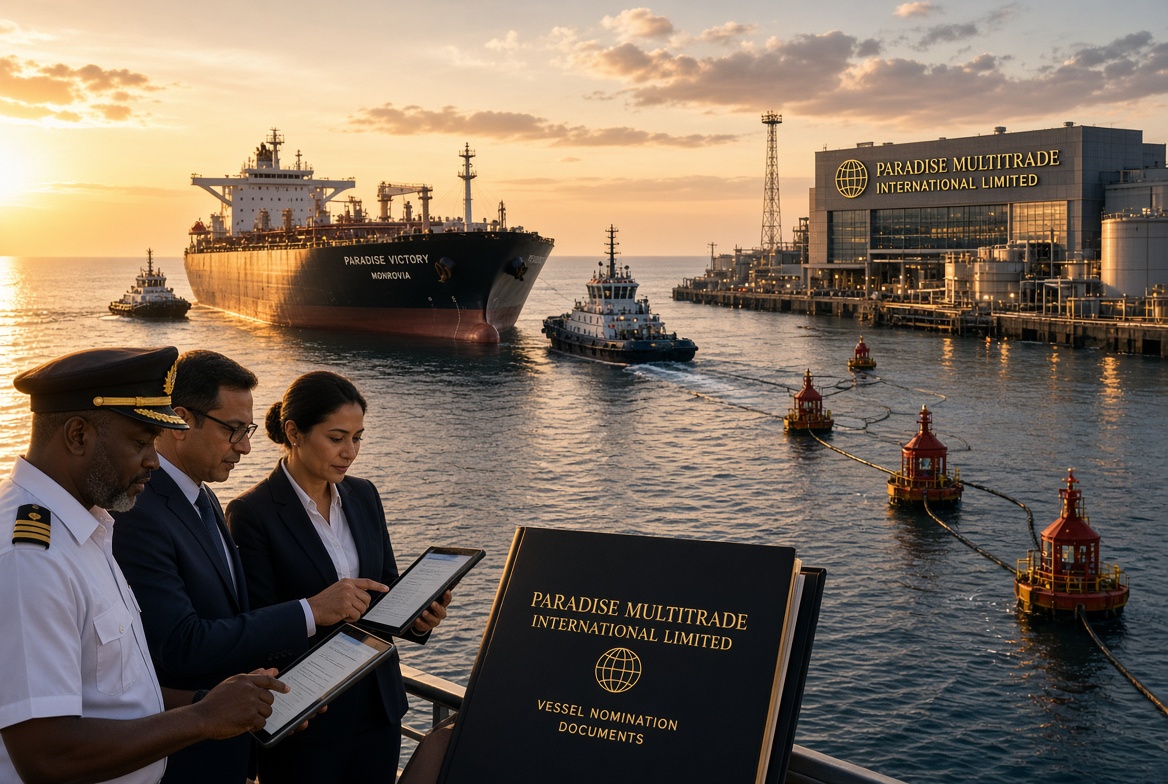
Vessel Nomination in Crude Oil Trading: The Complete Guide to Tanker Selection and Cargo Lifting
One of the clearest signs that an oil transaction has moved beyond paperwork is vessel nomination.
At this stage, the buyer identifies the ship that will physically transport the crude oil from the export terminal to its destination. The nominated vessel must satisfy commercial requirements, terminal safety standards, and regulatory approvals before loading can begin.
In professional oil trading, this isn’t simply choosing a ship—it is a carefully coordinated process involving terminal operators, shipping companies, inspectors, regulators, and both commercial parties.
If you’re following our Paradise MultiTrade Oil & Gas series, first read Proof of Product (POP) in Crude Oil Trading (https://paradisemultitrade.com/proof-of-product-pop-crude-oil-trading ), Sales and Purchase Agreement (SPA) in Crude Oil Trading (https://paradisemultitrade.com/sales-and-purchase-agreement-spa-crude-oil-trading ), and Crude Oil Lifting Procedures (https://paradisemultitrade.com/crude-oil-lifting-procedures ) to understand how vessel nomination fits into the overall transaction process.
Key Takeaways
-
Vessel nomination identifies the ship that will carry the crude oil cargo.
-
The nominated vessel must meet terminal and regulatory requirements.
-
Buyers usually nominate the vessel under FOB transactions.
-
Tanker approvals involve multiple stakeholders.
-
Successful nomination helps prevent loading delays.
What Is Vessel Nomination?
Vessel nomination is the formal process of proposing a specific vessel to load and transport crude oil under the agreed commercial terms.
Think of it this way.
The paperwork may already be completed, but without an approved vessel, the cargo cannot move.
The nominated vessel becomes the operational bridge between the contract and the physical shipment.
Why Vessel Nomination Matters
Every export terminal has operational limitations.
Some terminals can handle extremely large tankers.
Others have draft restrictions.
Some require specific safety approvals before allowing vessels to berth.
Choosing the wrong vessel can delay an entire shipment.
Where Vessel Nomination Fits in the Transaction Process
A simplified workflow looks like this:
-
Inquiry
-
LOI
-
ICPO
-
FCO
-
SPA
-
POP
-
Vessel Nomination
-
Cargo Inspection
-
Loading
-
Shipment
Notice that vessel nomination happens after commercial agreements have advanced and before cargo loading begins.
Who Nominates the Vessel?
The answer often depends on the agreed Incoterm.
For example:
-
Under FOB, buyers typically arrange and nominate the vessel.
-
Under CIF, sellers often arrange transportation.
To understand these differences, read FOB vs CIF in Crude Oil Trading (https://paradisemultitrade.com/fob-vs-cif-crude-oil-trading ).
What Information Is Included in a Vessel Nomination?

A professional vessel nomination usually includes information such as:
-
vessel name
-
IMO number
-
vessel type
-
flag state
-
deadweight capacity
-
expected arrival date
-
master details
-
loading terminal
Providing accurate information helps terminal operators evaluate compatibility.
Understanding the IMO Number
Every commercial vessel has a unique IMO number.
This permanent identification number helps distinguish ships throughout their operational life.
The International Maritime Organization (IMO) – https://www.imo.org maintains international shipping standards that support vessel identification and maritime safety.
Types of Crude Oil Tankers
Different cargo sizes require different vessels.

Aframax
-
approximately 80,000–120,000 DWT
-
commonly used for regional crude movements
Suezmax
-
approximately 120,000–200,000 DWT
-
designed for maximum Suez Canal dimensions
VLCC (Very Large Crude Carrier)
-
approximately 200,000–320,000 DWT
-
widely used for long-distance crude exports
ULCC (Ultra Large Crude Carrier)
-
above 320,000 DWT
-
used for extremely large cargo movements
Choosing the appropriate tanker depends on cargo size, destination, and terminal capability.
How Export Terminals Approve a Vessel

Before loading begins, terminal operators typically review whether the vessel is suitable.
They may evaluate:
-
vessel dimensions
-
draft
-
safety records
-
operational compatibility
-
scheduling availability
For Nigerian exports, this process connects directly to Nigerian Crude Oil Export Terminals (https://paradisemultitrade.com/nigerian-crude-oil-export-terminals ).
Pre-Arrival Coordination
Long before the vessel reaches the terminal, coordination begins.
Activities may include:
-
estimated arrival notifications
-
documentation review
-
cargo planning
-
pilot arrangements
-
berth scheduling
Good coordination reduces operational delays.
The Role of Marine Pilots

Large crude tankers rarely enter ports without professional assistance.
Marine pilots help guide vessels safely through local waters.
Their role becomes especially important at busy export terminals.
Safety Before Loading
Loading cannot begin immediately upon arrival.
Safety procedures may involve:
-
equipment checks
-
communication testing
-
emergency readiness
-
connection verification
-
operational approvals
The International Maritime Organization (IMO) – https://www.imo.org publishes international safety standards that influence many of these operational procedures.
How Vessel Nomination Connects to Nigerian Crude Exports

For Nigerian crude grades such as Bonny Light Crude Oil (https://paradisemultitrade.com/bonny-light-crude-oil-quality-pricing-buyers ), Forcados Crude Oil (https://paradisemultitrade.com/forcados-crude-oil-global-demand ), Qua Iboe Crude Oil (https://paradisemultitrade.com/qua-iboe-crude-oil-guide ), Bonga Crude Oil (https://paradisemultitrade.com/bonga-crude-oil-deepwater-export-guide ), and Egina Crude Oil (https://paradisemultitrade.com/egina-crude-oil-deepwater-export-guide ), vessel nomination becomes a critical operational step before lifting.
Nigeria’s upstream petroleum activities operate under the oversight of the Nigerian Upstream Petroleum Regulatory Commission (NUPRC) – https://www.nuprc.gov.ng , while the Nigerian Midstream and Downstream Petroleum Regulatory Authority (NMDPRA) – https://www.nmdpra.gov.ng regulates midstream and downstream petroleum operations.
International Shipping Standards
Vessel nomination operates within a broader international shipping framework.

For example:
-
BIMCO – https://www.bimco.org publishes widely used shipping documentation and charter-party guidance.
-
The International Chamber of Shipping – https://www.ics-shipping.org provides operational guidance for shipowners.
-
UNCTAD – https://unctad.org publishes global shipping and trade research.
-
The International Energy Agency (IEA) – https://www.iea.org and OPEC – https://www.opec.org publish valuable market intelligence that helps companies understand international crude movements.
Common Vessel Nomination Mistakes
Avoid these common mistakes.
Choosing an Incompatible Vessel
Terminal restrictions matter.
Incorrect IMO Number
Always verify vessel identification.
Late Nomination
Delayed nomination can affect loading schedules.
Missing Documentation
Incomplete information slows approvals.
Ignoring Terminal Requirements
Each export terminal has operational rules.
The Oil Trading Document Chain
As Paradise MultiTrade’s Oil & Gas knowledge hub grows, each article connects naturally.
Typical progression:
-
LOI
-
ICPO
-
FCO
-
SPA
-
POP
-
Vessel Nomination
-
Notice of Readiness
-
Lifting
-
Shipment
Our next article will cover Notice of Readiness (NOR)—the formal notice a vessel submits when it is ready to load, and the document that starts the clock for laytime and potentially demurrage, two concepts worth millions of dollars in real oil deals.
Frequently Asked Questions
What is vessel nomination?
It is the formal process of identifying the vessel that will transport the crude oil cargo.
Who nominates the vessel?
It usually depends on the agreed Incoterm.
What is an IMO number?
It is a unique identification number assigned to commercial vessels.
Can a terminal reject a vessel?
Yes. Terminal operators may reject vessels that do not meet operational or safety requirements.
Why is vessel nomination important?
Because cargo cannot be loaded until an appropriate vessel has been approved.
Why Paradise MultiTrade Focuses on Shipping Operations
At Paradise MultiTrade International Limited, we believe successful oil transactions extend beyond contracts.
Our Oil & Gas division focuses on:
-
international buyer sourcing
-
trade facilitation
-
commercial documentation
-
shipping coordination
-
vessel operations
-
transaction due diligence
Understanding vessel nomination helps businesses participate more confidently in legitimate international crude oil transactions.
Conclusion
Vessel nomination is one of the first visible signs that an oil transaction is moving from paperwork into physical execution. Selecting the right tanker, providing accurate vessel information, and coordinating with export terminals are all essential steps that determine whether a shipment proceeds smoothly or faces costly delays.
For companies involved in Nigerian crude exports, mastering vessel nomination builds credibility with refinery procurement teams, shipping companies, terminal operators, and commercial counterparties. As Paradise MultiTrade’s Oil & Gas knowledge hub continues to grow, understanding shipping operations becomes another essential step toward participating professionally in real-world crude oil transactions.