Proof of Product (POP) in Crude Oil Trading: How Buyers Verify Legitimate Oil Offers
One of the biggest challenges in international crude oil trading is separating genuine sellers from fake offers.
Every day, buyers receive emails claiming access to millions of barrels of crude oil. Many include impressive-looking certificates, tank farm documents, and inspection reports. Unfortunately, not all of those documents are genuine.
This is why experienced traders rely on Proof of Product (POP).
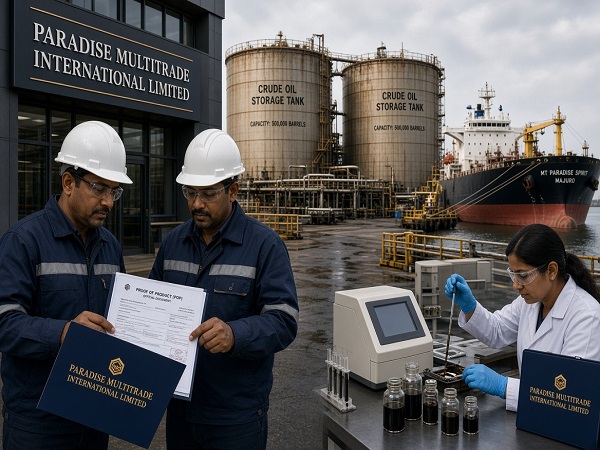
POP refers to the collection of documents and verification procedures used to demonstrate that a seller has legitimate access to a crude oil cargo before a transaction moves toward lifting and shipment.
If you’re following our Paradise MultiTrade Oil & Gas series, first read Sales and Purchase Agreement (SPA) in Crude Oil Trading (https://paradisemultitrade.com/sales-and-purchase-agreement-spa-crude-oil-trading ), Full Corporate Offer (FCO) in Crude Oil Trading (https://paradisemultitrade.com/full-corporate-offer-fco-crude-oil-trading ), and Crude Oil Lifting Procedures (https://paradisemultitrade.com/crude-oil-lifting-procedures ) to understand how POP fits into the broader transaction process.
Key Takeaways
-
POP helps buyers verify legitimate crude oil offers.
-
Genuine verification usually involves multiple supporting documents—not a single certificate.
-
Independent inspection companies play an important role in cargo verification.
-
Buyers should verify documents directly with the issuing organizations whenever possible.
-
Strong due diligence reduces fraud risk.
What Is Proof of Product (POP)?
Proof of Product (POP) refers to documentation and verification evidence showing that a seller has legitimate access to a crude oil cargo or an authorized supply position.
Think of POP as a verification stage.
Instead of relying on promises, buyers request evidence that supports the seller’s ability to perform the transaction.
However, an important point often misunderstood by beginners is this:
A document by itself does not automatically prove ownership.
Professional buyers still conduct independent verification.
Why POP Matters in International Oil Trading
Crude oil transactions involve extremely high values.
A single cargo may be worth tens or hundreds of millions of dollars.
Because of this, professional buyers rarely proceed without verification.
POP helps reduce uncertainty by providing supporting evidence before expensive operational steps begin.
Where Does POP Fit in the Transaction Process?
A simplified workflow looks like this:
-
Inquiry
-
LOI
-
ICPO
-
FCO
-
SPA
-
Proof of Product (POP)
-
Vessel nomination
-
Cargo lifting
-
Shipment
Notice that POP generally appears after commercial terms have advanced and before operational execution reaches critical stages.
Common Documents Associated with POP
Different transactions may involve different documentation.
Below are some of the documents buyers frequently encounter.

Certificate of Quality (COQ)
The COQ provides information about the cargo’s quality characteristics.
It may include:
-
API gravity
-
sulfur content
-
water content
-
sediment
-
laboratory measurements
Independent inspection companies often perform these tests.
Organizations such as SGS – https://www.sgs.com , Bureau Veritas – https://www.bureauveritas.com , and Intertek – https://www.intertek.com are among the globally recognized inspection companies operating across many commodity sectors.
Certificate of Quantity (COQTY)
This document records the measured cargo quantity during inspection.
It helps both parties understand the verified volume involved in the shipment.
Tank Storage Information

Some transactions involve documentation relating to storage facilities.
Professional buyers should verify such information independently rather than relying solely on copied documents.
Authorization Documents
Depending on the transaction structure, buyers may encounter:
-
seller authorization
-
mandate documentation
-
supplier authorization
Understanding authorization chains becomes especially important in large international transactions.
We’ll cover mandates separately in a future article.
What Buyers Should Verify
Experienced buyers verify much more than paperwork.
They typically review:
-
company registration
-
seller authority
-
cargo consistency
-
inspection validity
-
commercial logic
-
regulatory compliance
Verification protects both time and capital.
The Role of Independent Inspection Companies

One of the strongest confidence-building measures in oil trading is independent inspection.
Rather than relying entirely on seller-issued paperwork, professional transactions often involve recognized inspection companies.
Examples include:
-
SGS – https://www.sgs.com
-
Bureau Veritas – https://www.bureauveritas.com
-
Intertek – https://www.intertek.com
These companies provide inspection, testing, verification, and certification services across international commodity markets.
Red Flags of Fake POP Documents

Unfortunately, fake POP documents circulate frequently.
Warning signs include:
Unrealistic Quantities
Extraordinary claims deserve careful verification.
Poor Document Formatting
Professional certificates usually follow consistent formatting standards.
Missing Company Details
Legitimate documentation should identify the issuing organization clearly.
No Verification Path
Buyers should be able to verify documents independently.
Pressure to Pay Immediately
Professional transactions usually involve structured commercial procedures rather than rushed payment demands.
How POP Connects to Nigerian Crude Exports

For Nigerian crude grades such as Bonny Light Crude Oil (https://paradisemultitrade.com/bonny-light-crude-oil-quality-pricing-buyers ), Forcados Crude Oil (https://paradisemultitrade.com/forcados-crude-oil-global-demand ), Qua Iboe Crude Oil (https://paradisemultitrade.com/qua-iboe-crude-oil-guide ), Bonga Crude Oil (https://paradisemultitrade.com/bonga-crude-oil-deepwater-export-guide ), and Egina Crude Oil (https://paradisemultitrade.com/egina-crude-oil-deepwater-export-guide ), verification becomes especially important before cargo lifting.
Nigeria’s upstream petroleum sector operates under the oversight of the Nigerian Upstream Petroleum Regulatory Commission (NUPRC) – https://www.nuprc.gov.ng , while the Nigerian Midstream and Downstream Petroleum Regulatory Authority (NMDPRA) – https://www.nmdpra.gov.ng regulates midstream and downstream activities.
Commercial transactions involving NNPC cargoes also operate within frameworks established by NNPC Limited – https://www.nnpcgroup.com .
International Verification Standards

Oil cargo verification does not happen in isolation.
International shipping and trade rely on broader industry standards.
For example:
-
The International Maritime Organization (IMO) – https://www.imo.org develops global maritime safety standards.
-
BIMCO – https://www.bimco.org publishes widely used shipping documentation and charter-party guidance.
-
The International Chamber of Shipping – https://www.ics-shipping.org provides operational guidance for shipowners.
-
UNCTAD – https://unctad.org publishes international trade and shipping research.
-
The International Energy Agency (IEA) – https://www.iea.org and OPEC – https://www.opec.org publish valuable market intelligence that helps buyers understand global crude markets.
Common POP Mistakes
Avoid these common mistakes.
Accepting Scanned Documents Without Verification
Always verify independently.
Ignoring Inspection Companies
Recognized inspectors improve confidence.
Believing Every Certificate
Professional buyers verify issuing organizations.
Skipping Company Due Diligence
Corporate verification remains essential.
Rushing the Process
Legitimate transactions usually follow structured procedures.
The Oil Trading Document Chain
As Paradise MultiTrade’s Oil & Gas knowledge hub grows, each article connects naturally.
Typical progression:
-
LOI
-
ICPO
-
FCO
-
SPA
-
POP
-
Vessel Nomination
-
Lifting
-
Shipment
Each article strengthens the authority of the next one.
Frequently Asked Questions
What does POP stand for?
POP stands for Proof of Product.
Does POP guarantee ownership?
No. Buyers should still conduct independent verification.
Who issues inspection certificates?
Depending on the transaction, recognized inspection companies may issue relevant certificates.
Why is SGS frequently mentioned in oil trading?
SGS is one of the globally recognized inspection, testing, and verification companies operating across commodity markets.
Can POP eliminate fraud?
No single document eliminates fraud, but strong due diligence significantly reduces risk.
Why Paradise MultiTrade Focuses on Transaction Verification
At Paradise MultiTrade International Limited, we believe successful oil transactions depend on verification—not assumptions.
Our Oil & Gas division focuses on:
-
international buyer sourcing
-
trade facilitation
-
commercial documentation awareness
-
logistics coordination
-
cargo verification
-
transaction due diligence
Understanding Proof of Product helps businesses participate more confidently in legitimate international petroleum transactions.
Conclusion
Proof of Product is one of the most misunderstood concepts in crude oil trading. While many people think it refers to a single certificate, professional transactions usually involve multiple layers of verification, independent inspection, corporate due diligence, and regulatory awareness.
For companies exploring Nigerian crude procurement opportunities, understanding POP builds credibility with refinery procurement teams, commodity traders, shipping professionals, and legitimate commercial counterparties. As Paradise MultiTrade’s Oil & Gas knowledge hub continues to grow, mastering verification procedures becomes another essential step toward participating professionally in real-world oil transactions.