

Nigerian Nutmeg: The One Tree That Produces Two Completely Different Premium Spice Products From a Single Fruit — and Why Serious International Buyers Are Now Looking to West Africa for Supply Diversification From the Indonesian Origin That Has Defined the Global Nutmeg Market for Four Centuries
Nutmeg Exporter Nigeria — Whole Dried Nutmeg, Nutmeg Powder, Nutmeg Essential Oil, Nutmeg Butter, and Mace, Direct Southwestern and Southeastern Belt Sourcing, Bulk Supply to Food Manufacturers, Fragrance Houses, Pharmaceutical Ingredient Buyers, and Wholesale Spice Importers Worldwide
Nutmeg exporter Nigeria is a search phrase that arrives in two distinct commercial contexts — and understanding which context applies to a specific buyer is the first and most commercially important clarification that any serious West African nutmeg supply conversation must make. The first context involves Myristica fragrans — the true nutmeg of international spice commerce, native to the Banda Islands of Indonesia, now cultivated across tropical regions including Nigeria’s southwestern and southeastern states, and the spice that once drove the Dutch East India Company to commit some of the most commercially motivated colonial atrocities in recorded history to protect its monopoly supply position. The second context — and this disambiguation matters enormously — involves Monodora myristica, the African nutmeg, ehuru, or calabash nutmeg, a completely different botanical species from the Annonaceae family that Nigerian and West African cuisine uses as a traditional spice ingredient in pepper soup and native soups but that is not interchangeable with true Myristica nutmeg in food manufacturing, pharmaceutical, or fragrance applications.
Paradise MultiTrade supplies both. They are separate products serving separate markets with separate analytical profiles, separate regulatory frameworks, and separate buyer communities. This article addresses true nutmeg (Myristica fragrans) — the global spice of commerce — while noting that our African nutmeg (Monodora myristica) programme serves the West African diaspora and traditional spice markets through a separate product line whose buyers have equally specific and culturally precise procurement requirements.
What makes Myristica fragrans uniquely compelling as a Nigerian export category is not merely its cultivation in Nigerian coastal and forest-belt states — it is the botanical fact that the nutmeg tree is one of only a handful of commercially cultivated trees on earth that produces two completely distinct, commercially significant spice products from a single fruit. The seed — when dried and either sold whole or processed into powder, essential oil, or nutmeg butter — is the nutmeg of commerce: warm, sweet, slightly narcotic in its aromatic intensity, and present in the ingredient lists of everything from eggnog to béchamel sauce to premium gin botanical bills. The crimson seed covering — the aril that wraps the nutmeg seed in a delicate lacework of red-orange threads — is mace: a separate premium spice with a more delicate, floral, and slightly sweeter flavour profile than nutmeg itself, commanding its own premium pricing in the international spice market where it is valued specifically in white sauces, meat preparations, and the most sophisticated spice blend formulations where nutmeg’s intensity would overwhelm the dish but mace’s elegance precisely calibrates it.
Two products. One tree. One harvest. One supply chain. The commercial efficiency of this dual-product yield is unique in the spice world and makes Nigerian nutmeg cultivation one of the most compelling agricultural return-on-investment stories in the country’s expanding non-oil export portfolio.
At Paradise MultiTrade International Limited, nutmeg is one of our most commercially multidimensional spice exports — sourced from established cultivation communities across Ondo, Ogun, Delta, Cross River, Rivers, and Akwa Ibom states where Myristica fragrans has been grown since its colonial-era introduction into Nigeria’s coastal agricultural systems, processed into whole dried nutmeg, nutmeg powder, nutmeg essential oil, and nutmeg butter appropriate to the full range of international buyer applications, and exported with full analytical and regulatory documentation to food manufacturers, fragrance houses, pharmaceutical ingredient buyers, and global wholesale spice importers.
To discuss sourcing immediately, request a quotation here and our export team will respond within 48 hours.
History and Origin of Nutmeg — The Spice That Triggered a Colonial Genocide and Changed the World’s Trade Geography
The Banda Islands and the Most Commercially Motivated Atrocity in Spice History
No agricultural commodity in this entire article series carries a historical weight quite as dark as nutmeg’s. The Banda Islands of what is now Indonesia — the original and for centuries the exclusive natural habitat of Myristica fragrans — were the site of the 1621 Banda massacre: the systematic extermination of approximately 15,000 Bandanese people by the Dutch East India Company (VOC) in order to establish a complete monopoly over the global nutmeg supply. The VOC’s calculation was coldly commercial: if nutmeg could be purchased cheaply in the Banda Islands and sold at 300–400× the purchase price in European markets, then controlling the supply absolutely — eliminating every competing seller and every potential alternative source — was worth whatever violence that control required.
This history is not merely morally instructive. It is commercially instructive. No other spice — not black pepper, not cinnamon, not cloves — has ever been the object of so extreme a supply monopolisation attempt. The reason was nutmeg’s specific combination of extreme perishability in its original form (limiting storage and forward trading), extreme concentration in a single geographic location, and extremely inelastic demand in European markets where it had become integral to food preservation, medical practice, and social status display. The Dutch understood that a product with all three of these characteristics — concentrated supply, inelastic demand, no substitutes — was worth any price to control.
The commercial lesson for 21st-century nutmeg buyers is the same lesson we draw from castor oil’s India concentration, gum arabic’s Sudan concentration, and palm kernel oil’s Southeast Asian concentration: extreme supply concentration in a single geographic origin is a structural commercial risk that benefits no one except the dominant origin — and that prudent buyers systematically reduce through origin diversification. Research on the Banda Islands’ commercial and colonial history is documented through economic history research accessible via JSTOR’s academic database and reviewed in spice trade history publications from the Oxford Symposium on Food and Cookery.
Myristica Fragrans — Botanical Homeland and Global Dissemination
Myristica fragrans is native to the Banda Islands of the Maluku archipelago in eastern Indonesia — the original “Spice Islands” of colonial European geographic imagination. Its natural range within these islands was extraordinarily limited — historically covering perhaps 15 square kilometres of volcanic island terrain whose specific combination of tropical rainfall, volcanic soil fertility, and coastal humidity produced the precise growing conditions the tree had evolved in.
The colonial-era Portuguese — who reached the Banda Islands in 1512, a generation before the Dutch — initiated the first systematic dissemination of nutmeg cultivation beyond the Banda Islands. The subsequent Dutch monopoly era paradoxically limited this dissemination through deliberate botanical suppression — the Dutch lime-washed nutmeg seeds before export to prevent germination, specifically to prevent competing cultivation elsewhere. The monopoly eventually broke when French botanist Pierre Poivre smuggled live nutmeg plants from the Banda Islands to Mauritius in 1770 — an act of botanical espionage that effectively ended the Dutch monopoly and began the global dissemination of Myristica fragrans cultivation across the tropical world.
Nutmeg reached West Africa through the same colonial-era botanical distribution networks that brought neem, coconut, avocado, and tigernut to Nigeria. British colonial agricultural administration introduced Myristica fragrans cultivation into the coastal and forest belt zones of present-day Nigeria — recognising that the humid, warm, coastal conditions of the southwestern and southeastern states could support the tree’s growth — and established demonstration plantations whose descendant populations constitute the foundation of Nigeria’s current commercial nutmeg production.
Nigeria’s Nutmeg Production — The Emerging West African Origin
Nigeria’s Myristica fragrans production is concentrated in the humid coastal and forest-belt states where the combination of high annual rainfall (1,500–3,000mm), warm temperatures (24–30°C), high humidity, and the deep, well-drained loamy soils that nutmeg requires for productive growth are most consistently available:
Ondo State — particularly the Ondo/Ose and Akure forest zones — is Nigeria’s most commercially significant nutmeg producing territory, where established plantation and smallholder cultivation have produced a commercial nutmeg supply infrastructure of growing export relevance.
Ogun State — whose southern forest belt and proximity to Lagos’s export logistics infrastructure make it a commercially strategic producing zone for the Lagos-based export market.
Cross River and Akwa Ibom states — where the high-rainfall humid tropical conditions of the Niger Delta margins and Cross River basin support nutmeg cultivation in farming communities whose diverse spice crop portfolio includes both true nutmeg and African nutmeg.
Delta and Rivers states — contributing production from the Niger Delta forest zone whose specific high-humidity conditions are well-suited to Myristica fragrans cultivation.
According to FAO production statistics, Nigeria’s nutmeg production — while considerably smaller than the dominant Indonesian and Indian origins — constitutes a growing and commercially formalising sector whose development is directly supported by the Nigerian Export Promotion Council (NEPC) through its indigenous and tropical spice export promotion programme. International trade flow data from ITC Trade Map confirms Nigerian nutmeg entering formal export channels at growing volumes — with European spice processors, Middle Eastern food manufacturers, and American wholesale spice importers among the active buyer communities sourcing Nigerian origin nutmeg.
What Is Nutmeg? The Botanical Reality of the Dual-Product Tree and the Chemistry That Commands Premium Pricing
Myristica Fragrans — The Tree, the Fruit, and the Two Spices
Myristica fragrans is a large, spreading, dioecious evergreen tree of the Myristicaceae family — reaching 10–20 metres at maturity and producing commercially from approximately 7–9 years after planting, with productive life extending to 60–80 years under favourable conditions. The tree is dioecious — producing male and female flowers on separate trees — requiring careful plantation management to ensure adequate pollination and seed set.
The nutmeg fruit — botanically a drupe — is a large, fleshy, yellow-green structure resembling a peach or apricot at maturity, approximately 5–9cm in length. Its commercial value is entirely internal: the fruit’s outer fleshy layer (pericarp) splits open at full maturity to reveal the extraordinary internal structure that has made this tree commercially valuable for four centuries:
The aril (mace) — the crimson to scarlet network of waxy threads that wraps the inner seed in an intricate lacework structure. Fresh mace is brilliantly red — fading to orange-yellow as it dries. Dried mace is pressed flat, dried further, and sold as “blade mace” (whole flattened pieces) or ground into mace powder — a premium spice with a more delicate, floral version of nutmeg’s aromatic profile.
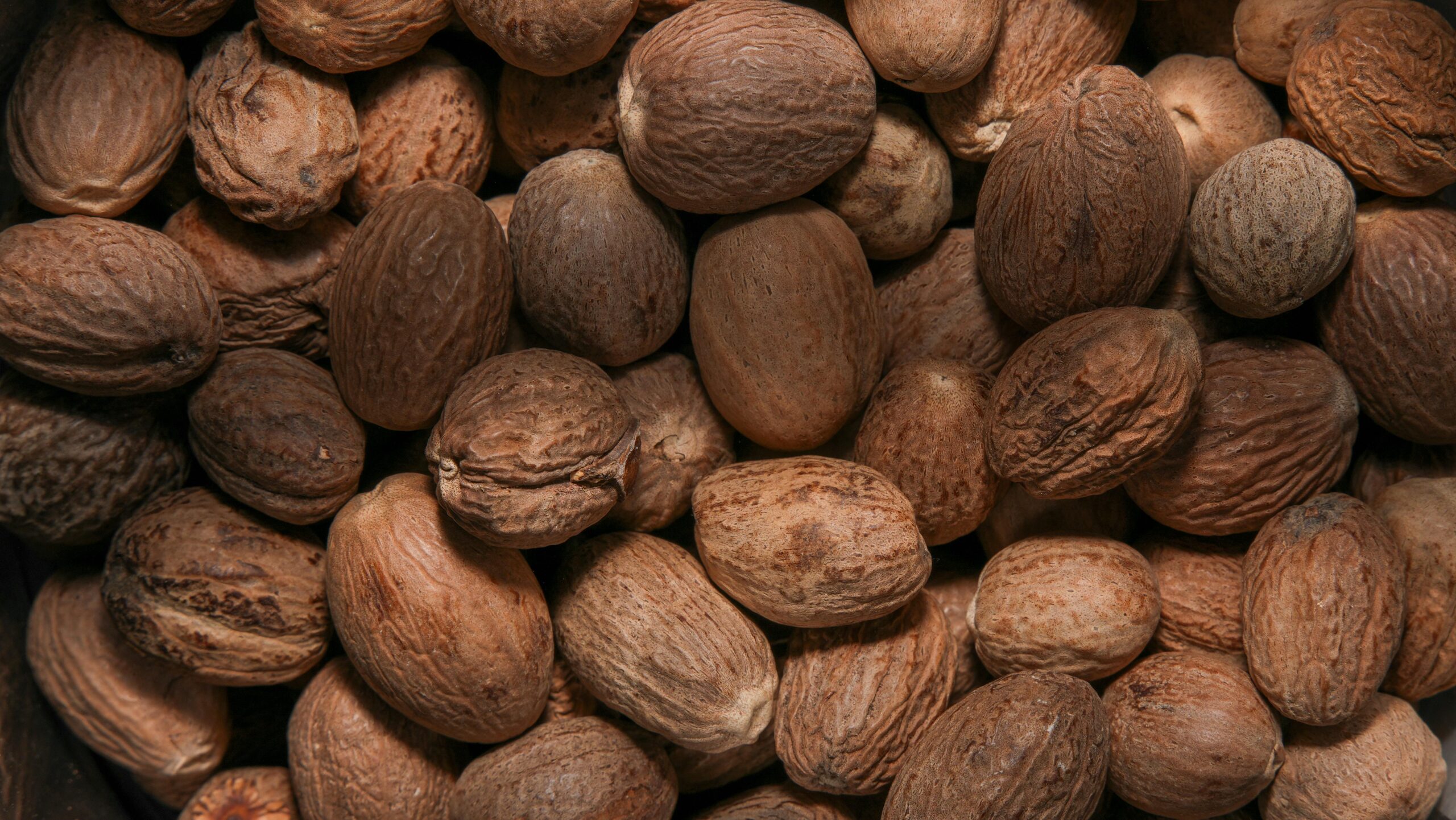
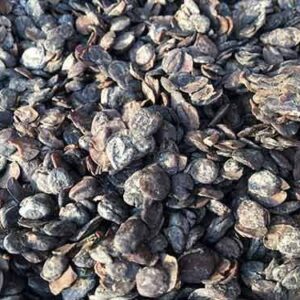
The seed (nutmeg) — the inner seed surrounded by a hard shell (testa) that is removed to reveal the actual nutmeg: the pale brown, oval seed approximately 2–3cm long whose inner surface shows the characteristic mottled pattern of dark aromatic oil cells distributed through the starchy seed tissue. The nutmeg seed is dried — typically for 6–8 weeks in the hot sun or through mechanical hot-air drying — then either sold whole (with or without shell), ground into powder, steam-distilled into essential oil, or solvent-extracted into nutmeg butter.
The Critical Commercial Disambiguation — True Nutmeg vs. African Nutmeg
This disambiguation is the most commercially important clarification in the Nigerian nutmeg market — and failing to make it explicitly in buyer conversations is the source of the most expensive procurement errors in West African spice purchasing:
True nutmeg (Myristica fragrans, Myristicaceae family) — the product of this article — is the international spice of commerce whose myristicin content, trimyristin fatty acid profile, and aromatic compound suite have been standardised in international pharmacopoeias and food additive regulations. It is warm, sweet, intensely aromatic, and slightly resinous in flavour. This is what food manufacturers, fragrance houses, and pharmaceutical buyers specify when they say “nutmeg.”
African nutmeg / Ehuru / Calabash nutmeg (Monodora myristica, Annonaceae family) — a completely different species from a completely different botanical family — is the traditional West African spice used in pepper soup and native soups. It is commercially significant in the diaspora food market and the West African restaurant supply chain, but it is not interchangeable with true nutmeg in any food manufacturing, pharmaceutical, or fragrance application. Its flavour profile — deeper, more camphor-like, slightly bitter — is distinct from Myristica fragrans. Its phytochemical profile is entirely different.
Paradise MultiTrade supplies both products as clearly differentiated, separately documented product lines. Contact our team to confirm which product your application requires — and to receive botanical species identity documentation confirming the species on every lot we supply.
The Phytochemical Profile — Myristicin, Elemicin, and the Chemistry of Nutmeg’s Commercial Value
The commercial value of Myristica fragrans across food manufacturing, pharmaceutical, fragrance, and traditional medicine applications is determined by a complex mixture of volatile aromatic compounds and fixed fatty acids whose concentrations and specific compositions define quality and determine application suitability:
Myristicin — approximately 4–8% of the essential oil — the primary aromatic compound responsible for nutmeg’s characteristic warm, slightly narcotic aromatic intensity and the compound whose pharmacological properties have attracted the most pharmaceutical research attention. Myristicin is a phenylpropanoid compound — chemically related to safrole and elemicin — whose documented monoamine oxidase (MAO) inhibitory activity, documented through research accessible via NCBI’s pharmacology database, gives nutmeg oil its historically documented mood-altering properties at high concentrations. At normal culinary concentrations, myristicin contributes to the characteristic warm, complex aromatic character that makes nutmeg irreplaceable in specific food formulation applications.
Elemicin — approximately 2–5% of the essential oil — the second major phenylpropanoid aromatic compound, contributing floral and slightly spicy aromatic notes that complement myristicin’s warmth and contribute to the overall aromatic complexity that distinguishes high-quality nutmeg essential oil from lower-grade alternatives.
Sabinene — approximately 10–30% of the total essential oil — the dominant monoterpene aromatic compound, contributing the characteristic fresh, woody, slightly peppery top note of nutmeg essential oil and providing the aroma foundation upon which myristicin and elemicin’s warmer basal notes sit.
Alpha-Pinene and Beta-Pinene — approximately 10–18% combined — the pine-like terpene compounds contributing freshness and lift to nutmeg essential oil’s aromatic profile and providing some of the antimicrobial properties documented through NCBI’s food safety and antimicrobial research database.
Eugenol — approximately 1–4% — the same compound that dominates clove essential oil, contributing warm, slightly medicinal spiciness and significant antimicrobial activity to nutmeg’s compound profile.
Trimyristin (fixed oil / nutmeg butter) — approximately 25–40% of total seed weight — the primary fatty acid triglyceride that constitutes nutmeg butter, dominated by myristic acid (C14:0) at approximately 70–75% of total fatty acids. Nutmeg butter — solid at room temperature, melting at approximately 45°C — is a separate commercial product extracted from the de-oiled seed cake through solvent extraction or supercritical CO₂ extraction, used in cosmetics, pharmaceutical formulation, and specialty food fat applications.
Essential oil content — approximately 5–15% of dried nutmeg seed weight — available through steam distillation, producing the pale yellow to colourless essential oil whose aromatic complexity drives the fragrance, flavour, and pharmaceutical applications that command the highest per-kilogram pricing in the nutmeg product range.
The Five Commercial Product Forms
Whole Dried Nutmeg (with shell) — the most traditional and most stable form, sold as whole round dried nuts whose hard outer shell provides protection against aromatic compound loss during storage and transport. Preferred by buyers who grind fresh to order, by spice retail buyers who sell whole nutmeg for consumer grating, and by distillers who source whole nutmeg for botanical processing.
Whole Dried Nutmeg (shelled / without shell) — the outer testa removed to expose the nutmeg seed directly — preferred by food manufacturing buyers who process nutmeg in-house and who do not need the shell’s protection during their relatively rapid production cycle.
Nutmeg Powder — finely milled shelled nutmeg for direct incorporation into food manufacturing seasoning systems, baked goods flavouring, meat processing seasonings, and retail spice packs. Powder has shorter aromatic shelf life than whole nutmeg — 6–12 months versus 3–4 years for properly stored whole nutmeg — but provides immediate incorporation convenience.
Nutmeg Essential Oil — steam-distilled from dried, comminuted (coarsely ground) nutmeg seed, producing the pale yellow to water-white essential oil whose aromatic compound profile makes it one of the most commercially versatile spice essential oils in the fragrance, food flavour, and pharmaceutical industries. Essential oil yield varies from 5–15% by seed weight depending on origin quality and distillation efficiency.
Nutmeg Butter (Expressed Nutmeg Oil) — the fixed fat extracted from nutmeg after essential oil removal or directly from whole seed through solvent extraction or supercritical CO₂ — a solid, red-orange to pale yellow fat dominated by trimyristin whose cosmetics, pharmaceutical excipient, and specialty food fat applications create a distinct commercial market from the essential oil.
Mace (from the same fruit) — available as whole blade mace (dried flattened aril) or ground mace powder — the premium companion spice whose delicate, floral aromatic profile commands prices 20–40% higher than equivalent-grade nutmeg in most international spice markets.
Benefits and Industrial Uses of Nigerian Nutmeg
Food Manufacturing Industry — The Irreplaceable Warming Spice of Global Cuisine
Nutmeg’s position in global food manufacturing is both commercially enormous and culturally specific — its use is so deeply embedded in the culinary traditions of European, Middle Eastern, South Asian, Southeast Asian, and Caribbean cuisine that the global food manufacturing industry’s nutmeg procurement runs continuously regardless of price cycles, driven by the compound’s genuine irreplaceability in specific applications:
Baked goods and confectionery — nutmeg is a mandatory spice in multiple European Christmas baking traditions whose production volume runs into hundreds of millions of units annually. German Lebkuchen (spiced gingerbread), Dutch speculaas (windmill cookies), British Christmas pudding and mince pies, French pain d’épices, and Scandinavian julekake all specify nutmeg as a core flavour component whose absence is immediately detectable by consumers with generational flavour familiarity. For the European food manufacturing companies whose Christmas confectionery production constitutes their highest-revenue quarter — nutmeg procurement planning is a multi-tonne annual commitment that requires reliable, quality-consistent supply documentation. Market intelligence on the European baked goods ingredient market is published by Mintel’s European food innovation database confirming nutmeg’s sustained category significance.
Meat processing and charcuterie — nutmeg is one of the defining spice ingredients in European meat processing traditions — specifically in German sausage production, Dutch frikandel and meat snack formulation, Belgian pâté and terrine seasoning, and the broader European charcuterie tradition whose spice blend specifications have been standardised over generations. The Verband der Fleischwirtschaft (VdF) — Germany’s meat processing industry association — tracks nutmeg’s commercial significance within European meat processing spice procurement. This application creates consistent, volume-significant procurement demand from European meat processing companies whose production scales run into thousands of tonnes of seasoned product annually.
Dairy product flavouring — nutmeg’s specific contribution to béchamel sauce and cream sauce formulation — where its warmth provides the background aromatic depth that transforms a simple white sauce into a complex flavour experience — makes it a standard ingredient in cream sauce manufacturing for ready meal producers, pasta sauce manufacturers, and food service sauce producers across Europe. The European Dairy Association (EDA) tracks ingredient trends across European dairy product formulation.
Beverages — nutmeg’s role in egg-based drinks (eggnog, advocaat), mulled wine and cider formulations, craft cocktail bitter formulations, and the growing category of warming winter beverage products creates sustained procurement demand from beverage manufacturers whose seasonal production planning requires nutmeg supply in reliable, consistent volumes. Craft gin botanical bills — discussed in the habanero and uziza articles — increasingly incorporate Nigerian nutmeg as an authentic West African botanical alongside alligator pepper and uziza for gin products specifically positioned around African botanical ingredients. The UK Craft Distillers Association and American Craft Spirits Association (ACSA) track botanical spice adoption trends in craft spirits formulation.
Curry powder and spice blend manufacturing — nutmeg is a component of multiple traditional spice blend formulations including specific British curry powder blends, Indonesian bumbu spice pastes, and Caribbean jerk seasoning systems where its warm aromatic depth contributes background complexity that simpler spice combinations cannot replicate. For spice blend manufacturers including established brands such as Schwartz (McCormick), Ducros, and Verstegen — consistent-quality nutmeg powder with documented ASTA colour value and volatile oil content is a procurement priority whose annual volumes run into significant tonnage.
For food manufacturing buyers evaluating Nigerian whole nutmeg and nutmeg powder, contact our export team to discuss grade specifications, ASTA colour value documentation, and supply arrangements.
Pharmaceutical Industry — From Ancient Apothecary to Modern Excipient
Nutmeg’s pharmaceutical history is documented in virtually every major traditional medicine pharmacopeia in existence — from the Ayurvedic medical texts that describe Jatiphala as a remedy for digestive disorders, vomiting, and diarrhoea through the Arab Islamic medical tradition’s use of Jawzat at-tib for digestive and neurological conditions through the European medieval apothecary tradition where nutmeg was prescribed for everything from plague prevention through childbirth support through general fortification:
Pharmacopoeial excipient — nutmeg oil — nutmeg essential oil is listed in the United States Pharmacopeia (USP) as an official pharmaceutical flavouring agent — used to mask the bitter taste of pharmaceutical preparations and as an aromatic component in pharmaceutical topical preparations. The European Pharmacopoeia (Ph. Eur.) similarly recognises nutmeg oil within its natural aromatic ingredient framework. For pharmaceutical buyers sourcing food-grade and pharmaceutical-grade nutmeg essential oil — documentation confirming myristicin content, absence of synthetic adulterants, and compliance with pharmacopoeial specifications is the primary analytical requirement.
Nutmeg butter pharmaceutical applications — nutmeg butter’s trimyristin-dominated fatty acid profile gives it specific pharmaceutical excipient properties: its melting point (approximately 45–50°C) makes it a candidate suppository base with appropriate body-temperature melting behaviour, and its myristic acid content’s documented skin penetration enhancement properties create transdermal drug delivery vehicle applications documented through pharmaceutical formulation research published in the International Journal of Pharmaceutics.
Traditional medicine and Ayurvedic pharmaceutical applications — the Ayurvedic Pharmacopoeia of India formally recognises Jatiphala (nutmeg) as a pharmaceutical-grade Ayurvedic drug substance — used in preparations for digestive disorders (Krimighna action), neurological support, and reproductive health management. Ayurvedic pharmaceutical manufacturers globally source authenticated nutmeg in both whole seed and essential oil forms as raw materials for registered Ayurvedic medicinal preparations.
Myristicin pharmacology research — myristicin’s documented monoamine oxidase (MAO) inhibitory activity — reviewed through NCBI’s neuropharmacology research database — has attracted pharmaceutical research interest as part of the broader investigation of naturally occurring MAO inhibitors for antidepressant and neuroprotective applications. For pharmaceutical natural product research institutions investigating myristicin as a drug candidate or drug-interaction compound — authenticated Nigerian nutmeg essential oil with documented myristicin content provides the appropriate starting raw material.
Antimicrobial pharmaceutical applications — nutmeg essential oil’s broad-spectrum antimicrobial activity — documented through NCBI’s antimicrobial pharmacology research against bacterial, fungal, and some viral pathogens — has attracted pharmaceutical research interest in the context of the global antimicrobial resistance crisis and the pharmaceutical industry’s ongoing search for novel natural antimicrobial compound leads.
For pharmaceutical-grade nutmeg essential oil and nutmeg butter procurement with documented myristicin content and pharmacopoeial compliance testing, contact Paradise MultiTrade to discuss sourcing requirements.
Fragrance and Fine Perfumery Industry — The Warm Spice Heart Note
Nutmeg essential oil occupies one of the most commercially well-established positions in natural perfumery — a heart note ingredient whose specific aromatic contribution (warm, spicy, slightly sweet, faintly woody, with underlying complexity from myristicin and elemicin) appears in both classic and contemporary fragrance formulations across luxury, premium, and mass-market perfumery:
Fine fragrance application — nutmeg essential oil appears in the heart and base of multiple iconic fragrance compositions — from classic masculine fougères through oriental spice compositions through contemporary unisex fragrances. The International Fragrance Association (IFRA) publishes standards for nutmeg essential oil use in fragrance — confirming its approved status in leave-on and rinse-off personal care fragrance applications with specific concentration limits for certain sensitising components. The Research Institute for Fragrance Materials (RIFM) maintains the global fragrance ingredient safety assessment database that includes nutmeg essential oil’s complete safety profile.
Aromatherapy and wellness products — nutmeg essential oil’s documented warming, analgesic, and digestive support properties — cited through traditional medicine research in the Journal of Ethnopharmacology — make it one of the most commercially established aromatherapy essential oils for musculoskeletal pain management, digestive wellness, and general warming comfort applications. The National Association for Holistic Aromatherapy (NAHA) represents the professional aromatherapy community whose procurement of therapeutic-grade nutmeg essential oil is documented through the professional essential oil supply market.
Cosmetics fragrance applications — nutmeg essential oil appears in the fragrance components of premium personal care products including body lotions, shaving preparations, beard care products, and premium soap formulations where its warm, masculine-adjacent spice character contributes to sophisticated product fragrance profiles. The Cosmetic Ingredient Review (CIR) has reviewed nutmeg oil in cosmetics — confirming its safety profile for use in rinse-off and leave-on cosmetics formulations.
Natural fragrance ingredient sourcing — the natural perfumery movement’s demand for authentic, documented-origin botanical essential oils — documented through CBI Netherlands market intelligence on natural cosmetics ingredients — creates growing procurement interest in West African origin nutmeg essential oil for natural fragrance houses who want authentic African botanical provenance alongside Indonesian-origin material. For natural fragrance buyers specifically seeking West African nutmeg essential oil, contact our team to discuss essential oil supply and GC composition documentation.
Nutraceutical and Dietary Supplement Industry
Nutmeg’s nutraceutical applications are built across three distinct evidence-based health positioning dimensions:
Digestive health supplements — nutmeg’s documented efficacy in digestive symptom management — specifically its antidiarrhoeal, carminative, and digestive enzyme stimulating properties documented through traditional medicine research and limited clinical pharmacology accessible via NCBI — creates nutraceutical product development interest in nutmeg extract as a digestive health supplement active. The Natural Products Association (NPA) tracks nutmeg-containing supplement development within the broader digestive health supplement category.
Sleep support and relaxation formulations — nutmeg’s traditional use as a mild sedative and sleep aid — documented across Ayurvedic, Unani, and European herbal medicine traditions — has attracted nutraceutical product development interest in low-dose nutmeg extract supplements positioned for natural sleep support. The myristicin component’s MAO inhibitory and mild psychoactive properties at sub-toxic concentrations provide a pharmacological basis for this positioning, though responsible nutraceutical brands carefully manage dosage communication given myristicin’s toxicity at high concentrations.
Joint and muscle comfort supplement applications — nutmeg essential oil and extract’s documented analgesic and anti-inflammatory properties — reviewed through NCBI’s pain and inflammation research database — create topical supplement and oral supplement formulation interest in nutmeg as a natural pain management active for the growing joint health supplement category.
Cosmetics and Personal Care — Nutmeg Butter as a Premium Emollient
Nutmeg butter’s cosmetics applications are anchored in its specific fatty acid profile — trimyristin-dominated, with a melting point and skin feel that gives it specific cosmetics functionality:
Lip care — nutmeg butter’s relatively low melting point (approximately 45°C) and its myristic acid-dominated fatty acid profile give it a melting-on-skin behaviour that makes it valued in lip care formulation — contributing to the smooth, protective film that premium lip balm and lip treatment products require. Its warm, slightly spiced natural aroma adds an authentic natural character to unfragranced or minimally fragranced lip care products.
Body butter and intensive moisturisation — nutmeg butter incorporated into body butter formulations — alongside shea butter, cocoa butter, and coconut oil — provides the specific myristic acid-based skin penetration that distinguishes premium body butter from simple oil-based moisturisers. Myristic acid’s documented role in skin penetration enhancement — reviewed through cosmetics science research in the International Journal of Cosmetic Science — gives nutmeg butter a functional moisturisation mechanism that simple emollient fats cannot replicate.
Artisan soap making — nutmeg butter incorporated into cold process and hot process artisan soap formulations contributes a characteristic creamy lather, skin conditioning, and mild natural fragrance that distinguishes premium artisan soap from standard bar soap. The Handcrafted Soap and Cosmetics Guild (HSCG) references nutmeg butter within its artisan soap formulation educational resources.
Hair care conditioning — nutmeg butter’s myristic acid component and its specific penetration properties make it a valued conditioning ingredient in hair butter formulations for Afro-textured hair care — where the combination of deep moisture penetration and the light, non-waxy finish that myristic acid provides are specifically valued. The CBI Netherlands natural cosmetics ingredient intelligence documents West African spice-derived butters as a growing European natural cosmetics ingredient category.
Traditional Medicine and Herbal Products
Nutmeg’s traditional medicine applications across Ayurvedic, Unani, West African, and Caribbean healing traditions create consistent procurement demand from herbal product companies, Ayurvedic pharmaceutical manufacturers, and ethnobotanical supplement brands:
Digestive herbal preparations — nutmeg’s traditionally documented role in managing diarrhoea, dysentery, nausea, and digestive discomfort across multiple independent traditional medicine systems creates herbal product demand from manufacturers whose traditional digestive formulations specify Jatiphala (nutmeg) as a primary or supporting active. The World Health Organization’s traditional medicine programme recognises nutmeg within documented traditional medicine application frameworks.
Women’s health and tonic preparations — nutmeg’s traditional use in several West African and Caribbean healing traditions for menstrual regulation, postpartum support, and general women’s health tonic formulation creates procurement interest from herbal product brands developing culturally authentic women’s wellness product lines for diaspora and mainstream markets.
Why Buy Nutmeg From Nigeria?
The Dual-Product Yield — Commercial Efficiency No Other Spice Crop Matches
The single most commercially compelling argument for Nigerian nutmeg cultivation and export development is the dual-product yield structure that no other commonly cultivated spice crop provides. Every nutmeg fruit harvested from a productive Nigerian plantation or farm garden produces both nutmeg seed and mace from the same harvest operation at the same labour cost. The mace commands premium pricing — typically 20–40% above equivalent-grade nutmeg — and is fully available as a co-product that Nigerian nutmeg processors can either supply alongside nutmeg to the same buyer or sell into a separate mace-specific market channel.
For international buyers evaluating Nigerian nutmeg procurement — the availability of authenticated Nigerian mace alongside nutmeg from the same documented supply chain creates a procurement consolidation opportunity that single-product spice exporters cannot offer. Contact our team to discuss combined nutmeg and mace procurement from Nigerian origin.
Supply Diversification From Indonesia’s 75–80% Global Market Dominance
Indonesia — specifically the island provinces of North Maluku (Ternate, Tidore, and the original Banda Islands) and West Sumatra — accounts for approximately 75–80% of global nutmeg and mace production according to FAO production statistics and international trade intelligence from ITC Trade Map. This concentration — the most extreme of any major spice commodity in the global spice trade — creates structural supply risk for every food manufacturer, fragrance house, and pharmaceutical buyer who sources nutmeg and mace without diversified origin coverage.
Indonesia’s El Niño drought years — when the Maluku Islands’ rainfall patterns are disrupted by Pacific Ocean temperature anomalies — periodically create significant nutmeg production shortfalls that ripple through the global spice supply chain as price spikes and supply shortages. The World Bank’s commodity price monitoring programme documents this nutmeg price volatility — with historical price swings of 40–100% within single crop years during severe El Niño events. Nigeria provides West African supply diversification from this Indonesian concentration — a supply chain risk management investment that procurement teams at serious food manufacturing companies should be making proactively rather than reactively.
India (Grenada) — the second significant nutmeg origin through its Kerala state production — provides some geographic diversity but remains closely price-correlated with Indonesian origin. Nigerian origin provides genuine supply chain independence from both major origins. Market intelligence for global nutmeg trade is tracked through Tridge’s nutmeg commodity intelligence platform — providing the price and supply flow data that procurement teams use to evaluate the timing and economics of Nigerian origin development.
Essential Oil Quality — The Distillation Advantage
Nigerian nutmeg essential oil distilled from whole fresh-ground Nigerian-origin seed carries the specific aromatic compound profile that experienced fragrance and flavour buyers evaluate: myristicin content in the range appropriate for premium fragrance application, sabinene-dominant terpene profile providing the characteristic nutmeg fresh top note, and the eugenol and elemicin minor compound contributions that distinguish quality nutmeg essential oil from adulterated or reconstituted alternatives.
Gas chromatography (GC) analysis of nutmeg essential oil — the analytical standard used by the American Spice Trade Association (ASTA) and the European Spice Association (ESA) for quality verification — provides the complete aromatic compound fingerprint that fragrance buyers and pharmaceutical buyers use to verify authenticity and quality. We coordinate GC analysis on all nutmeg essential oil export lots. Contact us to discuss GC composition documentation requirements.
Complete Export Documentation from a Licensed Exporter
Every nutmeg shipment processed through Paradise MultiTrade carries phytosanitary certification from the Nigerian Agricultural Quarantine Service (NAQS), NEPC export documentation, certificate of origin, botanical species identity confirmation (Myristica fragrans — not Monodora myristica or any other species), commercial invoice, packing list, and bill of lading. For food-grade buyers, we coordinate ASTA colour value, volatile oil content, moisture content, pesticide residue screening, aflatoxin testing, and microbiological safety certification following AOAC International validated procedures. For fragrance and pharmaceutical buyers requiring essential oil GC analysis, we coordinate complete GC compound profile documentation through accredited analytical laboratories. EU-bound shipments comply with Regulation (EU) 2017/625 on official controls for food and botanical imports. Our NEPC Export Licence No. 0042385 and CAC Registration No. RC-9284647 are current and verifiable through NEPC.
Nigeria’s Nutmeg Export Strength and Global Market Demand
The Global Market — Sustained Demand From Multiple Independent Industries
The global nutmeg and mace market — tracked through Grand View Research’s nutmeg market analysis and Mordor Intelligence’s spice market intelligence — is valued at hundreds of millions of USD with consistent growth driven by expanding food manufacturing production across Asian and Middle Eastern markets, growing natural fragrance industry demand for authentic spice essential oils, and the Ayurvedic and traditional medicine market’s sustained consumption of authenticated nutmeg as a pharmaceutical raw material.
The International Spice Group (ISG) — the global trade association for the international spice industry — tracks nutmeg trade flows and quality standards across all major origins. The American Spice Trade Association (ASTA) and European Spice Association (ESA) publish the analytical quality standards — including volatile oil content minimums, colour value specifications, and microbiological limits — that define premium-grade nutmeg procurement for European and American buyers.
Key Export Destination Markets
The Netherlands and Germany — Europe’s primary spice processing and wholesale distribution hubs — are the most commercially significant European destinations for Nigerian nutmeg. Dutch spice processors including McCormick Netherlands, Euroma, and multiple specialty spice companies process imported whole nutmeg into powder, extract, and essential oil for distribution across the European food manufacturing market. The CBI Netherlands market intelligence on spice exports for developing countries provides direct market entry guidance for Nigerian nutmeg development targeting European buyers.
The United Kingdom — whose Christmas baking tradition is among Europe’s most nutmeg-intensive and whose craft spirits industry is among the most active in adopting West African botanical ingredients — is a priority European destination for Nigerian nutmeg at both food manufacturing and craft spirits scales.
India — simultaneously a nutmeg-producing nation and a significant consumer for Ayurvedic pharmaceutical preparation — imports nutmeg during domestic supply shortfalls and presents a pharmaceutical ingredient buyer community whose Ayurvedic Pharmacopoeia of India specification requirements are directly relevant to Nigerian nutmeg quality standards.
The Middle East — where nutmeg use in Arabic spice blends (baharat, ras el hanout) and meat seasoning systems creates consistent food manufacturing procurement — is a growing destination market tracked through ADAFSA’s food import intelligence and Gulf food manufacturing sector data.
The United States — whose annual eggnog and holiday baking season creates peak nutmeg procurement demand in the October–December window — is a significant destination for Nigerian whole nutmeg and nutmeg powder. US food import compliance for spices is administered through the FDA’s food import programme with specific attention to aflatoxin and pesticide residue compliance.
Japan — whose food manufacturing sector’s precision ingredient specification standards and natural essential oil fragrance market’s quality expectations are among the most exacting globally — represents a premium destination for documented-quality Nigerian nutmeg essential oil and whole seed. Japanese food and fragrance import intelligence is tracked through JETRO.
Indonesia — paradoxically, Indonesia’s domestic nutmeg processing industry creates periodic import demand during domestic supply shortfalls from competing islands — creating an opportunistic export channel for Nigerian nutmeg into the world’s dominant producing nation during deficit years.
Why Choose Paradise MultiTrade International Limited?
The Critical Species Disambiguation — Written Into Every Contract. We formally document botanical species identity — Myristica fragrans versus Monodora myristica — on every nutmeg export lot’s certificate of analysis and botanical identity declaration. This documentation commitment is not a supplementary service — it is the foundational quality assurance step that protects buyers from the most commercially expensive nutmeg procurement error in West African spice sourcing. Contact us immediately if any alternative supplier you are evaluating cannot provide written botanical species confirmation.
Both Nutmeg and Mace Available from the Same Harvest. We supply Nigerian whole dried nutmeg (shelled and unshelled), nutmeg powder, nutmeg essential oil, nutmeg butter, and mace (blade and powder) — all from the same documented Nigerian origin supply network. Buyers who want to source both spices from a single West African export partner can consolidate both procurement relationships through Paradise MultiTrade. Contact our team to discuss combined nutmeg and mace supply.
Essential Oil GC Analysis as Standard for Fragrance and Pharmaceutical Buyers. We coordinate complete gas chromatography aromatic compound profile documentation — including myristicin, elemicin, sabinene, alpha-pinene, eugenol, and total volatile oil percentage — on every nutmeg essential oil export lot, providing the analytical documentation that fragrance houses, pharmaceutical ingredient buyers, and natural flavour companies require for ingredient identity verification and application performance prediction. Contact us to discuss GC analysis documentation.
Supply Diversification Programme for Indonesia-Concentrated Buyers. We specifically serve buyers who are building Nigerian origin positions as strategic diversification from Indonesian-concentrated nutmeg procurement. We structure supply arrangements that allow buyers to maintain their existing Indonesian relationships while progressively building Nigerian origin volume — creating the supply chain redundancy that serious procurement risk management requires. Contact our team to discuss parallel-origin supply programme structuring.
Multi-Commodity West African Spice Sourcing. Nutmeg buyers frequently source complementary Nigerian spice commodities. Alongside nutmeg, Paradise MultiTrade exports cloves, habanero pepper, uziza seed, alligator pepper, fresh ginger, dry split ginger, turmeric, chilli pepper, moringa seeds, hibiscus flower, sesame seeds, bitter kola, cashew nut kernel, and raw cashew nuts. Explore our full range of Nigerian export commodities and consolidate your West African spice and botanical ingredient sourcing through one verified, licensed export partner.
Product Specifications
| Specification | Details |
|---|---|
| Product | Nigerian Nutmeg (Myristica fragrans) and Mace |
| Common Names | Nutmeg, Jatiphala (Ayurvedic/Sanskrit), Jawzat at-tib (Arabic), Muscade (French), Muskat (German) |
| Botanical Species | Myristica fragrans Houtt. (Myristicaceae) — confirmed botanical identity documentation provided |
| Origin | Nigeria (Ondo, Ogun, Cross River, Akwa Ibom, Rivers, Delta States) |
| Forms Available | Whole dried nutmeg (shelled); Whole dried nutmeg (unshelled); Nutmeg powder; Nutmeg essential oil (steam distilled); Nutmeg butter (fixed oil); Mace (blade/whole); Mace powder |
| Volatile Oil Content (Seed) | Minimum 5% v/w (ASTA method) — typically 8–12% in quality Nigerian material |
| Myristicin Content (Oil) | 4–8% of total essential oil (GC documented) |
| Sabinene Content (Oil) | 10–30% of total essential oil (GC documented) |
| ASTA Colour Value | 3.0+ (whole nutmeg reference standard) |
| Moisture Content | ≤10% (whole); ≤8% (powder) |
| Foreign Matter | ≤0.5% |
| Aflatoxin | Screened per EU maximum limits (B1 ≤2 ppb; Total ≤4 ppb) |
| Pesticide Residue | Multi-residue analysis to EU MRL standards — standard for all EU-bound lots |
| Microbiological | Total viable count, Salmonella (absent/25g), E. coli per food safety standards |
| Mace: Volatile Oil Content | Minimum 4% v/w |
| Nutmeg Butter: Myristic Acid | 65–75% of total fatty acids |
| Nutmeg Butter: Melting Point | 45–52°C |
| Packaging Options | 25kg, 50kg polypropylene bags (whole/powder); drums (essential oil/butter); retail packs on request |
| Supply Capacity | Whole nutmeg: 10–200+ MT per season; Essential oil: 100–1,000+ kg; Butter: 500kg–10+ MT |
| MOQ | Whole nutmeg: 2 MT; Powder: 1 MT; Essential oil: 50kg; Butter: 100kg; Mace: 500kg |
| Shelf Life | Whole (unshelled): 3–4 years; Whole (shelled): 12–18 months; Powder: 6–12 months; Oil: 12–24 months; Butter: 18–24 months |
| Export Documentation | Phytosanitary Certificate (NAQS), Botanical Species Identity Certificate, Certificate of Origin, NEPC Export Licence, ASTA Colour/Volatile Oil Certificate, GC Essential Oil Profile (oil grade), Pesticide Residue Certificate, Aflatoxin Certificate, Microbiological Certificate, Commercial Invoice, Packing List, Bill of Lading |
| Payment Terms | T/T, Letter of Credit (LC at sight), Escrow |
| Loading Port | Lagos (Apapa / Tin Can Island Port), Nigeria |
| Incoterms Available | EXW, FOB Lagos, CNF, CIF |
Packaging and Export Process
Fruit Harvest and Initial Processing. Myristica fragrans fruits ripen and split naturally — the outer fleshy pericarp splitting open to reveal the red mace-covered seed within. Harvest timing requires careful monitoring: fruits harvested before full maturity have lower volatile oil content and lower mace quality; fruits left past optimal maturity lose volatile oil through evaporation. The mace is removed first — carefully peeled away from the nutmeg seed by hand, flattened, and transferred immediately to drying racks to preserve its brilliant red colour and prevent fermentation.
Mace Drying. Fresh blade mace is spread on drying platforms in the sun — or through mechanical drying at controlled temperatures below 55°C — for 10–14 days until fully dried to below 10% moisture. Proper mace drying at this low temperature preserves the characteristic orange-yellow colour and aromatic quality that premium buyers specify. Over-dried or heat-damaged mace loses colour and aromatic intensity rapidly.
Nutmeg Seed Drying. After mace removal, nutmeg seeds (still in their hard outer shell) are dried — traditionally through 6–8 weeks of slow sun drying — until the kernel within the shell rattles audibly when shaken, indicating that drying is complete and the kernel has separated from the inner shell surface. Mechanical drying at 40–50°C accelerates this process to 2–3 weeks while preserving volatile oil content more effectively than prolonged sun exposure.
Shelling. Dried nutmeg in shell is passed through mechanical cracking equipment to remove the outer testa — producing shelled whole nutmeg ready for direct sale or further processing. Shell percentage yield is approximately 20–25% of total dried fruit weight — the shell itself having minor commercial value as garden mulch or boiler fuel.
Grading and Quality Verification. Shelled whole nutmeg is graded by size — typically expressed as a count per kilogram (110, 80, 60 count per 500g, etc.) — with larger nutmegs commanding premium pricing in whole nut retail markets. ASTA colour value and volatile oil content by steam distillation are measured on representative lot samples before export documentation preparation.
Essential Oil Distillation. Nutmeg designated for essential oil production is coarsely ground (comminuted) and subjected to steam distillation in purpose-built copper or stainless steel distillation equipment — with distillation runs of 6–10 hours extracting approximately 8–12% oil from quality Nigerian seed. The distillate is separated, dried over anhydrous sodium sulphate, and stored in amber glass or stainless steel containers under nitrogen headspace before GC analysis and export documentation.
Nutmeg Butter Extraction. Following essential oil distillation or from whole shelled nutmeg, nutmeg butter is extracted through solvent extraction (hexane) or supercritical CO₂ extraction — with solvent-extracted butter requiring subsequent solvent removal through evaporation before cosmetics or pharmaceutical application. Supercritical CO₂-extracted nutmeg butter retains a fuller aromatic compound profile and is preferred for premium cosmetics applications.
Pesticide and Aflatoxin Testing. All EU, UK, and North American-bound lots undergo multi-residue pesticide analysis and aflatoxin B1 and total aflatoxin screening through accredited laboratory partners before loading confirmation.
Lead Times. Whole dried nutmeg: 14–21 days from order to container loading. Powder: 21–28 days. Essential oil: 28–42 days (distillation scheduling and GC analysis add lead time). Nutmeg butter: 28–42 days. Contact us early — particularly for essential oil orders where distillation scheduling must be planned in advance.
Frequently Asked Questions
What is the difference between Nigerian nutmeg (Myristica fragrans) and African nutmeg (Monodora myristica) — are they the same product?
No — they are completely different plants from different botanical families that share only the word “nutmeg” in their common names. True nutmeg (Myristica fragrans, Myristicaceae) is the international spice of commerce — the seed whose myristicin-rich essential oil drives food manufacturing, fragrance, and pharmaceutical applications globally. African nutmeg / Ehuru (Monodora myristica, Annonaceae) is a traditional West African spice used in Nigerian pepper soup and native soups — botanically unrelated to true nutmeg, with a completely different chemical profile and flavour character. The two products serve completely different markets and are not interchangeable in any food manufacturing, pharmaceutical, or fragrance application. Paradise MultiTrade supplies both products as clearly documented, separately identified product lines with botanical species confirmation on every lot. Contact us to confirm which product your application requires.
What volatile oil content should I specify for food manufacturing nutmeg procurement?
The American Spice Trade Association (ASTA) sets minimum volatile oil content of 5% (v/w) for food-grade whole nutmeg — which is the baseline specification for standard food manufacturing procurement. Premium-grade Nigerian nutmeg from quality-managed harvests typically delivers 8–12% volatile oil — significantly above the ASTA minimum and reflecting the quality-optimal harvest timing and drying protocols that Paradise MultiTrade mandates for export-grade supply. For food manufacturers whose product formulation depends on a specific aromatic intensity — we recommend specifying minimum 7% volatile oil content as a quality-above-baseline procurement standard. ASTA volatile oil content determination by steam distillation is documented per lot on request. Contact us to discuss volatile oil specification.
What GC compound profile should fragrance and pharmaceutical buyers specify for nutmeg essential oil?
For fragrance application — specify minimum 4% myristicin, 10–30% sabinene, and total eugenol below 2% (high eugenol indicates adulteration with clove oil or eugenol addition). Complete GC compound profile including myristicin, elemicin, sabinene, alpha-pinene, beta-pinene, terpinene-4-ol, and eugenol should be documented per lot. For pharmaceutical application referencing USP nutmeg oil monograph — specify conformance to USP nutmeg oil identity criteria including specific gravity 0.880–0.910, optical rotation, and refractive index alongside GC compound profile. For aromatherapy application — the complete GC profile documentation plus absence of synthetic adulterants (testing for synthetic terpene additions) is the standard quality requirement. We coordinate complete GC analysis through accredited laboratories. Contact us to build your specific essential oil analytical package.
How does Nigerian nutmeg quality compare to Indonesian origin material?
Nigerian Myristica fragrans — the same botanical species as Indonesian origin — produces nutmeg whose volatile oil content, ASTA colour value, and aromatic compound profile fall within the commercially acceptable range for the same applications Indonesian nutmeg serves. The primary commercial differentiation is not quality but supply chain origin and availability — Nigerian origin provides West African supply diversification from Indonesia’s 75–80% global market dominance, with the specific transit time advantage to European ports (14–20 days from Lagos versus 25–35 days from Indonesian origins) that is commercially relevant for buyers managing inventory cycles. For buyers who want to verify Nigerian versus Indonesian quality equivalence analytically — we supply comparative samples for independent GC and ASTA analysis at accredited laboratories. Contact us to arrange comparative sample supply.
Is mace available alongside nutmeg from Nigerian origin and what does it cost relative to nutmeg?
Yes — mace is available as a co-product from Nigerian nutmeg harvest and is one of the most compelling commercial arguments for Nigerian nutmeg procurement. Every nutmeg fruit produces both the nutmeg seed and the mace aril — making mace fully available from the same documented Nigerian supply chain without separate supplier relationships. Mace typically commands 20–40% premium pricing above equivalent-grade nutmeg in international spice markets — reflecting both its more delicate processing requirements and its more limited availability relative to nutmeg (yield ratio is approximately 1 part mace to 4–5 parts nutmeg by weight). For buyers who currently source mace and nutmeg from separate Indonesian origin suppliers — consolidating both through Paradise MultiTrade’s Nigerian supply programme simplifies procurement while building West African origin diversification across both products simultaneously. Contact us to discuss combined nutmeg and mace supply.
What is the Nigerian nutmeg harvest season and when should I plan procurement?
Myristica fragrans produces fruit year-round in Nigeria’s humid coastal producing states — with fruits maturing continuously under the high-rainfall tropical conditions of Ondo, Cross River, and Delta states rather than following the strict seasonal cycles of drier agricultural zones. This year-round production means that fresh nutmeg is available for processing and drying throughout the year — with practical procurement planning focused on coordinating with drying, shelling, and processing schedules rather than around a single annual harvest window. Peak availability of newly dried, freshest-aromatic whole nutmeg is typically in the post-rainy-season period of October–February when the largest volumes of freshly dried material become available from the preceding growing season. For essential oil distillation — fresh-season October–January material provides the highest volatile oil content and best GC compound profile. Contact us to plan your procurement schedule.
What transit times should I expect from Nigeria?
Whole nutmeg, powder, mace, and nutmeg butter (standard dry container — no temperature control required): UK (Tilbury, Felixstowe) — 14–18 days from Lagos. Netherlands (Rotterdam) — 14–18 days. Germany (Hamburg) — 14–20 days. France (Le Havre) — 14–18 days. USA (East Coast — New York, Baltimore, Savannah) — 18–25 days. UAE (Jebel Ali) — 10–14 days. India (Nhava Sheva, Mundra) — 10–15 days. Japan (Yokohama) — 25–32 days. Canada (Halifax, Montreal) — 18–28 days. Nutmeg essential oil (sealed drums, no temperature control but light-protected storage recommended): same transit times, with amber drum or light-protected container strongly recommended to prevent UV-driven aromatic compound degradation during transit. Contact us to plan your logistics programme.
Ready to Source Premium Nigerian Nutmeg — Whole, Powdered, Essential Oil, Butter, and Mace From the Supply Diversification Origin That Indonesia’s 75–80% Global Market Dominance Has Made Commercially Urgent For Every Serious Buyer?
If you are a European food manufacturer sourcing consistent-quality nutmeg for Christmas baking, meat processing, dairy sauce, or spice blend production and want to reduce Indonesian origin concentration risk, a fragrance house or natural perfumery sourcing Nigerian nutmeg essential oil with full GC compound profile documentation for fine fragrance or aromatherapy formulation, a pharmaceutical ingredient buyer sourcing Myristica fragrans oil meeting USP/Ph. Eur. aromatic specification for flavouring and drug formulation applications, a spice wholesale importer building West African origin nutmeg and mace positions before competitive buyer saturation from Indonesian concentration risk management arrives, a craft spirits producer developing West African botanical gin or bitters formulations incorporating authentic Nigerian nutmeg, an Ayurvedic pharmaceutical manufacturer sourcing Jatiphala nutmeg meeting Ayurvedic Pharmacopoeia specifications, a cosmetics formulator incorporating nutmeg butter into premium lip care, body butter, or hair conditioning formulations, or a nutraceutical brand developing digestive health or sleep support supplement products containing Nigerian nutmeg extract — Paradise MultiTrade International Limited is the licensed Nigerian exporter your nutmeg supply chain needs.
We supply Nigerian Myristica fragrans nutmeg — whole (shelled and unshelled), powder, steam-distilled essential oil, expressed butter, and mace — botanically authenticated as Myristica fragrans on every lot, volatile oil content and ASTA colour value documented as standard, GC essential oil profile coordinated for fragrance and pharmaceutical buyers, aflatoxin and pesticide residue certified for EU and US market entry, and exported with full regulatory documentation to buyers in every major regulated destination market.
Request a Quotation — share your required product (nutmeg whole, powder, essential oil, butter, or mace), grade specification (volatile oil minimum, GC profile requirements, pharmacopoeial grade), volume, destination market, and preferred incoterms. We respond with a detailed, competitive quote within 48 hours.
Contact Our Export Team — speak directly with our export coordinators about botanical species identity confirmation, volatile oil content documentation, GC essential oil analysis, nutmeg and mace combined procurement, Indonesian origin diversification programme structuring, pharmacopoeial specification testing for pharmaceutical buyers, craft spirits botanical specification, and long-term contract supply arrangements.
Explore Our Full Product Range — alongside nutmeg, Paradise MultiTrade exports cloves, habanero pepper, uziza seed, alligator pepper, fresh ginger, dry split ginger, turmeric, moringa seeds, hibiscus flower, sesame seeds, sheanut and shea butter, bitter kola, cashew nut kernel, and raw cashew nuts. One licensed Nigerian exporter. One consolidated West African spice, botanical oil, and agricultural ingredient sourcing relationship. Consistent quality, botanical identity documentation, analytical certification, and regulatory compliance across every commodity.
Paradise MultiTrade International Limited | NEPC Export Licence No. 0042385 | CAC No. RC-9284647 | Lagos, Nigeria | www.paradisemultitrade.com
Reviews
There are no reviews yet.