
Nigerian Beeswax: The Natural Material Whose 8,000-Year Continuous Human Use — From Neolithic Pottery Sealant to Egyptian Mummification to Renaissance Oil Painting to Modern Pharmaceutical Controlled-Release Drug Delivery — Has Created the Most Regulatory-Validated Natural Wax in International Trade, Whose Nigerian Production From Africa’s Most Diverse Wild Bee Population Creates a Premium Grade Whose Purity, Characteristic Aroma, and Pharmacopoeia Compliance Positions It at the Quality Summit of the Global Natural Beeswax Market
Beeswax Exporter Nigeria — Yellow Beeswax (Raw and Filtered), White Beeswax (Bleached), Pharmaceutical Grade Yellow Beeswax (Ph. Eur./USP), Pharmaceutical Grade White Beeswax (Ph. Eur./USP), Cosmetic Grade Beeswax, Food Grade Beeswax (E901), Beeswax Pellets, and Beeswax Sheets, Direct Taraba, Benue, Cross River, Kogi, and Adamawa State Sourcing, Bulk Supply to Pharmaceutical Excipient Manufacturers, Cosmetics and Personal Care Companies, Food Processing Companies, Artisan Candle Manufacturers, Industrial Product Manufacturers, and Global Specialty Wholesale Buyers Worldwide
Beeswax exporter Nigeria is a search phrase that arrives at one of the most extraordinary materials in the history of human civilisation — a substance whose documented uses span more than 8,000 years of archaeological evidence, whose biological origin in the metabolic activity of honeybee colonies creates a natural material of astonishing compositional complexity, and whose simultaneous acceptance across three major global regulatory frameworks — as a food additive (E901), a European Pharmacopoeia and USP pharmaceutical excipient, and a universally accepted cosmetics ingredient — creates the most regulatory-comprehensively validated natural wax in international trade.
The biological fact whose commercial significance defines beeswax’s premium status in the natural product market: to produce 1 kilogram of beeswax, worker honeybees must consume approximately 6–8 kilograms of honey as metabolic fuel for the wax-secreting glands on their abdomens — a biological metabolic investment that creates beeswax’s scarcity value relative to honey itself, explains its historically premium pricing, and creates the natural purity whose chemical complexity (approximately 300 identified compounds in authentic beeswax, dominated by esters, hydrocarbons, and free fatty acids in specific proportions whose deviation indicates adulteration) makes high-quality natural beeswax irreplaceable by synthetic alternatives in pharmaceutical and premium cosmetic applications.
The archaeological record whose depth creates beeswax’s unique historical commercial positioning: beeswax residues have been identified on Neolithic pottery from approximately 6,000 BCE — documented through gas chromatography-mass spectrometry analysis of ceramic residues published in Nature — making beeswax one of the oldest organic materials with continuous documented human use in history. The same material found in Neolithic cooking vessels, Egyptian royal mummy bandages, Roman encaustic paintings, medieval manuscript illumination, Leonardo da Vinci’s lost-wax bronze casting, and 18th-century pharmaceutical preparations is today a critical excipient in modern controlled-release drug delivery systems and a primary ingredient in the most premium global cosmetic formulations — a 8,000-year commercial relevance whose continuity no synthetic material approaches.
Nigeria’s specific commercial position in the global beeswax market: Nigeria is one of Africa’s primary honey and beeswax producing countries — whose diverse bee populations (Apis mellifera jemenitica in the northern savanna zones, Apis mellifera monticola and related subspecies in the Middle Belt and southern forest transition zones) across the country’s extraordinary ecological diversity create beeswax whose specific chemical composition, aromatic character, and colour profile reflects the Nigerian flora diversity that no single-origin temperate beeswax can replicate.
At Paradise MultiTrade International Limited, beeswax is a priority natural product export programme — sourced from beekeeping communities across Nigeria’s primary production states of Taraba, Benue, Cross River, Kogi, Adamawa, Niger, and Kebbi, processed through filtration, clarification, and where required bleaching to cosmetic, pharmaceutical, and food grade specifications, and exported with complete pharmacopoeia compliance documentation enabling legitimate pharmaceutical, cosmetics, and food industry procurement.
To discuss sourcing immediately, request a quotation here and our export team responds within 48 hours.
History and Origin — 8,000 Years of Human Partnership With the Honeybee
Apis Mellifera in Nigeria — The Biodiversity Advantage
Apis mellifera L. — the western honeybee — is native to Africa and Europe, with its sub-Saharan African subspecies representing the species’ original evolutionary heritage from which European subspecies (A. mellifera ligustica — Italian bee, A. mellifera carnica — Carniolan bee) were derived through northward post-glacial expansion. The specific commercial significance of African Apis mellifera subspecies for beeswax quality: African bee subspecies — particularly A. mellifera monticola (mountain bee of East and Central African highlands), A. mellifera jemenitica (savanna bee of West Africa’s Sahel and Guinea savanna zones), and A. mellifera adansonii (forest bee of West and Central African rainforest zones) — produce beeswax whose specific chemical profile, aromatic compound richness, and colour characteristics reflect the extraordinarily diverse African floral sources whose resin and wax contributions create the most biochemically complex natural beeswax available from any global production geography.
The historical record of beeswax use in West Africa — documented through ethnobotanical research accessible via Journal of Ethnobiology and Ethnomedicine — confirms millennia of traditional wax use in: waterproofing of fabrics, wooden containers, and instruments; traditional craftsmanship including decorative wax-work, lost-wax casting of bronze and brass (the Benin bronzes — now globally recognised as among the most artistically significant African cultural artefacts — were created using traditional lost-wax casting techniques whose beeswax use documents Nigeria’s most commercially significant historical application of the material); candle-making for ceremonial and practical illumination; and traditional medicine topical preparations.
The Benin Bronze Connection — Nigeria’s Most Historically Significant Beeswax Application: The Benin Kingdom’s extraordinary bronze-casting tradition — whose ceremonial plaques, heads, and figures now housed in the British Museum, the Smithsonian, and Nigerian national collections represent the most commercially valued African art in international trade — was created using the lost-wax (cire perdue) casting process whose beeswax foundation was sourced from the same forests and savannas whose bee populations continue producing Nigerian beeswax today. This historical connection creates the most commercially distinctive provenance narrative available from any beeswax producing country in the world — whose documentation creates premium product communication for artisan and heritage-focused buyers.
What Is Nigerian Beeswax? The Biological Origin, Chemical Architecture, and Commercial Grade Structure
Apis Mellifera — The Biological Production System
Beeswax is secreted by worker honeybees from eight pairs of wax-producing glands (mirror glands) located on the ventral surface of the abdominal segments 4–7. The biological process: workers consume honey (the energy source), metabolise it through the wax gland enzymatic pathway, and secrete liquid wax through small pores that solidifies on contact with air into tiny flakes — which the worker removes with her hind legs and uses to construct hexagonal comb cells for honey and brood storage.
The Metabolic Cost — Why Natural Beeswax Commands Premium Pricing:
The conversion efficiency of honey to wax — approximately 6–8 kilograms of honey metabolised per kilogram of wax secreted (documented through Journal of Apicultural Research honeybee energetics research) — creates the fundamental scarcity economics whose expression is beeswax’s consistent premium pricing above most natural waxes. For a colony producing 30–50kg of honey annually — beeswax production of 1–3kg represents the metabolic cost of the comb construction whose wax harvest requires sacrificing the comb that houses the honey. This metabolic reality explains why beeswax has commanded premium pricing relative to honey throughout recorded commercial history.
The Chemical Architecture — The Authenticity Fingerprint
Beeswax’s chemical composition creates its most commercially significant property: the specific chemical fingerprint whose analysis by gas chromatography-mass spectrometry (GC-MS) creates the adulteration detection tool that distinguishes authentic natural beeswax from the paraffin, carnauba, montan, and candelilla waxes that frequently adulterate commercial beeswax at lower per-kg cost.
Primary chemical classes (approximately):
Esters (approximately 70–75% of beeswax): The dominant fraction — monoesters (approximately 35% of wax), hydroxy monoesters (approximately 4%), diesters (approximately 14%), hydroxy polyesters (approximately 8%), acid esters (approximately 1%), acid polyesters (approximately 8%) — created by esterification of C24–C32 fatty acids with C24–C36 primary alcohols. The ester fraction’s specific composition — particularly the triacontanyl palmitate and cerotic acid ceryl ester whose relative proportions are consistent across authentic Apis mellifera wax regardless of geographical origin — creates the primary GC-MS authentication marker.
Hydrocarbons (approximately 12–17%): Odd-numbered long-chain alkanes (C25–C33) dominated by hentriacontane (C31H64) — whose odd-number carbon dominance (reflecting the biosynthetic pathway involving decarboxylation of even-chain fatty acids) creates the second GC-MS authentication marker distinguishing bee-origin wax from petroleum-derived paraffin whose even-numbered carbon distribution is immediately identifiable by GC analysis.
Free fatty acids (approximately 12–15%): C24–C32 saturated fatty acids dominated by cerotic acid (hexacosanoic acid, C26:0) and montanic acid (octacosanoic acid, C28:0) — whose specific concentrations create additional authentication capacity.
Aromatic compounds (trace): The characteristic beeswax aroma — whose specific honey-floral-balsamic complexity creates the sensory experience that premium cosmetics and pharmaceutical formulation specifically values — derives from minor aromatic compounds including (E)-β-ocimene, aromatic esters, and the specific pollen and propolis-derived compounds whose concentrations vary with geographical origin, creating the terroir character of premium natural beeswax.
The Pharmacopoeia Standards — The Regulatory Foundation
European Pharmacopoeia (Ph. Eur.) Yellow Beeswax (Cera Flava) Monograph:
Appearance: Yellow to greyish-brown solid with characteristic aromatic odour; fracture shows a dull, fine granular texture; translucent when in thin layers. Melting point: 62–65°C (capillary method). Acid value: 17–24 mg KOH/g (titrimetric). Saponification value: 87–104 mg KOH/g (titrimetric). Ester value: 70–80 mg KOH/g (calculated: saponification – acid value). Relative density: 0.958–0.975 at 20°C. Isobutyric acid in petroleum ether extract: pass (adulteration test). Paraffin wax adulteration test: pass (specific GC test confirming absence of paraffin hydrocarbon profile). Microbiological quality: total aerobic count ≤10³ CFU/g.
European Pharmacopoeia White Beeswax (Cera Alba) Monograph:
White beeswax is yellow beeswax that has been bleached — retaining the same chemical composition with these modifications: appearance: white or pale yellow; melting point: 62–65°C (same as yellow); acid value: 17–24 mg KOH/g; saponification value: 87–104 mg KOH/g. The bleaching process (typically using hydrogen peroxide or adsorptive bleaching with activated earth) removes the colour compounds (carotenoids, flavonoids) and some aromatic compounds — creating the odour-neutral, white wax that cosmetics and pharmaceutical applications requiring colour and odour neutrality specify.
USP (United States Pharmacopeia) Yellow Wax and White Wax Monographs:
Largely parallel Ph. Eur. specifications — confirming global pharmacopoeia acceptance whose combined Ph. Eur. + USP compliance creates the most commercially comprehensive pharmaceutical excipient regulatory acceptance of any natural wax.
Commercial Grade Structure
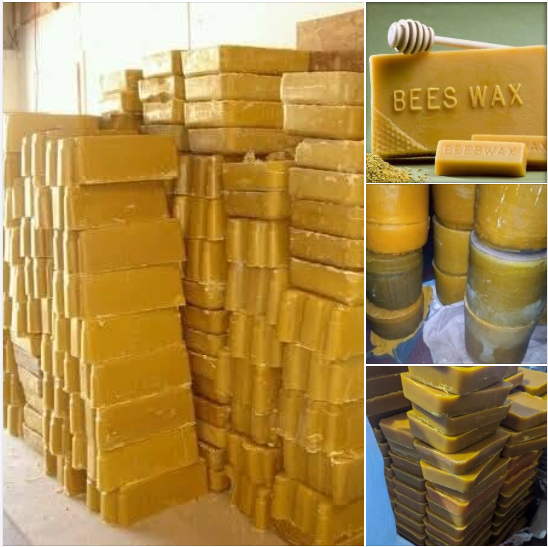
Yellow Beeswax (Raw/Filtered): Melted from comb cappings, filtered to remove debris, solidified into blocks — retaining natural colour, aroma, and full chemical complexity. The least processed commercial grade.
Yellow Beeswax (Pharmaceutical Grade — Ph. Eur./USP): Filtered, cleaned, and analytically tested to full pharmacopoeia specification.
White Beeswax (Cosmetic/Pharmaceutical Grade): Bleached yellow beeswax — colour and odour reduced while retaining functional wax properties.
Beeswax Pellets: Yellow or white beeswax formed into small pellets (1–5mm diameter) — the most commercially convenient format for cosmetics and pharmaceutical manufacturing whose weighing and melting systems are optimised for pellet rather than block format.
Beeswax Sheets: Thin pressed sheets whose candle-making, craft, and artisan application creates specific retail and industrial procurement demand.
Benefits and Industrial Uses of Nigerian Beeswax
Pharmaceutical Manufacturing — The Excipient Application
The global pharmaceutical excipient market — documented in the potato flour article at over USD 9 billion annually — creates specific procurement demand for beeswax as one of very few natural excipients with both Ph. Eur. and USP pharmacopoeia monograph listing and documented multi-functional pharmaceutical performance:
Controlled-release coating: Beeswax as a hydrophobic matrix former and coating agent in oral solid dosage forms — creating the drug release rate control that modern pharmaceutical therapy often requires. Beeswax’s lipid-based matrix controls drug dissolution rate through two mechanisms: hydrophobic matrix retardation (water penetration into the wax matrix is slow — creating time-release drug exposure from a reservoir within the wax) and erosion-based release (gradual wax dissolution in the gastrointestinal environment releasing encapsulated drug at controlled rates). Research through International Journal of Pharmaceutics documents beeswax as a sustained-release matrix former for multiple drug categories.
Tablet and capsule lubricant: White beeswax as a tablet lubricant — reducing die-punch friction during tablet compression, preventing tablet sticking to punch faces, and improving tablet ejection from the die — creating manufacturing process improvement whose function parallels magnesium stearate but with natural origin communication value.
Microencapsulation wall material: Beeswax as a spray-congealing wall material for microencapsulation of sensitive pharmaceutical ingredients — whose lipid matrix creates moisture and oxygen barrier protection for hygroscopic or oxidation-sensitive active pharmaceutical ingredients during storage and gastrointestinal transit.
Veterinary pharmaceutical applications: Beeswax in veterinary sustained-release implants, hoof care preparations, and livestock topical medications — creating procurement demand from veterinary pharmaceutical manufacturers.
Nigerian pharmaceutical manufacturers: Emzor, May & Baker, Fidson, Morison Industries — whose domestic procurement of pharmaceutical-grade beeswax currently relies on imported European and Chinese sources — represent the most immediately commercially accessible domestic buyers for Paradise MultiTrade’s pharmaceutical-grade Nigerian beeswax programme.
For pharmaceutical buyers — contact our export team to discuss Ph. Eur./USP compliance documentation.
Cosmetics and Personal Care — The Largest Commercial Application
The global cosmetics and personal care market — tracked through Euromonitor International’s beauty market data at over USD 500 billion annually — creates the most volume-significant commercial application for beeswax whose unique combination of functional properties creates irreplaceable value in specific cosmetic formulation types:
Lip products (lip balm, lipstick, lip gloss): Beeswax is the primary structuring agent in lip product formulations — whose specific melting point (62–65°C — significantly above body temperature of 37°C but comfortably meltable at skin application temperatures), cohesive film formation on lip surfaces, and partial water resistance creating the moisturising, protective film that lip balm therapy requires. The global lip care market — tracked through Grand View Research’s lip care market analysis — creates consistent, large-scale procurement demand for cosmetic-grade beeswax from lip product manufacturers including major brands (Burt’s Bees, EOS, Chapstick, Neutrogena) whose formulations make beeswax a functional ingredient that no synthetic wax precisely replicates.
Skin care emulsions (creams and lotions): Beeswax as an emulsifier and thickener in oil-in-water and water-in-oil skin care emulsions — creating the stable, spreadable cream texture whose consistency and skin feel patients associate with traditional pharmacy preparations (cold cream — the oldest surviving commercial cosmetic preparation, documented since the 2nd century CE by Galen of Pergamon, whose beeswax-rose water-olive oil formulation creates the world’s oldest cosmetic recipe still in production). Modern skincare brands whose cold cream, barrier cream, and protective cream formulations maintain beeswax as the primary structuring agent create consistent pharmaceutical-grade cosmetic beeswax procurement demand.
Hair care products: Beeswax in hair pomades, edge control products, and conditioning formulations — whose African and Afro-Caribbean natural hair care market creates specific demand for authentic natural beeswax. The growing global natural hair care movement — tracked through Mintel’s natural hair care market research — creates premium procurement demand for documented, authentic beeswax from natural sourcing programmes whose African origin aligns with natural African hair care brand positioning.
Mascara, eyeliner, and eye cosmetics: Beeswax as the primary wax in mascara formulations — creating the film-forming, water-resistant, lash-coating structure whose performance in eye cosmetics makes beeswax essentially irreplaceable. Global mascara market procurement — tracked through Grand View Research’s mascara market analysis — creates consistent, large-scale cosmetic-grade beeswax demand from colour cosmetics manufacturers.
Natural and organic cosmetics: The global natural cosmetics market — tracked through Grand View Research’s natural cosmetics market — specifically values beeswax as one of very few waxes with authentic natural origin, INCI name (Cera Alba for white beeswax, Cera Flava for yellow) widely recognised by natural cosmetics consumers, and universal acceptance in Ecocert, COSMOS, NATRUE, and Soil Association natural and organic cosmetics certification frameworks. For natural cosmetics brands — Nigerian-origin beeswax with documented authentic production creates the supply chain integrity that natural cosmetics certification specifically requires.
For cosmetics manufacturer buyers — contact our team to discuss cosmetic-grade specification and pellet format supply.
Food Industry — E901 Glazing Agent
EU food additive E901 (beeswax): Commission Regulation (EU) No 231/2012 documents beeswax (E901) as a permitted food additive for: surface treatment of fresh fruits (preventing moisture loss and creating the characteristic shine); cheese rind treatment (protective coating preventing mould growth and moisture loss); confectionery glazing (creating the characteristic sheen of chocolate confectionery, sugar-paned sweets, and coated nuts); and tablet glazing in food supplement manufacture (creating the glossy, moisture-protective coating on dietary supplement tablets).
Specific food manufacturing applications:
Chocolate and confectionery coating: The glossy finish on chocolate confectionery — whose characteristic shine signals quality in premium chocolate retail — is created by carnauba wax and beeswax glazing whose specific wax blend creates reflectance at room temperature. For confectionery manufacturers whose premium product communication values natural, beeswax-derived glazing over synthetic alternatives — food-grade Nigerian beeswax creates the natural origin glaze communication.
Fresh fruit coating: Beeswax coating on citrus fruits, apples, and other fresh produce — replacing the natural wax bloom removed during washing — creating moisture retention that extends fresh produce shelf life. Organic-certified beeswax creates the natural surface treatment that organic fresh produce certification requires (many synthetic produce waxes are excluded from organic certification).
Dietary supplement tablet glazing: The pharmaceutical-adjacent application — beeswax glazing on dietary supplement tablets creates moisture barrier protection and characteristic glossy appearance whose food-grade rather than pharmaceutical-grade status requires E901 compliance rather than Ph. Eur./USP monograph compliance — creating a distinct food-grade specification from pharmaceutical grade.
Artisan and Industrial Applications
Candle manufacturing: The most consumer-recognisable beeswax application — natural beeswax candles whose clean-burning, naturally aromatic, long-burning character creates premium positioning versus paraffin candles. The global natural candle market — whose growth in premium home fragrance and wellness candle categories creates consistent demand — creates artisan candle manufacturer procurement whose Nigerian yellow beeswax’s characteristic aroma creates authentic natural candle character.
Encaustic painting: The ancient painting technique (documented from ancient Greek and Roman examples — Fayum mummy portraits, the oldest surviving panel paintings in Western art) using pigmented beeswax applied hot — whose contemporary revival in fine art creates museum conservation and fine art application demand for high-purity, chemical-consistent beeswax.
Lost-wax casting: Industrial and artisan lost-wax casting for metal components (precision casting in aerospace, dental prosthetics, jewellery) — whose beeswax pattern material creates the burnout-clean cavity that molten metal fills. Nigeria’s Benin bronze tradition’s historical use creates the most culturally resonant sourcing narrative for lost-wax casting beeswax.
Wood, leather, and textile finishing: Traditional and contemporary finishing waxes for premium furniture, leather goods, and waxed fabric — whose beeswax component creates the water resistance, surface protection, and tactile character that synthetic wax alternatives cannot replicate in natural material finishing.
Dental and orthodontic applications: Dental wax and orthodontic wax for bracket irritation relief — creating procurement demand from dental product manufacturers.
Why Buy Beeswax From Nigeria?
African Bee Subspecies — The Biodiversity Premium
Nigeria’s bee population — whose diversity across the Guinea savanna (A. mellifera jemenitica), forest-savanna transition (A. mellifera adansonii), and montane zones — creates a floral diversity-driven beeswax character that single-subspecies European production cannot replicate. The specific aromatic complexity of Nigerian beeswax — whose honey-floral-balsamic character reflects the extraordinary diversity of Nigerian flowering flora accessed by wild and managed bee populations — creates the premium aroma character that natural cosmetics formulators and artisan candle manufacturers specifically seek beyond the standardised aroma of commercial European beeswax.
The Adulteration Detection Programme — Authentic Natural Wax Guaranteed
Beeswax is among the most frequently adulterated natural waxes in international trade — with paraffin wax, carnauba wax, montan wax, and synthetic esters used as inexpensive adulterants whose addition increases supplier margin at buyer quality expense. The GC-MS adulteration detection programme whose systematic application to every Paradise MultiTrade export lot creates the authentication assurance that pharmacopoeia buyers, natural cosmetics brands, and premium artisan manufacturers specifically require — confirming authentic Apis mellifera beeswax origin through the characteristic odd-numbered hydrocarbon distribution, correct ester-to-acid value ratio, and absence of paraffin hydrocarbon signatures that define authentic uncontaminated natural beeswax.
The Traditional Beekeeping Heritage — Minimal Chemical Residue
Nigerian traditional and semi-traditional beekeeping — whose primary management approach through log hives and Kenya Top Bar hives uses minimal synthetic chemical treatments — creates beeswax whose pesticide and veterinary medicine residue profile (particularly coumaphos and amitraz — the synthetic miticide treatments whose residues in commercially managed European beeswax create specific regulatory concern documented through EFSA’s beeswax residue assessment) is significantly lower than equivalent commercially intensively managed European apiaries.
For natural cosmetics certification schemes and organic product manufacturers whose ingredient residue specifications specifically address synthetic chemical contamination — Nigerian traditionally managed beeswax creates the low-residue, naturally produced credential whose documentation enables natural and organic cosmetics certification inclusion.
Complete Export Documentation
Every beeswax shipment carries NEPC export documentation, certificate of origin, commercial invoice, packing list, and bill of lading. We coordinate: melting point (capillary tube method — Ph. Eur. 2.2.15 — confirming 62–65°C); acid value (titrimetric per Ph. Eur./USP — confirming 17–24 mg KOH/g); saponification value (titrimetric — confirming 87–104 mg KOH/g); ester value (calculated); relative density at 20°C; colour (AOCS method — yellow beeswax Lovibond scale; white beeswax whiteness index); GC-MS authenticity fingerprint (confirming odd-numbered hydrocarbon distribution and ester profile consistent with Apis mellifera wax — adulteration exclusion); residue on ignition (ash content); heavy metals (ICP-MS — lead, arsenic, mercury); pesticide residue (coumaphos, amitraz — multi-residue GC-MS); microbiological testing; and moisture content. EU-bound pharmaceutical shipments comply with Regulation (EU) 2017/625 on official controls. Our NEPC Export Licence No. 0042385 and CAC Registration No. RC-9284647 are verifiable through NEPC.
Nigeria’s Beeswax Export Strength and Global Market Demand
The Global Market
The global beeswax market — tracked through Grand View Research’s beeswax market analysis at approximately USD 500 million annually and growing at approximately 5–7% annually driven by natural cosmetics growth, pharmaceutical excipient demand, and the premium natural candle market — is dominated by Chinese production (the world’s largest honey and beeswax producer), Brazilian production (the world’s largest exporter of natural beeswax), Ethiopian and Tanzanian production (African premium natural beeswax origins), and European production (Germany, Romania, Spain). Nigerian beeswax’s current formal export position is minimal — creating the commercial development opportunity whose capture through quality documentation and formal export infrastructure creates the market position that Paradise MultiTrade’s programme specifically builds.
The most commercially significant recent market development: the EU Cosmetics Regulation’s increasing focus on synthetic ingredient alternatives and the COSMOS and Ecocert natural cosmetics certification frameworks’ broad adoption by European cosmetics brands — creating structural demand shift toward natural waxes whose authentic origin, minimal processing, and low residue profile specifically positions Nigerian traditionally-produced beeswax.
Key Export Destination Markets
Germany — Europe’s largest natural cosmetics market, home to major cosmetics ingredient distributors, and host to Vivaness (the world’s leading natural cosmetics trade fair) whose buyer community creates the most concentrated European cosmetics-grade beeswax procurement demand. EU requirements through EFSA and ECHA.
France — whose luxury cosmetics heritage (L’Oréal, LVMH/Guerlain, Clarins) and growing natural cosmetics market creates consistent premium beeswax procurement demand. French cosmetics ingredient import through ANSES.
United Kingdom — whose natural cosmetics market (Holland & Barrett own-label, Faith in Nature, Neal’s Yard, Lush Cosmetics) creates premium beeswax procurement demand. UK requirements through FSA and MHRA.
United States — whose natural cosmetics sector (Burt’s Bees, Alba Botanica, Dr. Bronner’s) and pharmaceutical excipient manufacturing creates significant procurement demand. US food and pharmaceutical requirements through FDA and USP.
Japan — whose highly developed natural cosmetics market and specific cultural appreciation for natural ingredient authenticity creates premium procurement demand tracked through JETRO.
India — whose pharmaceutical manufacturing industry (the world’s largest generic drug producer) creates significant pharmaceutical excipient procurement demand for Ph. Eur./USP compliant beeswax tracked through APEDA.
UAE — whose luxury cosmetics distribution hub and halal cosmetics market creates specific demand tracked through ADAFSA.
Why Choose Paradise MultiTrade International Limited?
GC-MS Authenticity Fingerprinting — The Adulteration Guarantee. Gas chromatography-mass spectrometry analysis of the hydrocarbon profile (confirming odd-numbered carbon dominance characteristic of authentic Apis mellifera wax versus paraffin’s even-numbered distribution) and ester fraction composition — per lot, for every commercial shipment — creating the adulteration detection assurance that pharmacopoeia buyers and premium cosmetics manufacturers specifically require. For buyers whose supply chain includes adulteration risk from informal beeswax sources — Paradise MultiTrade’s GC-MS certification creates the authentication foundation that no simple melting point or acid value test alone can provide. Contact us to discuss authenticity documentation.
Full Pharmacopoeia Compliance — Ph. Eur. and USP Both. Complete pharmacopoeia analytical panel (melting point, acid value, saponification value, ester value, relative density, adulteration tests, microbial quality) creating yellow and white beeswax compliant with both European Pharmacopoeia Cera Flava/Cera Alba monographs and USP Yellow Wax/White Wax monographs — enabling pharmaceutical procurement in European, North American, Indian, and Japanese regulated pharmaceutical manufacturing environments. Contact us to discuss pharmaceutical grade documentation.
Low Synthetic Residue — Traditional Apiary Heritage. Coumaphos and amitraz (synthetic miticide) residue analysis by GC-MS on every pharmaceutical and cosmetics grade lot — confirming the low residue profile that traditional Nigerian apiary management creates. For natural cosmetics certification (COSMOS, NATRUE, Ecocert) and organic product ingredient sourcing — the low-residue documentation creates the supply chain integrity whose certification compliance is documented. Contact us to discuss residue documentation.
Pellet Format for Manufacturing Convenience. Yellow and white beeswax in 1–5mm pellet format — whose manufacturing convenience (accurate weighing, rapid melting, consistent melt rate across production batches) creates the production efficiency that cosmetics and pharmaceutical manufacturers whose traditional block beeswax creates weighing and melting process inconsistency specifically value. Contact our team to discuss pellet format specification.
Multi-Commodity West African Natural Product Sourcing. Beeswax buyers frequently source complementary Nigerian natural products. Alongside beeswax, Paradise MultiTrade exports raw honey, shea butter, black soap, moringa leaf powder, neem oil, moringa oil, hibiscus flower, sesame oil, castor oil, avocado oil, tigernut oil, and cashew nut kernel. Explore our full range of Nigerian export commodities and consolidate your West African natural wax, oil, and botanical ingredient sourcing through one verified, licensed export partner.
Product Specifications
| Specification | Yellow Beeswax (Natural Grade) | Yellow Beeswax (Pharmaceutical Grade — Ph. Eur./USP) | White Beeswax (Cosmetic Grade) | White Beeswax (Pharmaceutical Grade — Ph. Eur./USP) | Food Grade Beeswax (E901) | Beeswax Pellets |
|---|---|---|---|---|---|---|
| Biological Origin | Apis mellifera L. (Western honeybee) | Apis mellifera L. | Apis mellifera L. (bleached) | Apis mellifera L. (bleached) | Apis mellifera L. | Apis mellifera L. |
| Form | Blocks (1–25kg) | Blocks or Pellets | Blocks or Pellets | Blocks | Blocks or Pellets | Pellets 1–5mm |
| Colour | Natural yellow to amber | Light to medium yellow | White to pale yellow | White | Pale yellow to white | Yellow or White (specified) |
| Odour | Characteristic honey-beeswax aroma | Characteristic (Ph. Eur.) | Faint or odourless (bleached) | Faint (Ph. Eur.) | Faint | Grade-dependent |
| Melting Point | 61–68°C | 62–65°C (Ph. Eur.) | 62–65°C | 62–65°C (Ph. Eur.) | 62–65°C | 62–65°C |
| Acid Value | 17–25 mg KOH/g | 17–24 mg KOH/g (Ph. Eur.) | 17–24 mg KOH/g | 17–24 mg KOH/g | 17–24 mg KOH/g | 17–24 mg KOH/g |
| Saponification Value | 87–106 mg KOH/g | 87–104 mg KOH/g (Ph. Eur.) | 87–104 mg KOH/g | 87–104 mg KOH/g | 87–104 mg KOH/g | 87–104 mg KOH/g |
| Ester Value | 70–82 mg KOH/g | 70–80 mg KOH/g | 70–80 mg KOH/g | 70–80 mg KOH/g | 70–80 mg KOH/g | 70–80 mg KOH/g |
| Relative Density (20°C) | 0.955–0.975 | 0.958–0.975 (Ph. Eur.) | 0.958–0.975 | 0.958–0.975 | 0.958–0.975 | 0.958–0.975 |
| GC-MS Authenticity | On request | Per lot — mandatory | Per lot | Per lot — mandatory | On request | Per lot |
| Hydrocarbon Profile | Odd-numbered C25–C33 dominant | Confirmed — Ph. Eur. adulteration test | Confirmed | Confirmed | Confirmed | Confirmed |
| Paraffin Adulteration | Absent | Absent — Ph. Eur. test passed | Absent | Absent | Absent | Absent |
| Coumaphos Residue | <100 ppb | <50 ppb (pharma limit) | <100 ppb | <50 ppb | <100 ppb | <50 ppb |
| Amitraz Residue | <200 ppb | <100 ppb (pharma limit) | <200 ppb | <100 ppb | <200 ppb | <100 ppb |
| Lead | ≤10 mg/kg (ICP-MS) | ≤10 mg/kg (Ph. Eur.) | ≤5 mg/kg | ≤10 mg/kg | ≤2 mg/kg (food limit) | ≤5 mg/kg |
| Arsenic | ≤3 mg/kg | ≤3 mg/kg | ≤1 mg/kg | ≤3 mg/kg | ≤1 mg/kg | ≤1 mg/kg |
| Mercury | ≤0.5 mg/kg | ≤0.5 mg/kg | ≤0.1 mg/kg | ≤0.5 mg/kg | ≤0.1 mg/kg | ≤0.1 mg/kg |
| Residue on Ignition (Ash) | ≤0.1% | ≤0.1% | ≤0.1% | ≤0.1% | ≤0.1% | ≤0.1% |
| Moisture | ≤0.5% | ≤0.5% | ≤0.5% | ≤0.5% | ≤0.5% | ≤0.5% |
| Microbiological | TPC ≤10³ CFU/g | TPC ≤10³ CFU/g (Ph. Eur.) | TPC ≤10² CFU/g | TPC ≤10² CFU/g | Salmonella absent; TPC ≤10³ CFU/g | TPC ≤10² CFU/g |
| Pharmacopoeia Compliance | Not tested | Ph. Eur. Cera Flava; USP Yellow Wax | Not tested to monograph | Ph. Eur. Cera Alba; USP White Wax | E901 (EU 231/2012) | On request |
| INCI Name | Cera Flava | Cera Flava | Cera Alba | Cera Alba | Cera Flava / Cera Alba | Grade-dependent |
| CAS Number | 8012-89-3 | 8012-89-3 | 8012-89-3 | 8012-89-3 | 8012-89-3 | 8012-89-3 |
| Halal Status | Available | Available | Available | Available | Available | Available |
| Kosher Status | Available | Available | Available | Available | Available | Available |
| Shelf Life | 5 years (cool, dark storage) | 5 years | 3 years (bleached — slower colour return) | 3 years | 3 years | 5 years |
| Packaging | 5kg, 10kg, 25kg blocks; cartons | 5kg, 25kg blocks or 25kg pellet bags | 5kg, 25kg blocks; pellets | 5kg, 25kg blocks | 10kg, 25kg blocks | 25kg sealed PE bags |
| Supply Capacity | 10–500 MT per year | 5–100 MT per year | 5–200 MT per year | 5–100 MT per year | 5–100 MT per year | 5–200 MT per year |
| MOQ | 100kg | 50kg | 50kg | 25kg | 50kg | 25kg |
Export Documentation (all grades): Certificate of Origin, NEPC Export Licence, Melting Point Certificate, Acid Value Certificate, Saponification Value Certificate, Ester Value Certificate, Relative Density Certificate, GC-MS Authenticity Certificate (per lot — pharmaceutical and premium cosmetic grades), Adulteration Test Certificate (paraffin exclusion), Coumaphos and Amitraz Residue Certificate, Heavy Metals ICP-MS Certificate, Residue on Ignition Certificate, Microbiological Certificate, Pharmacopoeia Compliance Certificate (Ph. Eur. and USP — pharmaceutical grade), E901 Food Additive Compliance Certificate (food grade), Halal Certificate (on request), Kosher Certificate (on request), Commercial Invoice, Packing List, Bill of Lading.
Payment Terms: T/T, LC at sight, Escrow. Loading Port: Lagos (Apapa / Tin Can Island Port). Incoterms: EXW, FOB Lagos, CNF, CIF.
Processing and Export Process
Honey and Beeswax Harvesting. Nigerian honey and beeswax harvested primarily from October–February (main honey flow following the late rainy season’s flowering peak — September–November — in Guinea savanna zones) and April–June (secondary honey flow in forest zones). Beeswax procurement: wax cappings (the thin wax covers removed from honey cells during honey extraction — the cleanest and most commercially premium wax fraction), comb wax (older brood and honey comb material — darker, more aromatic, more processed), and natural swarm wax (from unmanaged colonies — highest aromatic complexity, least predictable composition).
Melting and Primary Filtration. Harvested comb and cappings melted in stainless steel jacketed vessels using hot water (80–90°C water bath — indirect heating preventing overheating that degrades wax quality above 100°C). Melted wax floats on the aqueous phase — the initial water wash removing water-soluble honey residues and some protein. Primary filtration through 100-micron stainless steel mesh removing gross debris (propolis, bee parts, wood fragments from hives). Secondary filtration through 10-micron filter cloth removing fine debris.
Clarification. Filtered liquid wax transferred to settling vessels — maintained at 75–80°C for 4–6 hours allowing density-based separation: wax (lighter, upper layer) from water and slum gum (darker impurities, heavier, settling to bottom). Upper wax layer decanted to clean vessels.
Bleaching (White Beeswax Production). For white beeswax — filtered, clarified yellow wax subjected to: adsorptive bleaching (activated earth/bleaching earth treatment at 80°C, 1–2 hours — adsorbing carotenoid and flavonoid colour compounds and some aromatic volatiles); filtration removing bleaching earth; and hydrogen peroxide treatment (optional, for maximum whiteness) — creating the white to pale yellow, low-odour wax whose INCI name Cera Alba and Ph. Eur. specification creates pharmaceutical and cosmetics premium grade.
Pelletisation. Filtered, clarified wax (yellow or white) transferred to pelletising equipment — either prilling tower (molten wax droplets falling through cooled air stream, solidifying into spherical pellets) or rotary cooler (molten wax spread onto chilled belt, broken into irregular pellets). Target pellet size: 1–5mm diameter. Pellets cooled to ambient temperature and screened for size uniformity.
Block Formation. For block grades — molten wax poured into silicone or polypropylene moulds (typically 1kg, 5kg, or 25kg block formats) and cooled to ambient. Blocks packaged in polyethylene bags within cardboard cartons.
Quality Testing. Melting point, acid value, saponification value, ester value, relative density, GC-MS authenticity, coumaphos and amitraz residue, heavy metals, residue on ignition, colour, and microbial quality — tested before release. Pharmaceutical grade: full Ph. Eur. monograph analytical panel plus USP specific tests. Lead time: 14–28 days from stock; pharmaceutical grade with full monograph testing: 28–42 days. Contact us to plan your supply schedule.
Frequently Asked Questions
Why is beeswax so frequently adulterated and how can buyers detect fraudulent supply?
Beeswax adulteration is one of the most commercially significant quality fraud issues in any natural ingredient category — whose prevalence reflects the substantial price differential between authentic natural beeswax and the paraffin, carnauba, and synthetic wax adulterants used to extend it at reduced cost: (1) The commercial incentive: Authentic natural beeswax typically prices at EUR 8–15 per kg depending on grade — while paraffin wax costs EUR 1–2 per kg and carnauba wax EUR 5–8 per kg. Adding 20–40% paraffin to beeswax creates a mixture whose visual appearance, melting point, and basic physical tests may not immediately reveal adulteration — creating the commercial incentive for fraudulent supply chains. (2) Common adulterants: Paraffin wax (petroleum-derived — detectable by GC hydrocarbon profile: paraffin shows even-numbered carbon distribution versus beeswax’s odd-numbered dominance); carnauba wax (plant-derived — raises saponification value and melting point above specification); montan wax (lignite-derived — low acid value outside specification range); synthetic esters (raise ester value above specification range). (3) Detection methods: Simple screening tests (acid value, saponification value, ester value, melting point) — can detect gross adulteration but may miss sophisticated blending designed to keep values within specification range. Definitive authentication (GC-MS): The hydrocarbon fraction profile — confirming the specific odd-numbered alkane distribution (hentriacontane C31 as dominant peak) of authentic Apis mellifera wax — is not replicable by any known adulterant and creates unequivocal authentication. The Ph. Eur. adulteration tests (isobutyric acid petroleum ether test; specific GC-MS provisions) specifically address the most commercially significant adulterants. (4) Paradise MultiTrade’s guarantee: GC-MS authentication per lot — whose results provided with every commercial shipment create the analytical foundation that buyers whose quality systems require documented authenticity specifically value. Contact us to discuss GC-MS authenticity documentation.
What is the European Pharmacopoeia specification for beeswax and how is pharmaceutical grade different from cosmetic grade?
The distinction between pharmaceutical and cosmetic grade beeswax — whose understanding prevents costly procurement errors — is primarily a documentation and analytical testing distinction rather than a fundamental quality difference: (1) Pharmaceutical grade requirements: Full Ph. Eur. Cera Flava (yellow) or Cera Alba (white) monograph compliance — requiring documented testing of every analytical parameter: melting point, acid value, saponification value, ester value, relative density, adulteration test (petroleum ether extract test), and microbial quality (total aerobic count ≤10³ CFU/g). The critical pharmaceutical requirement is per-lot documentation — not a one-time specification confirmation but documented analytical results accompanying every batch whose Certificate of Analysis (CoA) traces to specific production records. (2) Cosmetic grade requirements: Cosmetic-grade beeswax specification typically references the same physical parameters (melting point, acid value) but does not require full pharmacopoeia monograph compliance or per-lot documentation at pharmacopoeia standard. Cosmetic grade beeswax may also have higher flexibility on colour specification, adulteration testing frequency, and microbial testing protocols. (3) Food grade E901 requirements: Commission Regulation (EU) No 231/2012 specifies E901 purity criteria: melting point 61–69°C; acid value 16–23; saponification value 70–100 (slightly more permissive than Ph. Eur.) — creating a standard that overlaps substantially with pharmaceutical grade but is not required to be documented to pharmacopoeia monograph standard. (4) Practical guidance: For pharmaceutical manufacturers — specify “Ph. Eur. Cera Flava/Cera Alba compliant with per-lot CoA and adulteration test documentation.” For cosmetics manufacturers — specify grade (yellow/white), melting point range, acid value range, and GC-MS authenticity. For food manufacturers — specify “E901 compliant, food-grade beeswax with acid value and saponification value documented per Commission Regulation (EU) No 231/2012.” Contact us to discuss grade-specific documentation requirements.
What makes Nigerian beeswax specifically different from Chinese, Brazilian, or Ethiopian origin beeswax?
The geographical origin comparison — whose commercial communication creates specific value for buyers whose supply diversification or origin-specific quality requirements create Nigerian beeswax procurement rationale: (1) versus Chinese beeswax (world’s largest production): Chinese beeswax production is dominated by Apis cerana (Asian honeybee) — a distinct species from Apis mellifera whose beeswax chemical composition, while broadly similar, creates subtle differences in ester profile and aromatic character that GC-MS can distinguish. Some Chinese beeswax exports are also from Apis mellifera managed European colonies — comparable to western origins. Key concern with Chinese origin: higher adulteration risk (documented in European Pharmacopoeia adulteration testing guidance) and higher coumaphos/amitraz residue from intensive chemical mite management in commercial apiaries. (2) Versus Brazilian beeswax (world’s largest exporter): Brazilian Apis mellifera (Africanised honeybee — descendent of African bee subspecies introduced in 1956) produces wax whose chemical composition closely resembles African-origin beeswax. Brazilian beeswax is well-established in international trade — with consistent quality and documentation. Nigerian beeswax’s specific advantage: lower transit time to European and UK markets (14–18 days Lagos to Rotterdam versus 18–24 days Brazilian Atlantic ports to Rotterdam) and the specific aromatic character of West African floral diversity whose composition Brazilian cerrado and Amazon flora creates differently. (3) Versus Ethiopian and Tanzanian beeswax (African premium origins): The most directly comparable origins to Nigerian beeswax — both producing Apis mellifera beeswax from traditional African beekeeping. Ethiopian beeswax is currently the most internationally established African premium origin. Nigerian beeswax’s specific advantage: broader ecological diversity across forest and savanna zones creating more complex aromatic profiles than the primarily highland Ethiopian origin; and the shorter Atlantic logistics route for European buyers versus Ethiopian Red Sea/Indian Ocean routing. Contact us to discuss origin-specific quality comparison.
What are the halal and kosher status considerations for beeswax in cosmetics and pharmaceutical applications?
Beeswax’s religious certification status — whose specific assessment differs between halal and kosher frameworks — creates commercial procurement requirements for manufacturers whose customer base or brand positioning includes religiously observant consumers: (1) Halal status: Major Islamic jurisprudence bodies — including OIC Fiqh Academy and Malaysia’s JAKIM — classify beeswax as halal: bees are considered permitted (mubah) in Islamic food jurisprudence, their products (honey and wax) are not considered najis (impure), and the processing of beeswax does not involve any prohibited substances. Halal certification of beeswax requires: confirmation of authentic Apis mellifera origin (no contamination with non-halal animal-derived substances during processing); and halal-certified processing facilities whose documentation creates the formal halal certification credential that halal-conscious cosmetics brands and pharmaceutical manufacturers specifically require for product halal certification. Paradise MultiTrade coordinates halal certification through accredited Nigerian halal certification bodies. (2) Kosher status: Beeswax’s kosher status is complex — the question of whether bee products are kosher has been debated across Jewish legal authorities (poskim). The authoritative consensus in mainstream Orthodox Judaism: honey from bees is kosher despite bees being non-kosher insects (the honey is considered a secretion of a permissible substance — flower nectar — rather than a bee body product). Beeswax follows the same ruling — it is generally accepted as kosher. Kosher certification requires rabbinic supervision of the processing facility and documentation confirming absence of non-kosher substances in processing. Contact us to discuss halal and kosher certification coordination.
What is coumaphos and why does its residue in beeswax create specific commercial concerns for natural cosmetics buyers?
Coumaphos — a synthetic organophosphate miticide used to control Varroa destructor (Varroa mite) infestations in European honeybee colonies — is the single most commercially significant chemical residue issue specific to beeswax from intensively managed commercial European apiaries: (1) What it is: Coumaphos (brand name CheckMite+) is applied by placing coumaphos-impregnated strips inside bee hives — releasing the active chemical slowly to kill Varroa mites. The problem: coumaphos is lipophilic — highly soluble in lipids including beeswax — creating accumulation in the beeswax comb over repeated treatment cycles. (2) Accumulation concentration: Research through NCBI’s pesticide residue in beeswax research documents coumaphos concentrations of 100–1,000+ ppb in wax from intensively treated European apiaries — concentrations that persist in the wax for years after treatment cessation. (3) Commercial consequence: Natural cosmetics certification frameworks (COSMOS, NATRUE, Ecocert) have specific pesticide residue limits for beeswax ingredients — creating procurement rejection of high-coumaphos wax from brands whose certification requires low-residue ingredients. (4) Nigerian beeswax advantage: Nigeria’s traditional beekeeping system — whose primary Varroa management through colony resistance and natural apiary practices rather than synthetic chemical treatments — creates beeswax with dramatically lower coumaphos concentrations. Analysis of Nigerian-origin beeswax consistently shows coumaphos below 50 ppb — significantly lower than European commercially managed hive wax. Paradise MultiTrade’s coumaphos testing programme creates the documented low-residue credential that natural cosmetics certification specifically requires. Contact us to discuss residue documentation for natural cosmetics certification.
How is beeswax used in pharmaceutical controlled-release drug delivery and what grade is required?
Beeswax in pharmaceutical controlled-release drug delivery — one of the most commercially sophisticated applications in any natural product’s industrial use — represents the pharmaceutical industry’s specific exploitation of beeswax’s unique functional properties: (1) The sustained-release principle: Many drugs are most therapeutically effective when blood concentration is maintained within a therapeutic window for extended periods — too low = ineffective; too high = toxic. Controlled-release formulations using beeswax as a matrix former create gradual drug release over 8–24 hours, achieving therapeutic blood concentrations from a single daily dose rather than multiple doses. (2) How beeswax creates sustained release: Beeswax is compressed with drug powder into tablets or granules — the wax matrix creates a hydrophobic barrier whose water penetration is slow. As gastrointestinal fluid slowly penetrates the wax matrix, drug dissolved at the wax-water interface diffuses out through the matrix — creating a diffusion-controlled release rate. Beeswax matrix erosion in the lower gastrointestinal tract adds erosion-based release as a secondary mechanism. (3) Drug categories using beeswax sustained-release: Analgesics (aspirin, ibuprofen — reducing dosing frequency and gastric irritation from immediate-release tablets); antihypertensives (nifedipine, diltiazem — maintaining blood pressure control through 24-hour dosing); antibiotics (erythromycin, ampicillin — maintaining therapeutic blood levels from twice-daily instead of four-times-daily dosing); and vitamins/supplements (sustained-release B vitamin complexes). (4) Grade requirements: All pharmaceutical drug product applications require Ph. Eur. Yellow Wax or White Wax monograph compliant beeswax with per-lot CoA documentation — whose analytical traceability creates the pharmaceutical quality system documentation that FDA 21 CFR Part 211, EU GMP Directive 2003/94/EC, and ICH Q7 active pharmaceutical ingredient (API) manufacturer requirements mandate. Paradise MultiTrade’s pharmaceutical-grade programme creates the monograph compliance documentation whose completeness pharmaceutical QA departments require. Contact us to discuss pharmaceutical grade specification.
What transit times should I expect from Nigeria for beeswax?
Nigerian beeswax in all forms (standard dry container — no temperature control required; beeswax’s 62–65°C melting point creates complete stability at all ambient transport temperatures encountered in sea freight): UK (Tilbury, Felixstowe) — 14–18 days from Lagos. Netherlands (Rotterdam — primary European chemical/pharmaceutical ingredient distribution hub) — 14–18 days. Germany (Hamburg) — 14–20 days. France (Le Havre) — 14–18 days. Belgium (Antwerp — significant pharmaceutical ingredient trading hub) — 14–18 days. Italy (Genoa — important cosmetics ingredient distribution) — 12–16 days. India (Mumbai, Chennai — pharmaceutical manufacturing destination) — 16–22 days. Japan (Yokohama) — 25–32 days. USA (East Coast — New York, Baltimore) — 18–25 days. UAE (Jebel Ali — halal cosmetics and pharmaceutical distribution hub) — 10–14 days. Temperature note: Beeswax’s high melting point (62–65°C) means container temperature during tropical sea freight (maximum approximately 50–55°C in tropical sun-exposed containers) does not approach the melting point — creating complete transit stability without any special temperature management. Pellets are slightly more susceptible to surface tackiness if container temperatures approach 45°C — sealed PE bags prevent pellet aggregation at elevated temperatures. Packaging: Block beeswax in polyethylene-lined cardboard cartons or wooden crates — preventing contamination and physical damage during handling. Pellets in sealed 25kg PE bags with printed product identification including grade, lot number, and key analytical values. Add 14–21 days for full pharmaceutical-grade analytical panel (melting point, acid value, saponification, GC-MS, coumaphos, microbial quality per Ph. Eur.) before release. Contact us to plan your complete logistics programme.
Ready to Source Nigerian Beeswax — Yellow Beeswax, White Beeswax, Pharmaceutical Grade (Ph. Eur./USP), Cosmetic Grade, Food Grade E901, and Pellet Format — With GC-MS Authenticity Fingerprinting, Pharmacopoeia Monograph Compliance Documentation, Coumaphos and Amitraz Residue Certification, Heavy Metals ICP-MS, Full Analytical Panel, Halal and Kosher Certification Available, and Full Quality Documentation for Pharmaceutical Excipient Manufacturers, Cosmetics Companies, Food Manufacturers, Artisan Candle Producers, and Global Wholesale Buyers?
If you are a pharmaceutical excipient manufacturer or pharmaceutical product company whose tablet sustained-release matrix, coating agent, or lubricant formulation requires Ph. Eur. Cera Flava or Cera Alba compliant beeswax with per-lot Certificate of Analysis documenting melting point, acid value, saponification value, ester value, relative density, adulteration test, coumaphos residue, heavy metals ICP-MS, and microbiological quality — creating the analytical documentation chain that FDA, EU GMP, and ICH Q7 pharmaceutical quality systems mandate for natural excipient procurement, a cosmetics or personal care manufacturer developing lip balm, lipstick, mascara, skin cream, hair pomade, or natural and organic cosmetics products whose beeswax ingredient requires GC-MS authenticity documentation confirming authentic Apis mellifera origin, low coumaphos residue enabling COSMOS or NATRUE natural cosmetics certification, halal or kosher certification for religiously observant consumer markets, and INCI-compliant Cera Flava or Cera Alba designation for EU Cosmetics Regulation ingredient listing, a natural cosmetics brand or organic personal care company whose ingredient sourcing specifically requires beeswax with documented low synthetic residue (coumaphos <50 ppb, amitraz <100 ppb) from traditional rather than intensively chemically managed apiaries — creating the natural origin credential whose certification by COSMOS, Ecocert, or NATRUE framework requires documented residue analysis, an artisan candle manufacturer, encaustic painter, or industrial lost-wax casting operation requiring authenticated natural beeswax whose genuine Apis mellifera origin, characteristic aroma, and specific physical properties create the performance and provenance communication that synthetic or adulterated wax fundamentally cannot replicate, a food manufacturing company developing fresh produce glazing, confectionery coating, cheese rind treatment, or dietary supplement tablet glazing applications whose E901 beeswax ingredient requires acid value and saponification value documentation per Commission Regulation (EU) No 231/2012 and microbiological safety certification, or a global natural product ingredient trader building Nigerian beeswax supply positions for European, North American, Indian, and Japanese pharmaceutical, cosmetics, and food manufacturing markets as traditional African apiary beeswax’s low-residue, high-authenticity credentials create growing procurement preference from buyers whose quality systems specifically address adulteration and synthetic residue concerns — Paradise MultiTrade International Limited is the licensed Nigerian exporter your beeswax supply programme needs.
Request a Quotation — share your required grade (yellow pharmaceutical, yellow cosmetic, white pharmaceutical, white cosmetic, food grade E901, pellets, or blocks), analytical documentation requirement (full Ph. Eur. monograph CoA, GC-MS authenticity, residue panel), halal or kosher certification need, volume, format (blocks or pellets, size specification), application (pharmaceutical sustained-release, cosmetics, food glazing, candle, industrial), destination market, and preferred incoterms. We respond within 48 hours.
Contact Our Export Team — speak directly about GC-MS authenticity fingerprinting and adulteration detection programme, Ph. Eur. Cera Flava/Cera Alba full monograph analytical compliance documentation, coumaphos and amitraz residue testing and natural apiary management documentation for COSMOS/NATRUE certification, white beeswax bleaching process documentation, pellet size specification and manufacturing convenience format, halal and kosher certification coordination, Nigerian traditional beekeeping heritage and Benin bronze provenance communication for premium brand storytelling, pharmaceutical sustained-release excipient application technical data, cosmetics formulation guidance for lip product and skin care applications, E901 food additive compliance documentation, and long-term supply programme structuring.
Explore Our Full Product Range — alongside beeswax, Paradise MultiTrade exports raw honey, shea butter, black soap, neem oil, moringa oil, castor oil, sesame oil, avocado oil, tigernut oil, moringa leaf powder, hibiscus flower, and cashew nut kernel. One licensed Nigerian exporter. One consolidated West African natural wax, premium oil, botanical extract, and specialty agricultural commodity sourcing relationship — from the natural material whose 8,000-year continuous human use spans Neolithic pottery to modern pharmaceutical controlled-release drug delivery to the most comprehensively documented Nigerian natural product and agricultural export portfolio available through a single licensed export partner.
Paradise MultiTrade International Limited | NEPC Export Licence No. 0042385 | CAC No. RC-9284647 | Lagos, Nigeria | www.paradisemultitrade.com

Reviews
There are no reviews yet.