
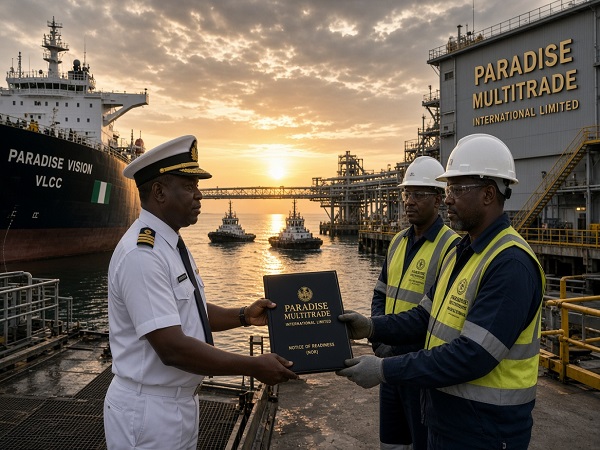
Notice of Readiness (NOR) in Crude Oil Trading: When Laytime Officially Begins
Imagine a crude oil tanker has travelled for weeks across the Atlantic.
It finally reaches the Nigerian export terminal.
The cargo is ready.
The crew is ready.
The terminal appears ready.
Yet loading cannot officially begin until one critical document enters the picture:
The Notice of Readiness (NOR).
In international crude oil shipping, the NOR is one of the most financially important documents because it determines when laytime may begin—and that directly affects whether someone eventually pays demurrage, which can amount to hundreds of thousands of dollars per day on large crude tankers.
If you’re following our Paradise MultiTrade International Limited Oil & Gas series, first read Vessel Nomination in Crude Oil Trading (https://paradisemultitrade.com/vessel-nomination-crude-oil-trading ), Crude Oil Lifting Procedures (https://paradisemultitrade.com/crude-oil-lifting-procedures ), and Sales and Purchase Agreement (SPA) in Crude Oil Trading (https://paradisemultitrade.com/sales-and-purchase-agreement-spa-crude-oil-trading ) before continuing.
Key Takeaways
-
The Notice of Readiness (NOR) is issued by the vessel’s master.
-
It formally declares that the vessel is ready to load or discharge cargo.
-
A valid NOR often determines when laytime begins.
-
Incorrect NOR timing can create costly disputes.
-
Understanding NOR is essential before learning demurrage and laytime calculations.
What Is a Notice of Readiness (NOR)?
A Notice of Readiness is a formal written notification issued by the vessel’s master informing the charterer, terminal, or cargo receiver that the ship has arrived and is ready to load or discharge cargo.
Think of it as saying:
“Our vessel is fully prepared. The cargo operation can begin once the agreed procedures are satisfied.”
Although the document itself is usually short, its financial consequences are enormous.
Why the NOR Is So Important
Many beginners assume that laytime starts when a ship arrives.
Not necessarily.
In many charter-party arrangements, the timing of a valid NOR becomes one of the key triggers for calculating operational time.
This matters because delays after laytime expires may lead to demurrage, while exceptionally fast operations may even create despatch in some contracts.
We’ll study those concepts separately.
Who Issues the NOR?

The NOR is normally issued by the Master (Captain) of the vessel.
The master sends it to the appropriate commercial party according to the charter-party agreement.
Depending on the transaction, this could involve:
-
the charterer
-
terminal operator
-
cargo receiver
-
shipping agent
Accuracy matters because incorrect submission can affect contractual timelines.
When Can a Valid NOR Be Issued?
A vessel cannot simply send an NOR from the middle of the ocean.
Several conditions usually need to be satisfied.
Typical requirements may include:
-
arrival at the agreed location
-
operational readiness
-
completed arrival formalities where required
-
compliance with charter-party terms
The exact requirements depend on the contract.
Physical Arrival vs Commercial Readiness

One of the biggest misunderstandings in shipping is confusing arrival with readiness.
A ship may:
-
reach the anchorage,
-
wait for berth availability,
-
complete inspections,
-
then issue a valid NOR according to contractual requirements.
This distinction becomes extremely important in dispute resolution.
What Information Does an NOR Contain?
A professional Notice of Readiness usually includes:
-
vessel name
-
IMO number
-
port or terminal
-
arrival time
-
date
-
cargo operation (loading or discharge)
-
master’s signature
-
readiness declaration
Simple document.
Major financial impact.
How NOR Connects to Laytime

Now we reach the critical concept.
After a valid NOR is accepted under the agreed contractual conditions, laytime may begin according to the charter-party agreement.
Laytime is the agreed period allowed for cargo operations without additional delay charges.
The entire countdown often depends on whether the NOR was valid.
This is why experienced shipping professionals pay close attention to its timing.
What Happens If the NOR Is Invalid?
An invalid NOR can create expensive consequences.
Examples include:
-
delayed laytime
-
contractual disputes
-
rejected notice
-
operational delays
-
financial disagreements
Professional documentation helps reduce these risks.
NOR at Nigerian Crude Export Terminals

For Nigerian crude exports involving Bonny Light Crude Oil (https://paradisemultitrade.com/bonny-light-crude-oil-quality-pricing-buyers ), Forcados Crude Oil (https://paradisemultitrade.com/forcados-crude-oil-global-demand ), Qua Iboe Crude Oil (https://paradisemultitrade.com/qua-iboe-crude-oil-guide ), Bonga Crude Oil (https://paradisemultitrade.com/bonga-crude-oil-deepwater-export-guide ), and Egina Crude Oil (https://paradisemultitrade.com/egina-crude-oil-deepwater-export-guide ), NOR becomes part of the operational sequence before loading begins.
Understanding terminal operations also becomes easier if you’ve already studied Nigerian Crude Oil Export Terminals (https://paradisemultitrade.com/nigerian-crude-oil-export-terminals ) and Vessel Nomination in Crude Oil Trading (https://paradisemultitrade.com/vessel-nomination-crude-oil-trading ).
Nigeria’s upstream petroleum sector operates under the oversight of the Nigerian Upstream Petroleum Regulatory Commission (NUPRC) – https://www.nuprc.gov.ng , while maritime operations around ports are supported by the Nigerian Ports Authority (NPA) – https://www.nigerianports.gov.ng .
International Maritime Rules Behind NOR

Although the NOR itself comes from the vessel’s master, its legal importance is closely connected to international shipping practices.
Relevant organizations include:
-
International Maritime Organization (IMO) – https://www.imo.org , which develops global maritime safety standards.
-
BIMCO – https://www.bimco.org , whose charter-party forms are widely used throughout international shipping.
-
International Chamber of Shipping – https://www.ics-shipping.org , which publishes operational guidance for shipowners.
-
UNCTAD – https://unctad.org , which publishes shipping and trade research.
-
International Chamber of Commerce (ICC Incoterms) – https://iccwbo.org/business-solutions/incoterms-rules/ , whose trade rules frequently interact with shipping responsibilities.
Common NOR Mistakes
Avoid these common mistakes.
Issuing the NOR Too Early
Timing matters.
Incorrect Arrival Time
Accurate records are essential.
Missing Signatures
Proper documentation reduces disputes.
Ignoring Charter Terms
Every agreement should be followed carefully.
Poor Communication
Timely notification helps cargo operations proceed smoothly.
The Oil Trading Document Chain
As Paradise MultiTrade International Limited’s Oil & Gas knowledge hub grows, each article connects naturally.
Typical progression:
-
LOI
-
ICPO
-
FCO
-
SPA
-
POP
-
Vessel Nomination
-
Notice of Readiness (NOR)
-
Laytime
-
Demurrage
-
Shipment
Our next article will explain Laytime in detail, including how shipping companies calculate operational time and why every hour matters during crude oil loading.
Frequently Asked Questions
What does NOR stand for?
NOR stands for Notice of Readiness.
Who issues the NOR?
The vessel’s master normally issues it.
Does laytime always start immediately after arrival?
Not necessarily. The timing depends on contractual conditions and whether the NOR is valid.
Why is the NOR important?
Because it plays a major role in determining when contractual operational time begins.
Can an NOR be rejected?
Yes. If contractual requirements are not satisfied, disputes over validity may arise.
Why Paradise MultiTrade Focuses on Shipping Documentation
At Paradise MultiTrade International Limited, we believe successful crude oil transactions depend on understanding operational documentation—not just commercial contracts.
Our Oil & Gas division focuses on:
-
international buyer sourcing
-
trade facilitation
-
shipping coordination
-
vessel operations
-
cargo documentation
-
transaction due diligence
Understanding the Notice of Readiness helps businesses participate more confidently in legitimate international crude oil transactions.
Conclusion
The Notice of Readiness may appear to be a simple document, but it sits at the heart of professional crude oil shipping operations. Its timing influences laytime calculations, operational coordination, and potentially significant financial consequences during cargo loading.
For companies involved in Nigerian crude exports, mastering NOR procedures builds credibility with shipping companies, terminal operators, refinery procurement teams, and commercial counterparties. As Paradise MultiTrade International Limited’s Oil & Gas knowledge hub continues to expand, understanding shipping documentation becomes another essential step toward participating professionally in real-world crude oil transactions.