
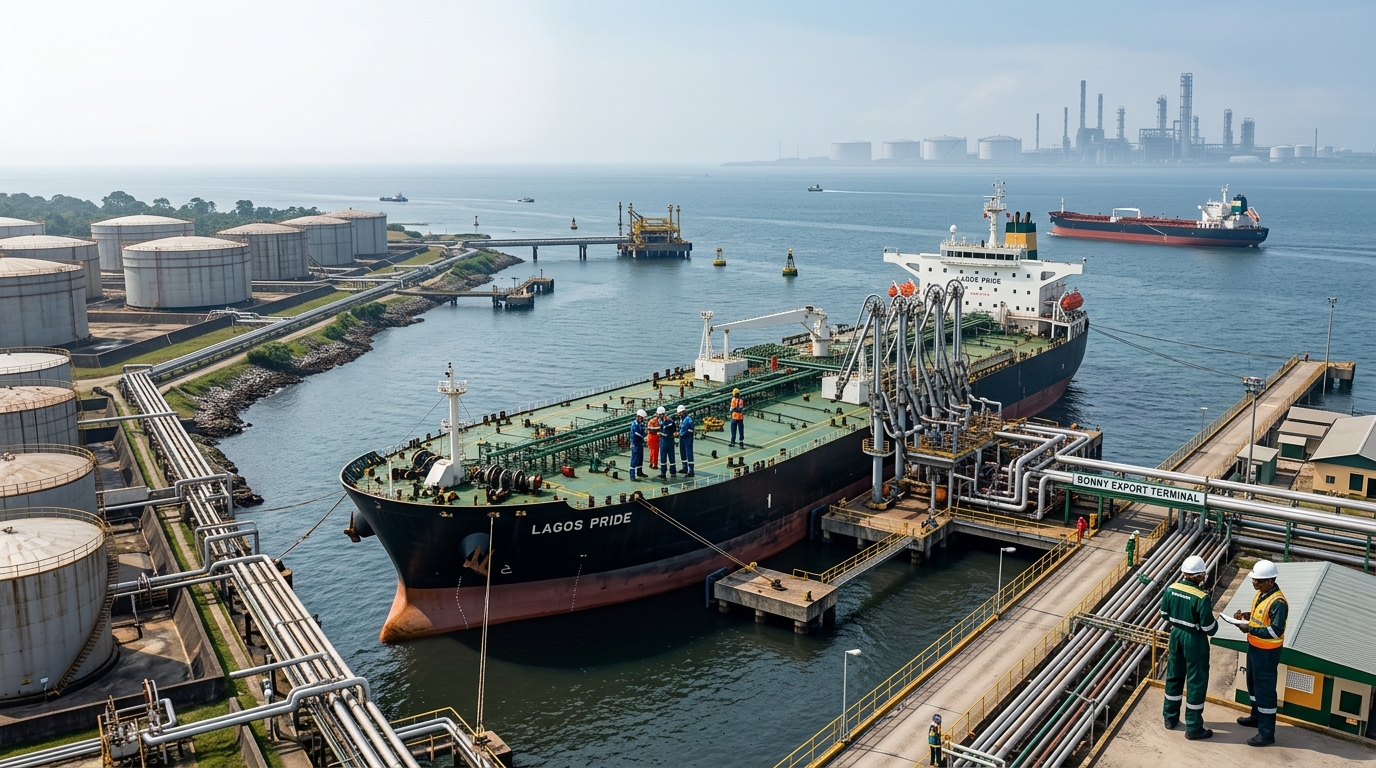
Nigerian Crude Oil Export Markets: Where Does Nigeria Sell Its Oil?
Nigeria is one of Africa’s established crude oil-producing countries, and its petroleum industry is closely connected to international energy markets.
But where does Nigerian crude oil actually go after it leaves the country’s production fields and export terminals?
The answer is broader than a single country or region.
Nigerian crude oil is exported to Europe, Asia, North America, Africa and other international markets, with the relative importance of each destination changing according to refinery demand, crude prices, shipping economics, refinery configuration and global market conditions.
According to the U.S. Energy Information Administration (EIA), Nigeria exported about 1.3 million barrels per day of crude oil and condensate in 2024, with Europe accounting for approximately 48% of those exports, Asia Pacific 21%, the Western Hemisphere 19%, and the Middle East and Africa 12%.
This makes Nigerian crude an important component of the international seaborne oil trade.
For international buyers, understanding these markets is useful when evaluating Nigerian crude supply, refinery procurement and trading opportunities.
Where Does Nigeria Sell Its Crude Oil?
Nigeria’s crude oil export markets can broadly be divided into several major regions:
- Europe
- Asia-Pacific
- North America and the wider Western Hemisphere
- Africa
- Other international destinations
Europe has historically represented the largest regional market for Nigerian crude.
However, individual countries within these regions can change in importance from year to year.
Crude oil is a globally traded commodity, so Nigerian cargoes can move toward whichever markets offer suitable refinery demand and commercially viable economics.
Nigeria’s Crude Oil Export Market at a Glance
Based on EIA’s 2024 destination analysis:
| Region | Approximate share of Nigerian crude oil and condensate exports |
|---|---|
| Europe | 48% |
| Asia Pacific | 21% |
| Western Hemisphere | 19% |
| Middle East & Africa | 12% |
The percentages are based on EIA’s 2024 destination data and may not add precisely to 100% because of rounding.
This distribution demonstrates that Nigerian crude has a geographically diversified customer base.
1. Europe Is a Major Market for Nigerian Crude Oil
Europe is one of the most important destination regions for Nigerian crude.
EIA’s 2024 data indicates that approximately 48% of Nigeria’s crude oil and condensate exports went to Europe.
Several European countries have historically purchased Nigerian crude.
These include:
- Spain
- France
- Netherlands
- Italy
- United Kingdom
- Germany
- Ireland
- Portugal and other European destinations
The exact volumes change from year to year.
European demand is important because the region contains numerous refineries that process imported crude from different producing countries.
Why Does Europe Buy Nigerian Crude?
Several factors can influence European demand for Nigerian crude.
Crude Quality
Many Nigerian crude grades are medium-to-light and relatively low in sulfur. EIA describes Nigerian crude as mostly medium-to-light with low sulfur content.
Geographic Position
Nigeria’s location on the Atlantic side of Africa provides relatively direct maritime access to European markets.
Refinery Compatibility
Individual Nigerian grades may be suitable for refineries designed to process particular crude characteristics.
Established Trading Relationships
Nigeria has supplied European markets for many years, creating established commercial relationships and infrastructure.
Shipping Economics
The economics of transporting a Nigerian cargo to Europe can be attractive depending on freight rates and prevailing crude prices.
Spain as a Nigerian Crude Oil Market
Spain is one of the European destinations that has historically received Nigerian crude.
Spanish refineries process imported crude from multiple international suppliers, meaning Nigerian crude competes with other grades available to European refiners.
For a refinery buyer, the question is not simply whether Nigerian crude is available.
The buyer must consider:
- Crude grade
- API gravity
- Sulfur
- Price
- Freight
- Refinery configuration
- Expected product yields
- Delivery timing
These factors determine whether a particular Nigerian cargo makes commercial sense.
France and Nigerian Crude
France is another European market associated with Nigerian crude exports.
Like other European refiners, French buyers can evaluate Nigerian crude against competing international grades.
The final purchasing decision can change according to global oil prices, refinery margins, freight rates and crude availability.
This is an important principle for anyone entering Nigerian crude oil trading:
International crude markets are competitive markets.
Nigeria competes with crude suppliers from Africa, the Middle East, the Americas and other producing regions.
The Netherlands and the Rotterdam Trading Hub
The Netherlands is particularly significant in international petroleum trading because of the importance of the Rotterdam energy and logistics hub.
Cargoes arriving in the Netherlands may serve domestic refining requirements or participate in wider European trading and distribution networks.
Consequently, a crude cargo recorded as going to the Netherlands does not necessarily mean that every barrel is ultimately consumed by a refinery located only within the Netherlands.
International petroleum hubs can function as points for:
- Storage
- Blending
- Trading
- Transshipment
- Refinery supply
- Regional distribution
This is one reason destination statistics should be interpreted carefully.
Italy and Nigerian Crude Oil
Italy is another European market that has purchased Nigerian crude.
Italian refineries can source crude from several producing regions, allowing procurement teams to compare Nigerian grades against alternatives.
A Nigerian crude cargo destined for Italy may therefore be evaluated based on its delivered refinery economics, rather than simply its headline purchase price.
The basic calculation can involve:
Crude Price + Freight + Insurance + Other Costs = Delivered Crude Cost
The refinery then compares this cost against expected refined-product value.
The United Kingdom and Nigerian Crude
The United Kingdom has also been a destination for Nigerian crude.
The UK’s refining and petroleum infrastructure connects it to the broader European energy market.
As with other destinations, Nigerian crude competes against alternative grades.
International buyers therefore need to consider the complete commercial picture rather than assuming that geographical proximity alone determines demand.
2. Asia-Pacific Is an Important Nigerian Crude Market
Asia-Pacific accounted for approximately 21% of Nigerian crude oil and condensate exports in 2024, according to EIA data.
This makes Asia an important destination for Nigerian crude.
Asian markets include countries such as:
- India
- Indonesia
- China and other Asian destinations depending on market conditions
The longer voyage from Nigeria to Asia means freight can play a particularly important role in determining whether a cargo is commercially attractive.
India Is an Important Buyer of Nigerian Crude
India is one of the notable Asian destinations for Nigerian crude.
EIA’s 2024 analysis shows India receiving approximately 9% of Nigeria’s crude oil and condensate exports.
India has a large refining industry and imports significant volumes of crude oil from international suppliers.
Its refineries process a diverse range of crude grades.
This creates opportunities for Nigerian crude when the quality, price and freight economics are compatible with refinery requirements.
Why Indian Refineries Consider Nigerian Crude
Indian refineries often process crude from multiple geographic sources.
A Nigerian crude cargo may be considered based on:
- API gravity
- Sulfur content
- Refinery compatibility
- Delivered price
- Freight
- Product yields
- Availability
- Timing
A refinery procurement team may compare Nigerian crude with crude from the Middle East, Russia, Africa, the Americas and other sources.
This competition is an important feature of international crude procurement.
Indonesia and Nigerian Crude Oil
Indonesia is another Asian destination for Nigerian crude.
Indonesia’s refining sector and energy demand can create opportunities for imported crude.
However, the commercial attractiveness of Nigerian crude to Indonesia depends heavily on transportation costs and the relationship between Nigerian crude prices and alternative supplies.
Long-distance crude trading is highly sensitive to freight.
A change in tanker rates can alter the economics of a cargo even when the crude price itself remains unchanged.
Why Asia Matters to Nigerian Oil Traders
For Nigerian crude oil traders, Asia provides access to a large and diverse group of refiners.
Asia is home to some of the world’s largest refining systems.
A trader evaluating Asian opportunities must therefore examine:
- Refinery demand
- Crude specifications
- Freight
- Vessel availability
- Delivery windows
- Benchmark pricing
- Refinery margins
- Competing crude grades
The result is a sophisticated market where Nigerian crude can compete when the commercial conditions are suitable.
3. The Western Hemisphere Is Another Nigerian Crude Market
EIA’s 2024 data indicates that approximately 19% of Nigerian crude oil and condensate exports went to the Western Hemisphere.
This category includes destinations in:
- North America
- The Caribbean
- South America
- Other Western Hemisphere markets
Canada and the United States have appeared among destinations for Nigerian crude.
Nigerian Crude Oil and the United States
The United States has historically imported Nigerian crude.
However, the U.S. petroleum market has changed substantially because domestic crude production has increased over the past decade.
This means Nigerian crude competes with growing domestic U.S. production and crude from other international suppliers.
Nevertheless, individual U.S. refineries may still evaluate imported crude according to refinery configuration, quality and delivered economics.
International crude trading therefore remains a matter of matching a particular crude stream with a suitable buyer.
Canada and Nigerian Crude
Canada has also appeared among destinations for Nigerian crude.
The country’s refining system and geographic distribution create different procurement requirements compared with European or Asian buyers.
A Nigerian cargo heading toward North America involves longer-distance shipping and therefore requires careful freight analysis.
This demonstrates an important principle:
The same Nigerian crude can have different commercial values in different destination markets.
4. Africa Is Also a Destination for Nigerian Petroleum
Nigeria’s crude oil exports are not exclusively directed toward Europe, Asia and North America.
African countries can also receive Nigerian petroleum.
EIA’s 2024 destination data identified South Africa and Côte d’Ivoire among the destinations for Nigerian crude oil and condensate.
Regional African trade can become increasingly relevant as refining capacity develops across the continent.
South Africa and Nigerian Crude
South Africa has a substantial petroleum market and relies on imported crude and refined products.
Its geographical location means Nigerian crude travels a considerable distance, but crude quality and market conditions can still make particular cargoes commercially relevant.
African petroleum trade is likely to remain an important part of the continent’s energy system as countries expand refining and petroleum infrastructure.
Côte d’Ivoire and Regional Petroleum Trade
Côte d’Ivoire is another West African destination appearing in Nigerian crude export data.
Regional trade can provide logistical advantages compared with shipments traveling to distant markets.
The growth of African refining capacity could potentially create additional opportunities for crude producers and traders within the continent.
5. Nigerian Crude Does Not Have One Permanent Export Destination
One of the biggest misconceptions about Nigerian crude oil exports is that Nigeria sells its oil to the same countries every year.
International crude trading does not work that way.
Destination patterns change.
A cargo may move toward Europe one month and another cargo may move toward Asia depending on:
- Refinery demand
- Crude pricing
- Freight rates
- Supply availability
- Refinery maintenance
- Seasonal demand
- Global geopolitical developments
- Arbitrage opportunities
Therefore, Nigeria’s crude export market should be viewed as a dynamic international network rather than a fixed list of customers.
Nigerian Crude Oil Export Markets Change With Global Prices
Crude oil is traded in a highly competitive international market.
Suppose European refinery demand increases while Asian demand declines.
The economics of sending Nigerian crude to Europe may become more attractive.
If Asian refinery demand subsequently strengthens while European demand weakens, the commercial balance can change again.
This is one reason oil traders constantly monitor international markets.
The Role of Brent in Nigerian Crude Pricing
Many Nigerian crude grades are priced relative to international crude benchmarks.
Brent-related pricing is particularly important for Atlantic Basin crude markets.
However, the final transaction price depends on the specific crude grade and commercial terms.
The price may incorporate a premium or discount relative to a benchmark.
Factors affecting that differential can include:
- Quality
- Supply
- Demand
- Freight
- Refinery economics
- Market conditions
Therefore, international buyers should evaluate the full pricing formula, not only the benchmark.
Why Crude Quality Influences Export Destinations
Different refineries require different crude characteristics.
Important characteristics include:
- API gravity
- Sulfur
- Acidity
- Metals
- Water and sediment
- Distillation profile
- Other contaminants
Nigeria produces a range of crude grades.
EIA’s Nigerian crude-grade table shows substantial variation between grades. For example, it lists Bonny Light at about 35° API and 0.15% sulfur, while Qua Iboe is listed at about 38° API and 0.12% sulfur.
This means Nigerian crude should not be treated as a single standardized product.
Bonny Light and International Markets
Bonny Light is one of Nigeria’s best-known crude grades.
Its relatively light and low-sulfur characteristics have historically made it relevant to international refiners.
International buyers interested in this grade can learn more through:
https://paradisemultitrade.com/buy-bonny-light-crude-oil-from-nigeria/
However, buyers should distinguish between a crude grade’s general specification and the availability of a specific cargo.
Forcados and Global Buyers
Forcados is another important Nigerian crude stream.
Buyers interested in Forcados can explore:
https://paradisemultitrade.com/buy-forcados-crude-oil-from-nigeria/
The commercial evaluation should include the specific cargo specification, loading arrangements, quantity, pricing and delivery requirements.
How Nigerian Crude Reaches International Markets
The export journey generally involves several stages:
PRODUCTION
↓
GATHERING / PROCESSING
↓
EVACUATION
↓
STORAGE
↓
EXPORT TERMINAL
↓
INSPECTION
↓
TANKER LOADING
↓
INTERNATIONAL SHIPPING
↓
DESTINATION PORT
↓
REFINERY / BUYER
This supply chain connects Nigerian petroleum production with international energy markets.
The Importance of Nigerian Export Terminals
Nigeria’s export infrastructure is an essential part of its international crude business.
Export terminals connect production assets to ocean-going tankers.
Cargoes can then be transported to international destinations.
For a buyer, the loading location matters because it can influence:
- Freight
- Vessel selection
- Loading schedule
- Cargo availability
- Marine logistics
- Insurance
- Delivery timing
This is why professional crude procurement requires more than identifying a crude grade.
Shipping Costs Can Change the Destination
Imagine two buyers offer the same price for a Nigerian crude cargo.
Buyer A is located in Europe.
Buyer B is located in Asia.
If shipping to Europe costs substantially less, the European transaction may provide different delivered economics.
However, the buyer offering the higher crude price could still be commercially competitive if its netback after freight is attractive.
This is why traders examine netbacks and delivered economics rather than simply comparing headline crude prices.
Tanker Chartering in Nigerian Crude Exports
Crude oil moves internationally primarily through marine transportation.
The vessel must be suitable for:
- Cargo volume
- Loading terminal
- Destination
- Draft restrictions
- Voyage requirements
- Charter terms
- Safety requirements
International buyers requiring shipping assistance can explore:
https://paradisemultitrade.com/crude-oil-shipping-tanker-charter-assistance/
The shipping component can be a major part of the overall transaction structure.
Inspection and Quality Verification
International crude transactions commonly require verification of quantity and quality according to contractual requirements.
Testing may involve:
- API gravity
- Sulfur
- Water
- Sediment
- Metals
- Other agreed parameters
Buyers can explore commodity analysis and laboratory testing support at:
https://paradisemultitrade.com/commodity-analysis-laboratory-testing/
The exact inspection process depends on the contract and transaction structure.
How International Buyers Source Nigerian Crude
A buyer interested in Nigerian crude should begin with a clearly defined procurement requirement.
The buyer should identify:
- Required crude grade
- Quantity
- Delivery location
- Preferred delivery period
- Refinery requirements
- Inspection requirements
- Commercial terms
- Shipping requirements
A structured enquiry can then be submitted through:
https://paradisemultitrade.com/nigerian-crude-oil-supplier-enquiry/
Buyer Registration for Nigerian Crude
For larger commercial transactions, proper buyer identification and due diligence are important.
A buyer registration process can provide relevant information about:
- Buying company
- Country
- Business activity
- Refinery
- Contact information
- Product requirement
- Authorized representatives
International buyers can access:
https://paradisemultitrade.com/crude-oil-buyer-registration/
LOI and ICPO for Nigerian Crude Procurement
A buyer may use an LOI or ICPO to communicate purchasing requirements, depending on the transaction process.
Such documentation can identify:
- Product
- Quantity
- Destination
- Delivery requirements
- Buyer information
- Commercial intent
However, an LOI or ICPO should not automatically be interpreted as proof that a particular cargo exists or that a transaction is guaranteed.
Buyers can submit relevant documentation through:
https://paradisemultitrade.com/submit-loi-icpo-for-nigerian-crude-oil/
Requesting an FCO
A buyer may also need to review a Full Corporate Offer where applicable.
The document should be carefully reviewed for:
- Crude grade
- Quantity
- Price
- Pricing formula
- Loading point
- Delivery terms
- Inspection
- Payment conditions
- Contractual requirements
Relevant buyers can explore:
https://paradisemultitrade.com/request-fco-for-nigerian-crude-oil/
Refinery Procurement and Nigerian Crude
Refineries are among the most important participants in the Nigerian crude market.
A refinery procurement team may evaluate several Nigerian grades before selecting a cargo.
The assessment can include:
TECHNICAL FIT
↓
CRUDE PRICE
↓
FREIGHT
↓
REFINERY YIELD
↓
PRODUCT VALUE
↓
NETBACK
This process explains why crude procurement is more sophisticated than simply finding the lowest-priced barrel.
For companies requiring assistance with procurement coordination, see:
https://paradisemultitrade.com/refinery-procurement-support/
Nigeria’s Export Market Is Evolving
Nigeria’s crude export market is not static.
The country’s petroleum sector is experiencing changes in:
- Upstream production
- New crude grades
- Domestic refining
- Export infrastructure
- Refinery demand
- International trading patterns
EIA notes that two newer Nigerian crude grades, Utapate and Obodo, entered the market in November 2024 and April 2025 respectively.
The development of new grades can give international refiners additional crude options.
Domestic Refining Is Changing Nigeria’s Petroleum Trade
Nigeria is also becoming a more significant refining market.
The Dangote refinery has substantially changed Nigeria’s downstream petroleum landscape.
EIA reported that the refinery reached its designed 650,000 barrels-per-day capacity in February 2026, and subsequent operations contributed to increased petroleum-product shipments from Nigeria.
This development means Nigeria’s petroleum trade increasingly includes both:
- Crude oil exports
- Refined petroleum product exports
The balance between domestic crude consumption and crude exports will continue to influence the country’s international petroleum market.
Why International Buyers Should Monitor Nigerian Export Markets
For an international refinery or trading company, monitoring Nigerian export destinations can provide useful market intelligence.
Destination changes can indicate shifts in:
- Refinery demand
- Crude pricing
- Freight economics
- Supply availability
- Regional market conditions
A buyer that understands these changes can make better-informed procurement decisions.
What Makes Nigerian Crude Attractive to Different Markets?
There is no single reason.
Different buyers may value Nigerian crude for different reasons.
European Buyers
May consider geographic proximity, crude characteristics and refinery compatibility.
Asian Buyers
May consider crude quality, refinery configuration and delivered economics.
North American Buyers
May evaluate Nigerian crude against domestic and imported alternatives.
African Buyers
May consider regional supply opportunities, refinery requirements and logistics.
The same Nigerian crude therefore has different commercial considerations depending on its destination.
Is Nigeria Dependent on One Crude Oil Market?
No.
Nigeria’s export data demonstrates a geographically diversified crude market.
In 2024, Europe was the largest regional destination, but substantial Nigerian crude also went to Asia-Pacific and the Western Hemisphere.
This diversification can give Nigerian crude access to multiple refinery markets.
At the same time, the actual destination mix changes over time.
How Paradise MultiTrade Supports Nigerian Crude Procurement
Paradise MultiTrade International Limited is a Nigerian-based international trading and commercial coordination company focused on connecting qualified international buyers with Nigerian supply opportunities.
For companies interested in Nigerian crude, the commercial process may involve:
- Supplier enquiries
- Crude grade identification
- Buyer registration
- Commercial coordination
- Documentation coordination
- Inspection coordination
- Refinery procurement support
- Shipping coordination
International companies can contact Paradise MultiTrade to discuss their requirements.
For oil and gas-specific enquiries, buyers can use:
https://paradisemultitrade.com/contact-paradise-multitrade-oil-and-gas-desk/
Frequently Asked Questions
Where does Nigeria sell its crude oil?
Nigeria exports crude oil to several international regions, including Europe, Asia-Pacific, the Western Hemisphere and Africa. Europe was the largest regional destination in 2024, accounting for approximately 48% of crude oil and condensate exports.
Which country buys the most Nigerian crude oil?
The leading individual destination can vary by year. In EIA’s 2024 destination breakdown, several European countries and India were significant destinations.
Does Nigeria sell crude oil to India?
Yes. India is an established destination for Nigerian crude and accounted for approximately 9% of Nigeria’s crude oil and condensate exports in 2024 according to EIA data.
Does Nigeria export crude oil to Europe?
Yes. Europe was Nigeria’s largest regional destination for crude oil and condensate exports in 2024, accounting for approximately 48%.
Does Nigeria export crude oil to Africa?
Yes. African destinations including South Africa and Côte d’Ivoire have received Nigerian crude.
Does Nigeria export crude oil to the United States?
The United States has historically imported Nigerian crude, although U.S. domestic production and changing refinery economics affect the level of demand.
What are Nigeria’s main crude oil export markets?
The major regional markets are Europe, Asia-Pacific, the Western Hemisphere and Africa.
What Nigerian crude grades are sold internationally?
Nigeria exports multiple crude grades, including Bonny Light, Forcados, Qua Iboe, Bonga, Egina and other streams. EIA also identifies newer grades such as Utapate and Obodo.
Can an international refinery buy Nigerian crude?
Qualified international buyers can participate in Nigerian crude procurement subject to appropriate commercial, regulatory and due-diligence requirements.
How can I request Nigerian crude?
You can begin by submitting a Nigerian crude oil supplier enquiry:
https://paradisemultitrade.com/nigerian-crude-oil-supplier-enquiry/
Conclusion
Nigeria’s crude oil export market is global, diversified and constantly changing.
Europe remains a major destination, accounting for about 48% of Nigeria’s crude oil and condensate exports in 2024. Asia-Pacific represented about 21%, while the Western Hemisphere accounted for approximately 19%.
Within these regions, countries such as Spain, France, the Netherlands, Italy, India, Indonesia, Canada, the United States, South Africa and Côte d’Ivoire have appeared among destinations for Nigerian crude.
The precise destination of each cargo depends on commercial factors such as crude quality, refinery compatibility, price, freight, availability and market demand.
For international buyers, this means Nigerian crude should be evaluated on a cargo-by-cargo and refinery-by-refinery basis.
Nigeria’s petroleum industry is also changing as domestic refining capacity expands, new crude grades enter the market and upstream investment develops.
For companies seeking to participate in the Nigerian crude oil market, understanding these export destinations is an important first step.
To discuss Nigerian crude procurement, visit:
https://paradisemultitrade.com/buy-nigerian-crude-oil/
Or submit a specific supplier enquiry:
https://paradisemultitrade.com/nigerian-crude-oil-supplier-enquiry/