
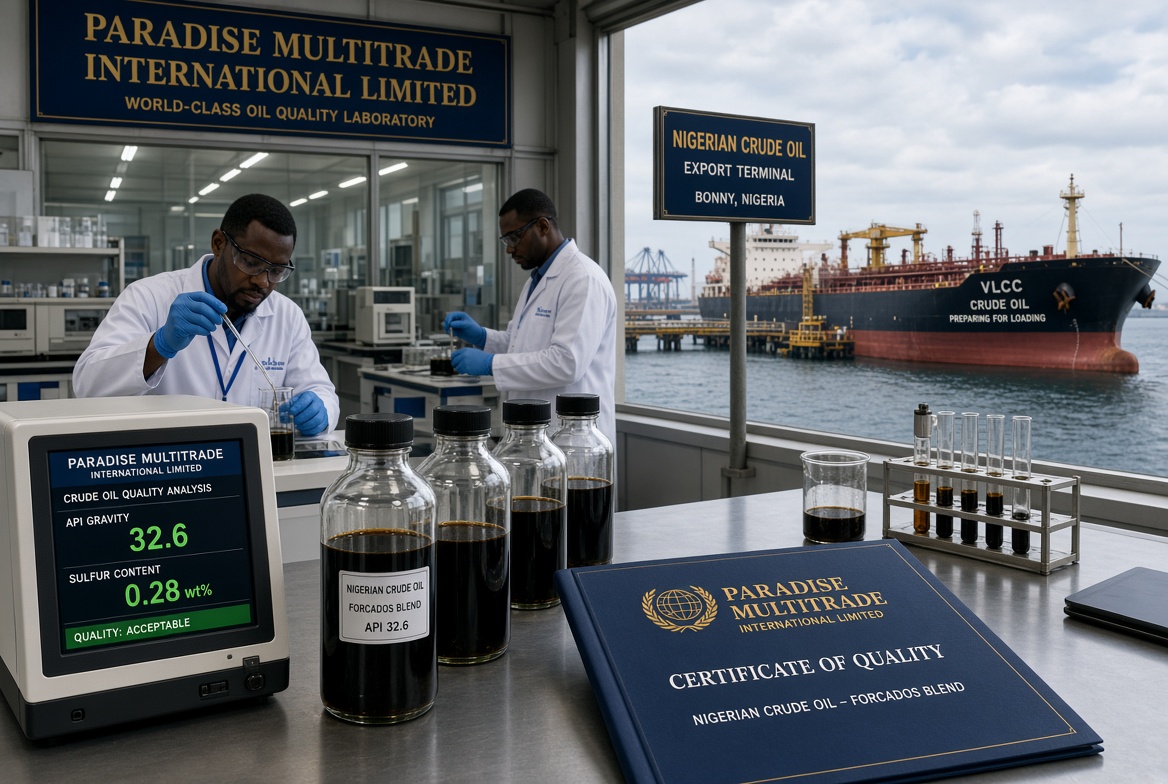
Certificate of Quality (COQ) in Crude Oil Trading: How Buyers Verify Oil Quality Before Shipment
A crude oil contract may specify Bonny Light, Forcados, or Qua Iboe, but how does the buyer know the cargo actually meets those specifications?
The answer is simple.
It gets tested.
The document that records those laboratory results is called the Certificate of Quality (COQ).
In international crude oil trading, this document gives buyers confidence that the cargo being loaded matches the agreed commercial specifications. It helps reduce disputes, supports trade finance documentation, and provides technical evidence about the characteristics of the crude oil.
If you’re following our Paradise MultiTrade International Limited Oil & Gas series, first read Bill of Lading (https://paradisemultitrade.com/bill-of-lading-bl-crude-oil-trading ), Proof of Product (POP) in Crude Oil Trading (https://paradisemultitrade.com/proof-of-product-pop-crude-oil-trading ), and Crude Oil Lifting Procedures (https://paradisemultitrade.com/crude-oil-lifting-procedures ) before continuing.
Key Takeaways
-
The COQ records laboratory-tested crude oil properties.
-
Independent inspection companies frequently issue or verify quality certificates.
-
API gravity and sulfur content are among the most important measurements.
-
Buyers use the COQ to confirm contractual specifications.
-
Quality verification helps reduce commercial disputes.
What Is a Certificate of Quality (COQ)?
A Certificate of Quality is a document that records laboratory test results describing the physical and chemical characteristics of a crude oil cargo.
Think of it as the crude oil’s medical report.
Instead of describing a person’s health, it describes the condition of the cargo.
The COQ provides measurable data that helps buyers understand exactly what they are receiving.
Why the COQ Matters
Every refinery is designed to process particular types of crude oil.
Small differences in quality can affect:
-
refining efficiency
-
product yields
-
processing costs
-
equipment performance
Because of this, quality verification becomes a critical part of international oil transactions.
Where the COQ Fits in the Transaction Process
A simplified workflow looks like this:
-
Inquiry
-
LOI
-
ICPO
-
FCO
-
SPA
-
POP
-
Vessel Nomination
-
NOR
-
Cargo Loading
-
Laboratory Testing
-
Certificate of Quality
-
Bill of Lading
-
Shipment
The COQ supports confidence that the loaded cargo matches agreed specifications.
Who Issues a Certificate of Quality?

The COQ is often prepared through laboratory testing performed by recognized inspection organizations.
Examples include:
-
SGS – https://www.sgs.com
-
Bureau Veritas – https://www.bureauveritas.com
-
Intertek – https://www.intertek.com
These companies provide testing, inspection, verification, and certification services across international commodity markets.
What Information Appears on a COQ?
A professionally prepared Certificate of Quality typically includes:
-
cargo identification
-
crude grade
-
sampling date
-
testing location
-
laboratory measurements
-
inspection details
-
authorized signatures
Every measurement supports commercial confidence.
Understanding API Gravity

One of the most important numbers on the COQ is API gravity.
API gravity measures how light or heavy crude oil is compared with water.
Generally speaking:
-
Higher API values indicate lighter crude.
-
Lower API values indicate heavier crude.
This measurement helps refineries understand processing characteristics.
For example, Bonny Light Crude Oil (https://paradisemultitrade.com/bonny-light-crude-oil-quality-pricing-buyers ) is widely recognized as a relatively light, sweet crude.
Understanding Sulfur Content
Another major quality indicator is sulfur.
Lower sulfur content generally makes crude easier to refine into cleaner petroleum products.
This is why buyers carefully examine sulfur measurements before accepting cargo.
Crude grades such as Qua Iboe Crude Oil (https://paradisemultitrade.com/qua-iboe-crude-oil-guide ) and Forcados Crude Oil (https://paradisemultitrade.com/forcados-crude-oil-global-demand ) are frequently discussed in terms of their quality characteristics.
Other Laboratory Tests

A COQ may also include measurements such as:
-
water content
-
sediment
-
density
-
viscosity
-
flash point
-
other agreed laboratory parameters
The exact tests depend on the transaction and applicable standards.
Why Buyers Trust Independent Inspection
Professional buyers rarely rely solely on seller statements.
Independent inspection provides additional confidence because testing is performed using recognized laboratory procedures.
This strengthens commercial credibility during international transactions.
COQ vs Certificate of Quantity
Many newcomers confuse these two documents.
|
COQ |
Certificate of Quantity |
|---|---|
|
Measures quality |
Measures volume |
|
Laboratory testing |
Quantity verification |
|
Technical properties |
Cargo measurement |
|
Supports product specifications |
Supports volume confirmation |
Both documents are important—but they answer different questions.
How COQs Connect to Nigerian Crude Exports

For Nigerian crude grades such as Bonny Light Crude Oil (https://paradisemultitrade.com/bonny-light-crude-oil-quality-pricing-buyers ), Forcados Crude Oil (https://paradisemultitrade.com/forcados-crude-oil-global-demand ), Qua Iboe Crude Oil (https://paradisemultitrade.com/qua-iboe-crude-oil-guide ), Bonga Crude Oil (https://paradisemultitrade.com/bonga-crude-oil-deepwater-export-guide ), and Egina Crude Oil (https://paradisemultitrade.com/egina-crude-oil-deepwater-export-guide ), laboratory quality verification becomes an important part of cargo documentation.
Understanding export operations becomes easier if you’ve already studied Nigerian Crude Oil Export Terminals (https://paradisemultitrade.com/nigerian-crude-oil-export-terminals ) and Proof of Product (POP) in Crude Oil Trading (https://paradisemultitrade.com/proof-of-product-pop-crude-oil-trading ).
Nigeria’s upstream petroleum activities operate under the oversight of the Nigerian Upstream Petroleum Regulatory Commission (NUPRC) – https://www.nuprc.gov.ng , while quality standards also interact with broader international testing practices.
International Standards Behind Oil Quality Testing
Crude oil quality testing follows internationally recognized laboratory methods.
Relevant organizations include:
-
ASTM International – https://www.astm.org , which publishes petroleum testing standards.
-
International Organization for Standardization (ISO) – https://www.iso.org , which develops international quality standards.
-
SGS – https://www.sgs.com , which performs inspection and testing services.
-
Bureau Veritas – https://www.bureauveritas.com , which provides verification services.
-
Intertek – https://www.intertek.com , which conducts laboratory testing worldwide.
-
International Energy Agency (IEA) – https://www.iea.org , which publishes valuable crude market intelligence.
-
OPEC – https://www.opec.org , which publishes production and market reports.
Common COQ Mistakes
Avoid these common mistakes.
Accepting Unverified Laboratory Reports
Independent verification matters.
Ignoring API Gravity
It influences refinery performance.
Overlooking Sulfur Content
Sulfur significantly affects processing.
Confusing COQ with Quantity Certificates
Quality and quantity are different.
Failing to Compare Results with Contract Specifications
Always compare laboratory results with the SPA.
The Oil Trading Document Chain
As Paradise MultiTrade International Limited’s Oil & Gas knowledge hub grows, each article connects naturally.
Typical progression:
-
LOI
-
ICPO
-
FCO
-
SPA
-
POP
-
Vessel Nomination
-
NOR
-
Laytime
-
Demurrage
-
Bill of Lading
-
Certificate of Quality
-
Certificate of Quantity
-
Shipment
Our next article covers the Certificate of Quantity (COQTY)—the document that confirms how much crude oil was actually loaded before the vessel sails.
Frequently Asked Questions
What is a Certificate of Quality?
It is a laboratory document describing the measured characteristics of a crude oil cargo.
Who issues the COQ?
Recognized inspection companies frequently perform the testing and issue or verify the documentation.
Why is API gravity important?
It helps describe whether crude oil is relatively light or heavy.
Does sulfur content matter?
Yes. Sulfur significantly influences refining characteristics.
Is a COQ the same as a quantity certificate?
No. One measures quality, while the other measures volume.
Why Paradise MultiTrade Focuses on Quality Verification
At Paradise MultiTrade International Limited, we believe successful crude oil transactions depend on technical verification—not assumptions.
Our Oil & Gas division focuses on:
-
international buyer sourcing
-
trade facilitation
-
quality verification
-
shipping coordination
-
cargo documentation
-
transaction due diligence
Understanding Certificates of Quality helps businesses participate more confidently in legitimate international petroleum transactions.
Conclusion
The Certificate of Quality is one of the most important technical documents in international crude oil trading because it provides laboratory evidence that the cargo meets agreed specifications. From API gravity and sulfur content to independent inspection and international testing standards, the COQ helps buyers, sellers, banks, and refineries make informed commercial decisions.
For companies involved in Nigerian crude exports, mastering quality verification builds credibility with inspection companies, refinery procurement teams, shipping professionals, and commercial counterparties. As Paradise MultiTrade International Limited’s Oil & Gas knowledge hub continues to grow, understanding laboratory documentation becomes another essential step toward participating professionally in real-world crude oil transactions.