
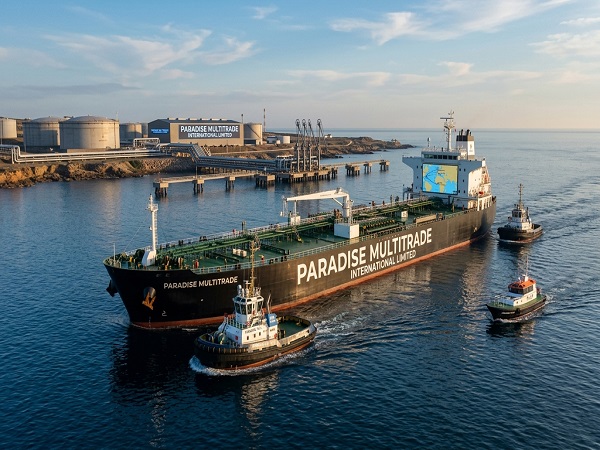
Aframax Tankers Explained: The Versatile Oil Tankers Powering Global Crude Transportation
Not every crude oil shipment requires a giant VLCC carrying two million barrels.
In fact, one of the busiest workhorses of the global petroleum industry is a smaller—but incredibly versatile—vessel known as the Aframax tanker.
These ships strike a balance between cargo capacity and operational flexibility, allowing them to serve many ports that larger vessels cannot easily access. That combination has made Aframax tankers one of the world’s most widely used crude oil vessel classes.
For companies exporting Bonny Light, Forcados, Qua Iboe, Bonga, and Egina crude, understanding Aframax logistics helps improve conversations with buyers, charterers, shipping companies, and refinery procurement teams.
If you’re following our Paradise MultiTrade International Limited Oil & Gas series, first read VLCC Guide — https://paradisemultitrade.com/vlcc-very-large-crude-carrier-crude-oil-trading , Suezmax Guide — https://paradisemultitrade.com/suezmax-tanker-crude-oil-shipping-guide , and Ship-to-Ship (STS) Guide — https://paradisemultitrade.com/ship-to-ship-sts-crude-oil-transfers before continuing.
Key Takeaways
-
Aframax tankers are among the world’s most versatile crude oil vessels.
-
They typically fall within the 80,000–120,000 DWT classification.
-
They generally carry around 600,000–800,000 barrels of crude oil, depending on vessel design and cargo characteristics.
-
They offer greater port accessibility than larger tankers.
-
They play an important role in regional and medium-distance crude oil transportation.
What Is an Aframax Tanker?
An Aframax tanker is a crude oil vessel classified within the 80,000–120,000 deadweight ton (DWT) range under the Average Freight Rate Assessment (AFRA) system developed by Shell in the 1950s to help standardize tanker freight classifications.
Unlike much larger supertankers, Aframax vessels were designed to maximize commercial efficiency while remaining practical for many ports around the world.
Their versatility explains why they remain one of the industry’s most popular tanker classes.
How Much Oil Can an Aframax Carry?
A typical Aframax tanker carries roughly 600,000–800,000 barrels of crude oil, although the exact cargo depends on:
-
vessel specifications
-
crude density
-
loading restrictions
-
draft limitations
-
voyage planning
-
safety requirements
Just like other tanker classes, actual cargo varies from voyage to voyage.
Where Did the Name Aframax Come From?
Many people assume Aframax refers to Africa.
It doesn’t.
The name comes from Average Freight Rate Assessment (AFRA)—a freight classification system introduced by Shell in 1954 that became widely adopted across the tanker industry.
Today, the term Aframax is recognized globally as a tanker size category rather than a geographic reference.
Aframax vs Suezmax vs VLCC
Understanding the three major tanker classes helps traders choose the right vessel for different commercial situations.
|
Feature |
Aframax |
Suezmax |
VLCC |
|---|---|---|---|
|
DWT Range |
80k–120k |
120k–200k |
200k+ |
|
Typical Cargo |
600k–800k barrels |
Around 1 million barrels |
Around 2 million barrels |
|
Port Flexibility |
High |
Moderate |
More limited |
|
Best For |
Regional & medium routes |
International routes |
Large-scale exports |
This comparison shows why vessel selection depends on logistics—not simply cargo size.

Why Aframax Tankers Are So Popular
One reason Aframax vessels remain in high demand is their ability to combine:
-
substantial cargo capacity
-
port flexibility
-
efficient regional transportation
-
commercial practicality
Many ports that cannot easily accommodate a fully loaded VLCC can often handle an Aframax more comfortably.
That flexibility creates important commercial advantages.
Why Port Access Matters
Imagine two buyers.
One refinery has deepwater infrastructure.
Another has tighter draft limitations.
The second refinery may benefit more from receiving crude through a vessel class that better fits its operational environment.
This is why vessel selection becomes part of commercial planning rather than an afterthought.

Aframax and Nigerian Crude Exports
Nigeria exports several internationally recognized crude grades.
These include:
Depending on the cargo size, destination, and commercial arrangement, different vessel classes may become appropriate for export operations.
Aframax and Freight Economics
Professional buyers evaluate more than the crude oil price.
Transportation costs matter.
Freight can be influenced by:
-
voyage distance
-
bunker fuel prices
-
vessel availability
-
port charges
-
market demand
-
seasonal shipping conditions
This connects directly to FOB vs CIF Guide — https://paradisemultitrade.com/fob-vs-cif-crude-oil-trading .
Vessel Nomination Still Comes First
Before an Aframax arrives at a loading terminal, operational planning takes place.
This includes:
-
vessel nomination
-
scheduling
-
terminal coordination
-
logistics preparation
Learn more in Vessel Nomination Guide — https://paradisemultitrade.com/vessel-nomination-crude-oil-trading .
A successful shipment begins long before loading starts.
Why Aframax Works Well on Regional Routes

Industry sources note that Aframax vessels are commonly used on routes such as:
-
the Mediterranean
-
the North Sea
-
the Caribbean
-
regional crude transportation markets
Their size allows them to operate efficiently where larger tankers may face greater infrastructure limitations.
Aframax and Ship-to-Ship Operations
Some Aframax vessels may participate in professionally planned Ship-to-Ship (STS) operations where appropriate.
These operations rely on:
-
marine coordination
-
communication
-
specialized equipment
-
safety planning
Read Ship-to-Ship Guide — https://paradisemultitrade.com/ship-to-ship-sts-crude-oil-transfers .

Common Mistakes New Oil Traders Make
Mistake 1: Thinking Aframax Means African Tanker
The name comes from the AFRA freight system—not Africa.
Mistake 2: Confusing DWT With Barrels
Deadweight tonnage is not the same as cargo volume.
Mistake 3: Assuming Bigger Is Always Better
The right vessel depends on the route and terminal.
Mistake 4: Ignoring Freight
Delivered cost matters.
Mistake 5: Forgetting Port Restrictions
Infrastructure influences vessel selection.
Official Industry References
Several organizations provide valuable shipping information.
-
U.S. Energy Information Administration (EIA) — https://www.eia.gov/todayinenergy/detail.php?id=17991
-
International Maritime Organization (IMO) — https://www.imo.org
-
BIMCO — https://www.bimco.org
-
OCIMF — https://www.ocimf.org
-
NUPRC — https://www.nuprc.gov.ng
These organizations publish information that supports professional shipping and petroleum operations.
The Oil Trading Journey So Far
Our Paradise MultiTrade International Limited Oil & Gas knowledge hub continues expanding into a comprehensive international petroleum resource.
We’ve now covered:
-
Commercial documentation
-
Buyer procurement
-
Shipping logistics
-
Storage operations
-
Tanker classes
-
Marine transfers
-
Nigerian crude grades
And now:
Aframax Tankers.
The next article moves into another highly searched maritime topic:
ULCC (Ultra Large Crude Carrier) Explained — the biggest oil tankers ever built, why they’re less common than VLCCs, and how they shaped global petroleum transportation.
This will complete our major crude tanker-class series.
Frequently Asked Questions
What does Aframax mean?
Aframax refers to a tanker class based on the Average Freight Rate Assessment (AFRA) system.
How much oil can an Aframax carry?
Typically around 600,000–800,000 barrels, depending on vessel and cargo characteristics.
Is an Aframax larger than a Suezmax?
No. Suezmax vessels are generally larger.
Why are Aframax vessels popular?
They combine strong cargo capacity with excellent port accessibility.
Can Nigerian crude be exported on Aframax vessels?
Yes. Depending on commercial and logistical requirements, Nigerian crude cargoes may be transported using Aframax vessels.
Why Paradise MultiTrade Understands Tanker Logistics
At Paradise MultiTrade International Limited, we believe successful crude oil trading requires understanding both commercial documentation and physical logistics.
Our Oil & Gas division focuses on:
-
International buyer sourcing
-
Shipping coordination
-
Vessel logistics
-
Export planning
-
Due diligence
-
Commercial professionalism
Understanding Aframax tankers helps us communicate more confidently with shipping companies, charterers, refinery procurement teams, and international buyers.
Conclusion
Aframax tankers remain one of the most important vessel classes in international crude oil transportation because they combine substantial cargo capacity with the flexibility to serve many ports that larger tankers cannot easily access. Their 80,000–120,000 DWT classification has made them a practical choice for regional and medium-distance crude oil movements around the world.
For companies exporting Bonny Light, Forcados, Qua Iboe, Bonga, and Egina crude, understanding Aframax logistics strengthens credibility with international buyers, charterers, and shipping companies. As Paradise MultiTrade International Limited’s Oil & Gas knowledge hub continues growing, mastering vessel classes like Aframax becomes another important step toward participating professionally in real-world global oil transactions.
Paradise MultiTrade International Limited | NEPC Export Licence No. 0042385 | CAC No. RC-9284647 | Lagos, Nigeria | www.paradisemultitrade.com