


Nigerian White Yam: The Crop That Built West African Civilisation, Feeds 200 Million People Daily, and Commands Reverence That No Other Root Vegetable on Earth Has Ever Earned — Now Available Direct From the World’s Largest Producer
Yam Exporter Nigeria — Fresh White Yam Tubers, Pounded Yam Flour, and Processed Yam Products, Direct Farm Sourcing, Bulk Supply to Diaspora Importers, Food Manufacturers, and Wholesale Buyers Worldwide
Yam exporter Nigeria is a search phrase that carries weight no other agricultural commodity export search quite replicates, because the product behind it is not merely a food crop or a commercial commodity. In Nigeria, yams are a cultural institution of such depth and pervasiveness that understanding it purely as an agricultural export misses the larger story that makes them commercially significant. Dioscorea rotundata — the white yam, the true yam of West African tradition, the Isu of Igbo cultural identity, the Iyán of Yoruba culinary tradition, the Doya of Hausa farming communities — has been grown, harvested, stored, traded, celebrated, and consumed in Nigeria for at least 5,000 years. It predates every other commercial crop in the country’s agricultural history. It has its own festivals. It has its own royalty protocols. It has its own economic calendar that once structured the entire social year of farming communities across the forest belt. No other root vegetable in the world — not potato, not cassava, not sweet potato — carries this accumulated cultural, economic, and spiritual significance in its country of origin.
And Nigeria does not merely produce yams as one of many competing in a balanced global market. Nigeria dominates global white yam production with a supremacy that has no parallel in any other agricultural commodity of its significance. According to FAO production statistics, Nigeria produces approximately 67–70% of the world’s total yam output — a market share so dominant that when Nigeria’s harvest is affected by drought, flooding, or pest pressure, global yam prices move in response regardless of what any other producing country does. The yam trade runs through Nigeria the way the coffee trade runs through Brazil or the cocoa trade runs through Côte d’Ivoire — not as a participant but as the market-defining origin that all others are measured against.
At Paradise MultiTrade International Limited, Nigerian white yam is one of our most culturally significant and commercially dynamic export categories — sourced from the primary yam-producing states of Benue, Kogi, Taraba, Niger, Oyo, Ondo, and Plateau where Nigeria’s most commercially significant white yam varieties are cultivated, processed into fresh tubers, sliced and dried yam chips, pounded yam flour, and other processed forms appropriate to international market requirements, and exported with full regulatory and food safety documentation to diaspora food importers, ethnic food wholesale distributors, West African food manufacturers, and food service buyers across Europe, North America, the Middle East, and beyond.
If you are ready to discuss sourcing immediately, request a quotation here and our export team will respond within 48 hours.
History and Origin of Nigerian White Yam — The Crop That Was Sacred Before It Was Commercial
A Domestication Story Written in West African Soil
The domestication of Dioscorea rotundata — white yam — is one of the most significant and least widely known agricultural achievements in human history. While the academic world’s discussion of crop domestication centres predominantly on the Fertile Crescent’s wheat and barley, China’s rice and millet, and Mesoamerica’s maize and squash — the independent domestication of Dioscorea rotundata in West Africa represents an agricultural revolution of comparable scale and consequence that occurred entirely separately from those celebrated centres of plant domestication, driven by entirely different human communities responding to entirely different ecological conditions.
Botanical and archaeological evidence — including analysis of wild Dioscorea populations across the Guinea forest zone and genetic diversity studies accessible through research databases maintained by the International Institute of Tropical Agriculture (IITA) — places the centre of Dioscorea rotundata domestication in the West African forest-savanna transition zone: specifically the ecological belt running across what is now southern Nigeria, Benin, Togo, and Ghana. This is the zone where wild Dioscorea cayenensis populations — the closest wild relative of the cultivated white yam — grow most densely, where the transition from wild harvest to deliberate cultivation most plausibly occurred, and where the greatest diversity of cultivated yam varieties has been maintained by farming communities over thousands of years.
The timeline of this domestication is the subject of ongoing research — with archaeological evidence from sites in the West African forest zone suggesting yam use as early as 5,000–8,000 years ago, and linguistic analysis of proto-languages across the Niger-Congo language family showing yam-related vocabulary among the oldest reconstructable agricultural terms. This antiquity positions white yam domestication as one of humanity’s earliest deliberate plant cultivation achievements — predating the introduction of any Asian or American crop to West Africa by millennia and establishing yam as the foundational agricultural crop of the West African forest civilisation zone.
The genetic diversity research programme on Dioscorea rotundata — conducted through institutions including IITA, the International Centre for Tropical Agriculture (CIAT), and the Global Crop Diversity Trust — has documented over 600 named cultivar varieties of white yam maintained by Nigerian farming communities across the forest and Guinea savanna zones. This extraordinary cultivar diversity — the product of millennia of farmer selection for specific qualities of size, texture, flesh colour, cooking properties, drought tolerance, and pest resistance — represents one of the world’s most significant agricultural genetic resources and underscores Nigeria’s position not merely as the world’s largest yam producer but as the custodian of the species’ primary genetic heritage.
The New Yam Festival — When a Root Crop Becomes a Cultural Institution
No discussion of Nigerian white yam’s commercial significance is complete without understanding the cultural infrastructure that surrounds it — because the ceremonies, protocols, and social structures associated with yam production in Nigeria directly shape the harvest calendar, the marketing dynamics, and the supply chain behaviours that international buyers must understand to source effectively.
The New Yam Festival — called Iri Ji (Igbo), Ọdún Iyán (Yoruba), or Eje and Alia in various Middle Belt cultures — is among the most significant ceremonial events in the agricultural calendar of Nigeria’s primary yam-producing communities. Celebrated annually at the end of the main yam harvest season — typically between August and October across most producing states — the festival marks the transition from the hunger season preceding harvest to the abundance of the new crop. It involves specific protocols around who is permitted to eat the first yam of the season, prayers and offerings to ancestral spirits and deities associated with yam and the earth, the suspension of field work for several days of communal celebration, and the formal social opening of the new harvest for trade and consumption.
The Igbo tradition’s relationship with yam is particularly profound — documented in Nigerian literary and ethnographic research including the foundational portrayals in Chinua Achebe’s Things Fall Apart, where yam wealth defines masculine social status, and in anthropological studies published through the African Studies Association. Among Igbo communities, yam is explicitly called Eze-ji — King of Crops — a title that captures the hierarchical position yam occupies not merely in agriculture but in the entire value system that organises social life, wealth measurement, and community identity.
This cultural centrality is commercially significant in a direct and measurable way: it means that demand for authentic Nigerian white yam from diaspora communities is driven not merely by nutritional preference or culinary habit but by cultural obligation — the preparation of specific dishes for specific ceremonies at specific times of year cannot be negotiated away from authentic Nigerian white yam by any substitute ingredient. The depth of cultural demand below the commercial surface of Nigerian yam trade is what makes diaspora importers characterise it differently from other commodity imports — it is a product whose buyers are not shopping for alternatives.
The Colonial Interruption and Nigeria’s Permanent Dominance
European colonial engagement with Nigerian yam production was economically ambivalent — the British colonial agricultural administration in Nigeria recognised yam’s importance to domestic food security but devoted relatively little attention to developing yam for export markets, preferring instead to focus agricultural development investment on cash crops including groundnut, cocoa, palm oil, and cotton. This relative neglect of yam as an export commodity during the colonial period — a period when competing crops like cassava and sweet potato received significant development investment from international agricultural research institutions — contributed to the yam sector’s relative isolation from the institutional support that might have accelerated its international commercial development.
The consequence of this trajectory is that Nigeria enters the 21st century as the world’s overwhelmingly dominant yam producer — accounting for approximately 67–70% of global output according to FAO — but with an export infrastructure for yam that is dramatically underdeveloped relative to the product’s production scale and international demand potential. The same gap between production scale and export infrastructure development that characterises egusi, Bambara nut, and ogbono seed applies to Nigerian white yam — with the additional dimension that the gap is proportionally much larger given yam’s much greater production volume and cultural significance.
The Nigerian Export Promotion Council (NEPC) has recognised yam as a flagship non-oil export commodity with significant untapped international market potential — and the International Yam Network (IYRN) coordinated through IITA has been actively working to develop the post-harvest technology, quality standards, and market linkage infrastructure that will progressively close this gap. Trade flow data from ITC Trade Map confirms Nigerian yam entering formal export channels across Europe, North America, and the Middle East — with growing volumes and an increasingly formalised procurement infrastructure replacing the informal community import channels that historically dominated diaspora yam supply.
What Is Nigerian White Yam? Botanical Profile, Variety Diversity, and the Commercial Product Landscape
Dioscorea rotundata — The True Yam of Commerce
Dioscorea rotundata — white yam — must be clearly distinguished from the multiple other tuber crops that are called “yam” in different parts of the world — a naming confusion that is commercially consequential for international buyers:
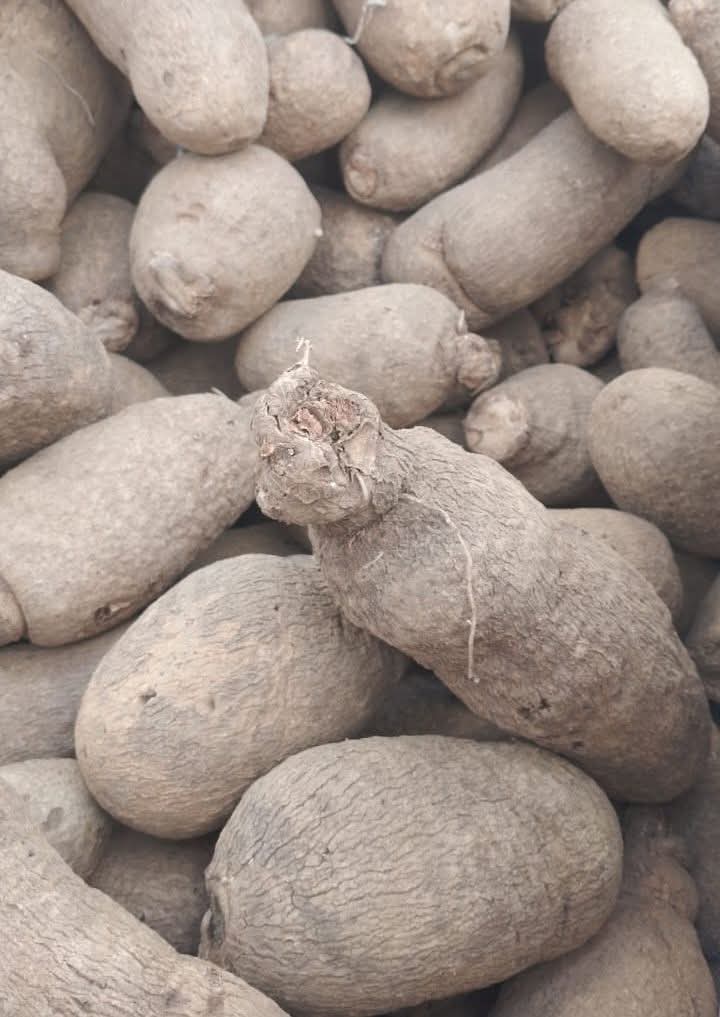
True yam (Dioscorea species) — the product that Nigeria produces and exports — are members of the Dioscoreaceae family, growing from corms as large climbing vines, producing large cylindrical tubers with rough, dark brown bark and white to cream flesh. They are botanically unrelated to sweet potato.
Sweet potato (Ipomoea batatas) — called “yam” in American English, particularly in the American South — is a completely different species from a different botanical family, with different nutritional properties, different flavour profile, and different culinary applications. American buyers new to Nigerian yam procurement should understand from the outset that Nigerian white yam is not sweet potato and the two products are not interchangeable.
Cocoyam (Colocasia esculenta or Xanthosoma sagittifolium) — called “yam” or “taro” in some West African contexts — is another distinct species frequently confused with white yam by buyers unfamiliar with West African culinary taxonomy.
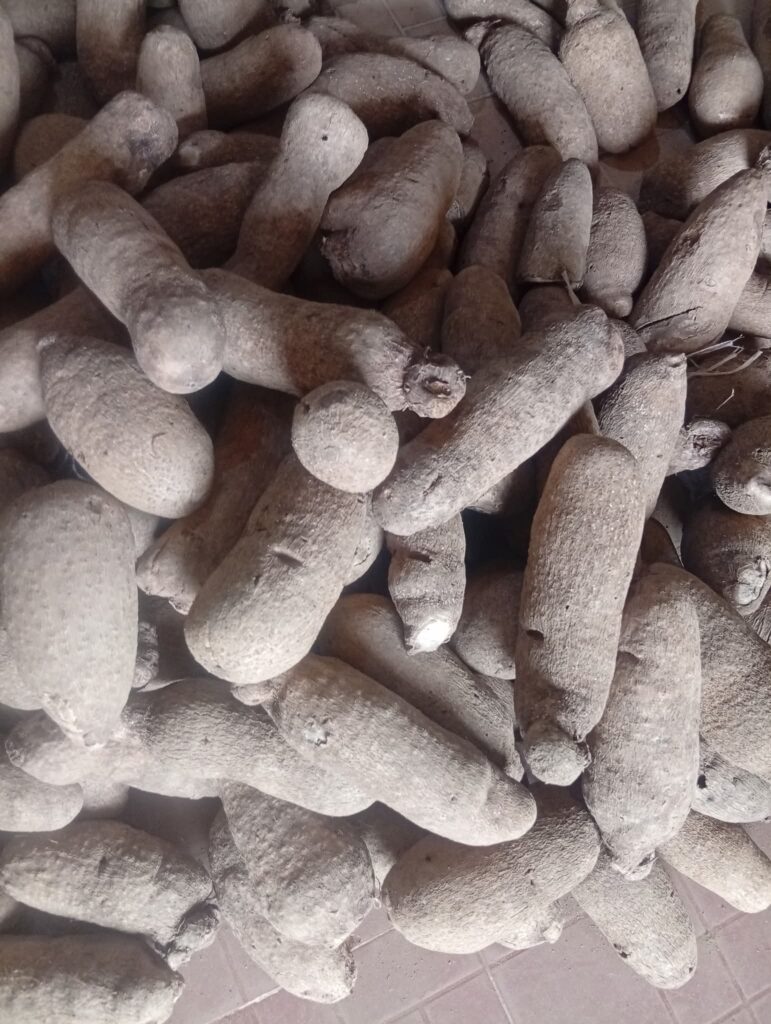
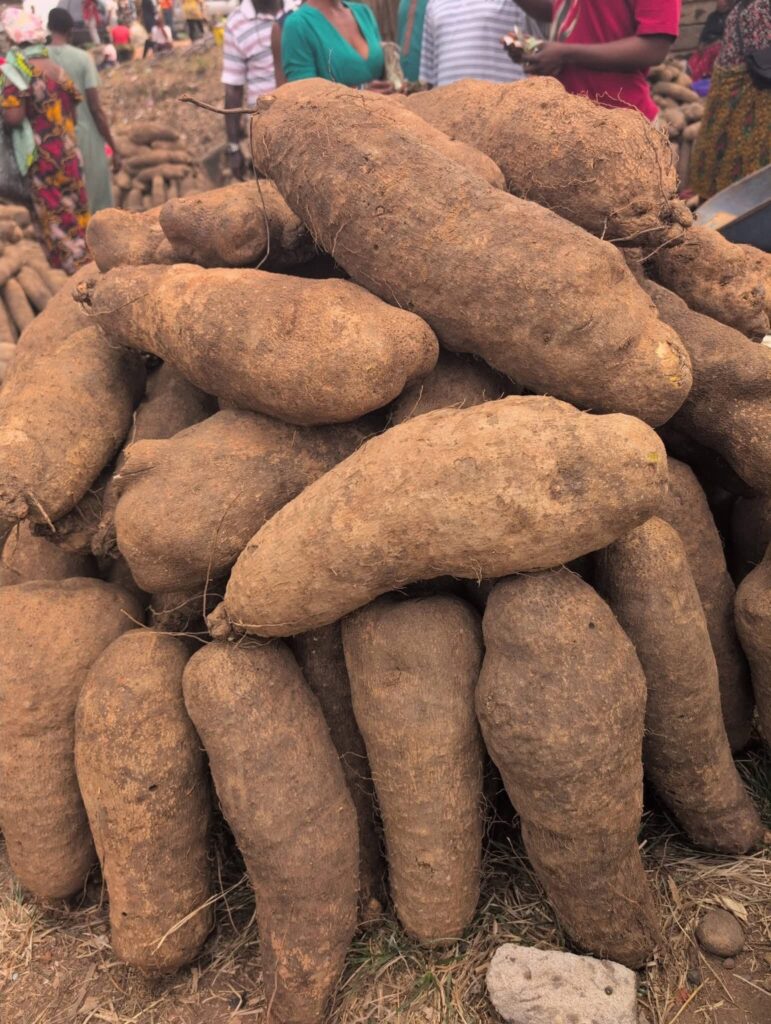
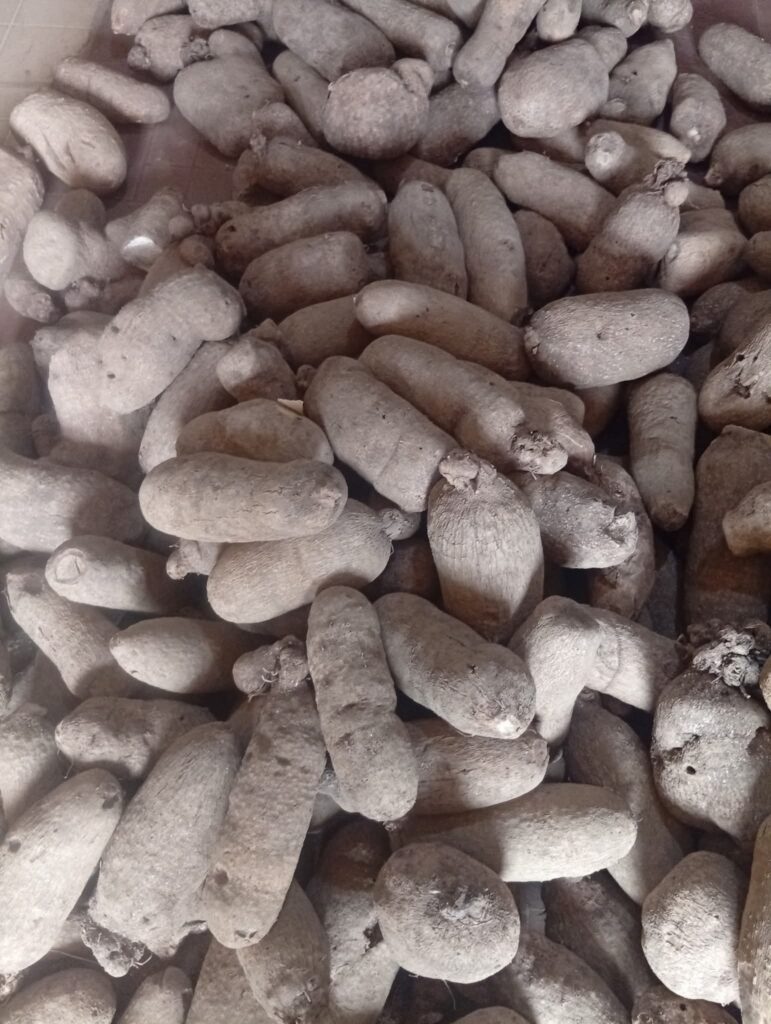
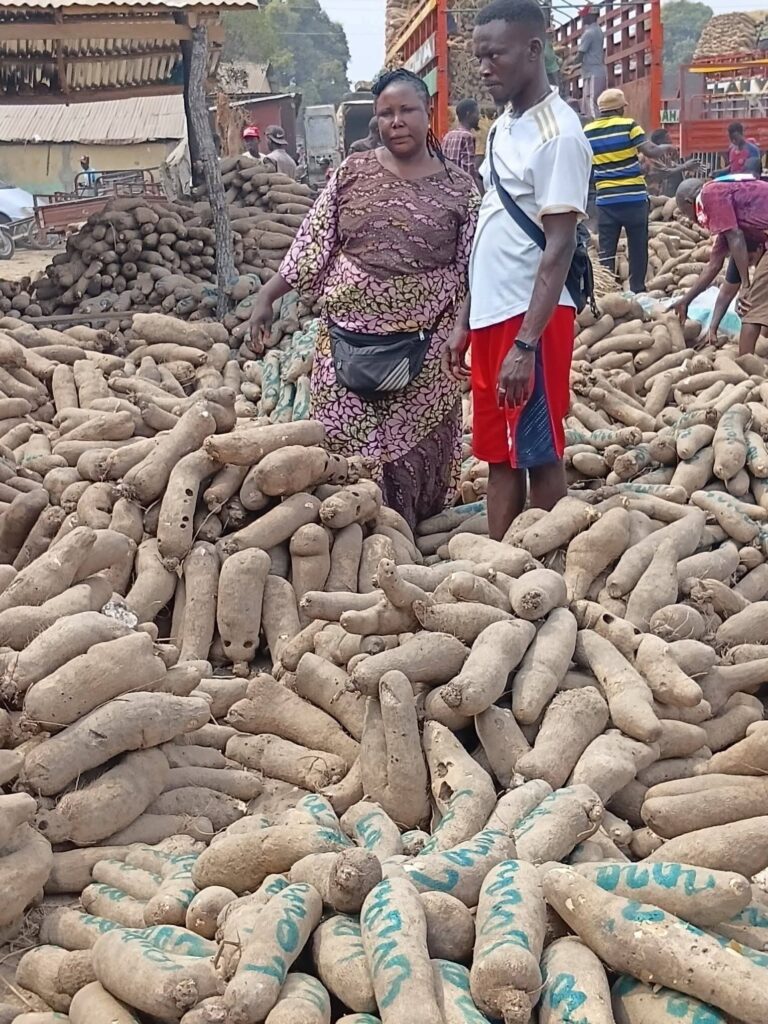
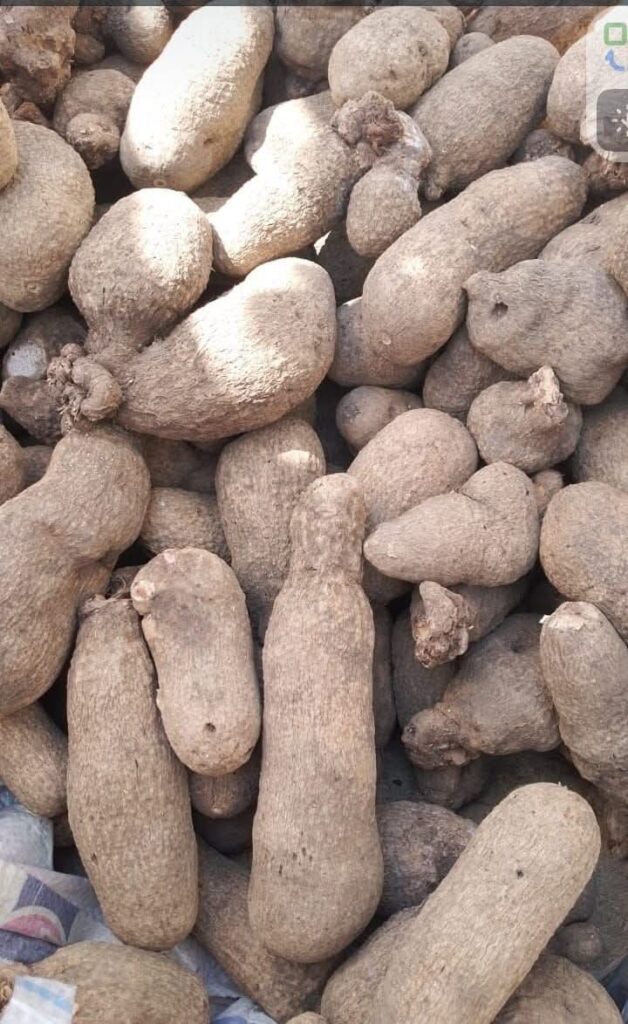
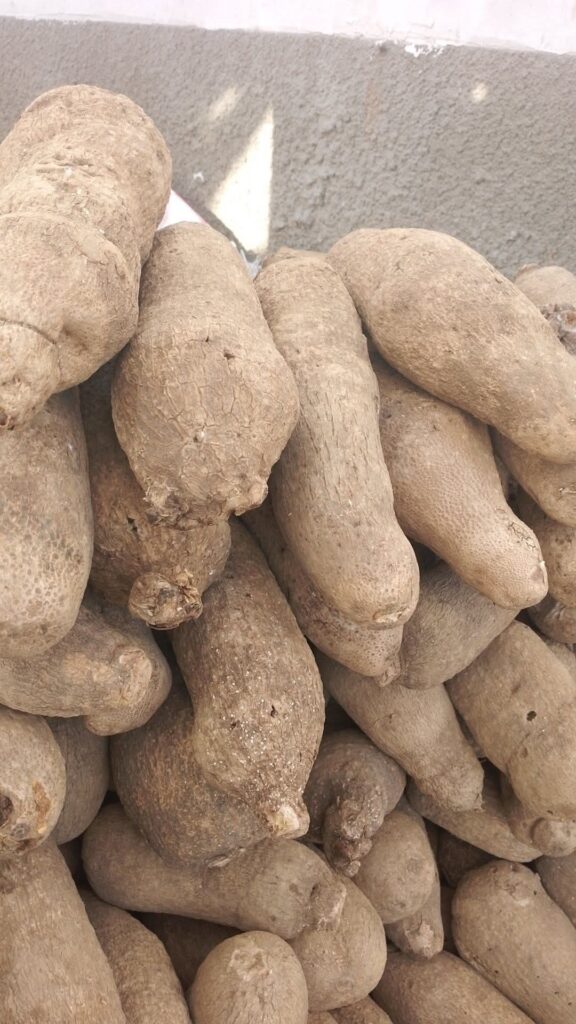
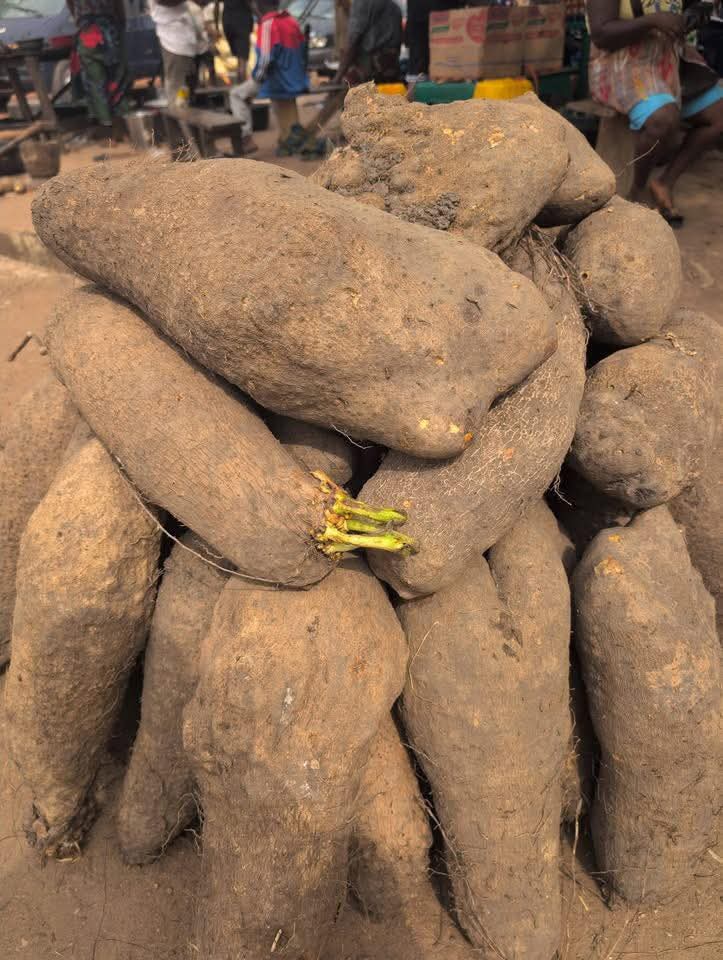
White yam (Dioscorea rotundata) — the specific species that Nigeria dominates in global production — produces large, elongated cylindrical tubers typically 30–100cm in length and 5–15cm in diameter at maturity, with a rough, brown, bark-like exterior that covers the characteristically white, firm, starchy flesh within. The flesh is dense, slightly sticky when raw, and transforms through cooking into a texture of extraordinary versatility — firm enough to be pounded into the smooth, elastic iyán (pounded yam) of Yoruba cuisine, or boiled to a tender, fluffy consistency for direct consumption, or fried to a crispy exterior for yam chips, or processed into flour for extended shelf life export products.
Nigeria’s Major White Yam Varieties
The cultivar diversity of Nigerian white yam — documented through IITA’s germplasm research programme and the Global Crop Diversity Trust’s crop improvement initiatives — produces commercially significant varieties with distinct quality profiles relevant to different market applications:
Puna — one of Nigeria’s most widely grown commercial white yam varieties, producing large, uniform tubers with excellent cooking quality and the smooth-pounding characteristic most valued for pounded yam preparation. The most widely specified variety in diaspora food retail and restaurant supply chains.
Kpozo — a high-yielding commercial variety particularly associated with Benue State production, valued for large tuber size and good shelf life — important commercial characteristics for long-distance export supply chains where shelf life directly determines the proportion of tubers that arrive at destination in commercially viable condition.
Alumaco — developed through IITA’s yam improvement programme, producing early-maturing tubers with high dry matter content — a property that improves both the cooking quality (firmer, less watery texture) and the efficiency of dried yam chip and flour production from fresh tubers.
Abi and Ogoja types — varieties associated with the Cross River State production zone, typically producing tubers with particularly dense, white flesh and a flavour profile valued by Efik and Calabar-area consumers — a specific variety preference that diaspora importers serving those communities specifically seek.
The Four Commercial Product Forms for International Export
Understanding the full range of commercial product forms in which Nigerian white yam is exportable is critical for buyers evaluating sourcing options — because different forms serve entirely different market applications with different shelf lives, regulatory frameworks, and logistical requirements:
Fresh White Yam Tubers — the primary and most culturally significant form, supplying the diaspora retail fresh produce market and the West African restaurant fresh produce supply chain. Fresh yam has a shelf life of approximately 3–5 months under proper storage conditions (cool, dry, well-ventilated, dark environments) — sufficient to allow fresh tuber export from Nigeria to European and North American destination markets via sea freight. Fresh tuber export is subject to phytosanitary requirements around soil-borne pathogen management and pest exclusion that are the primary regulatory complexity in Nigerian fresh yam export.
Dried Yam Chips (Gbodo/Elubo) — produced by peeling, slicing, and sun-drying fresh yam tubers to reduce moisture from approximately 70–75% at fresh harvest to 10–12% for extended shelf life storage. Dried yam chips — called gbodo in Yoruba and elubo in the context of dried yam flour production — are a traditional post-harvest processing method that converts perishable fresh yam into a shelf-stable product suitable for multi-year storage and international export without cold chain requirements. Dried yam chips are ground into flour at the point of use or purchased pre-ground.
Pounded Yam Flour (Instant Pounded Yam) — the highest-value-added processed yam product for international export, produced by cooking fresh yam tubers, pounding or processing the cooked flesh, and drying and milling to produce a fine powder that reconstitutes rapidly with boiling water into a texture approximating traditional pounded yam. Major Nigerian food brands including Ola Ola, TastyTom Yam Flour, Bigi, and Ayoola export packaged instant pounded yam flour to diaspora markets globally — products that serve diaspora consumers who want the experience of traditional pounded yam without the time and physical effort of traditional pounding. This processed product category is the fastest-growing segment of Nigerian yam’s international commercial development.
Yam Powder and Yam Starch — industrial ingredient forms produced from fresh or dried yam, used in food manufacturing applications including biscuit and snack production, soup thickening, pharmaceutical tablet excipient production, and the growing clean-label food ingredient market that is discovering yam starch as a natural, non-GMO alternative to modified corn and potato starch.
Benefits and Industrial Uses of Nigerian White Yam
Diaspora Food Retail and Wholesale — The Cultural Demand Foundation
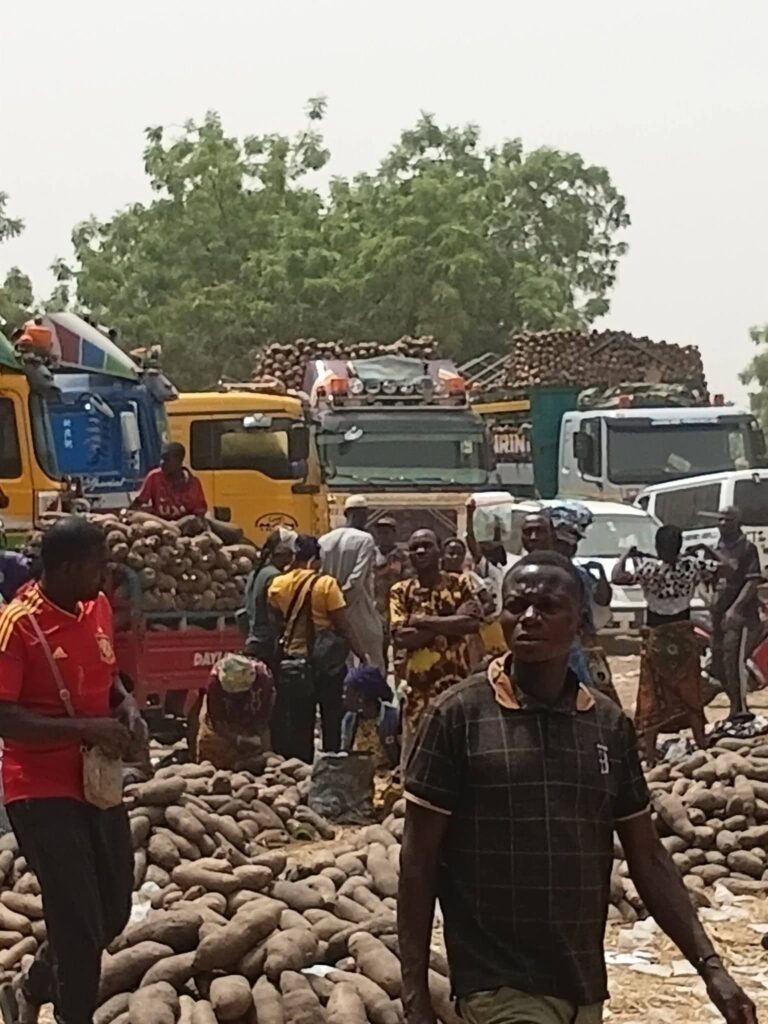
The West African diaspora communities across the United Kingdom, United States, Canada, France, Italy, Germany, the Netherlands, and Spain purchase Nigerian white yam with a frequency, loyalty, and volume that make it one of the most commercially significant ethnic food commodities in international food retail. Unlike some ethnic food ingredients whose consumption varies by occasion or season, yam consumption in Nigerian and broader West African communities follows a calendar of remarkable regularity — eaten multiple times per week in most households, serving as the basis for multiple dish types that appear on every menu in every West African restaurant, and consumed at the special occasions — naming ceremonies, weddings, funerals, church events — where authentic Nigerian food is not negotiable.
The pounded yam meal — iyán prepared by boiling white yam and pounding it in a mortar to a smooth, elastic consistency then served with soup — is one of the most regularly eaten meals across the Nigerian diaspora, consumed weekly or even daily in many households regardless of how long the family has been living outside Nigeria. This eating frequency makes fresh yam and pounded yam flour among the highest-turnover products in West African ethnic grocery retail — generating consistent weekly procurement from importers who supply African grocery networks across European and North American cities.
The ethnic food retail market intelligence published by Mintel’s food and drink research database confirms West African food staples — of which yam is the most volumetrically significant — as among the fastest-growing categories in European ethnic food retail. Euromonitor International’s diaspora food market analysis similarly documents the progressive formalisation of West African food import supply chains as diaspora populations grow and as organised ethnic grocery retail replaces community import networks as the primary procurement channel.
For wholesale importers supplying African grocery retail networks, contact our export team to discuss fresh tuber supply logistics, pounded yam flour bulk procurement, and dried yam chip supply arrangements.
Food Manufacturing — Yam Flour and Starch as Industrial Ingredients
Beyond the diaspora retail market, Nigerian white yam’s industrial ingredient applications are generating growing procurement interest from food manufacturers who have discovered yam starch and yam flour’s distinctive functional properties in food formulation:
Yam starch — extracted from fresh or dried white yam — has functional properties distinct from corn, potato, and cassava starch that make it commercially interesting to food technologists. Yam starch’s high amylose content, specific gelatinisation temperature, and gel stability properties have been documented through food science research published in the Journal of Food Science and the Carbohydrate Polymers journal — the primary peer-reviewed publications for starch science that food ingredient buyers reference when evaluating novel starch sources. The American Association of Cereal Chemists (AACCI) has published starch analytical standards relevant to yam starch characterisation that food manufacturing buyers can reference when specifying yam starch as an industrial ingredient.
Yam flour as a wheat flour extender and partial replacement ingredient has been researched extensively in the context of food fortification and cost reduction in bread, biscuit, and noodle production — with research published through the International Journal of Food Science and Technology documenting the functional, nutritional, and sensory properties of wheat-yam composite flour blends. For food manufacturers operating in African markets where wheat import dependence is an economic and supply chain vulnerability, yam flour blending is both a nutritional and a food security strategy.
Clean-label starch applications — the food industry’s growing preference for non-GMO, naturally derived, minimally processed starch ingredients over chemically modified starches — creates a commercial opening for Nigerian yam starch in European and American food manufacturing. Research on yam starch’s clean-label ingredient credentials is available through NCBI’s food science publications — providing the scientific documentation that clean-label food manufacturers require when evaluating novel natural starch sources.
Pharmaceutical and Nutraceutical Industry — Diosgenin and Beyond
Nigerian white yam’s pharmaceutical applications extend beyond its nutritional properties into the chemistry of steroidal sapogenins — specifically diosgenin, a steroidal compound found in several Dioscorea species that serves as a key starting material in the pharmaceutical synthesis of steroid hormones. As documented in pharmaceutical chemistry research accessible through NCBI’s pharmacology database, diosgenin is used industrially as a precursor compound in the synthesis of progesterone, estrogen, testosterone, corticosteroids, and other steroidal pharmaceutical compounds — making Dioscorea species commercially significant to the pharmaceutical industry beyond their food applications.
The diosgenin content of Dioscorea rotundata — while lower than some other Dioscorea species specifically cultivated for pharmaceutical diosgenin production — has attracted research interest from pharmaceutical ingredient companies evaluating West African wild and cultivated yam species as diosgenin sources. The World Health Organization’s traditional medicine programme recognises Dioscorea species in the context of traditional medicine applications documented across multiple cultures — applications including menopausal symptom management and anti-inflammatory formulation that reflect diosgenin’s downstream pharmaceutical relevance.
Beyond diosgenin, Nigerian white yam’s nutritional profile — documented through food composition research published by FAO’s food composition programme — positions it as a functional food ingredient relevant to glycaemic management, digestive health, and antioxidant nutrition: moderate glycaemic index (approximately 54 on the 100-point scale, significantly lower than potato), meaningful dietary fibre content, vitamin C, B6, potassium, and manganese — a nutritional constellation that has attracted nutraceutical research interest documented through the Journal of Ethnopharmacology.
Culinary and Restaurant Food Service Industry
West African restaurants — from community-serving casual establishments to the emerging tier of refined West African dining venues receiving mainstream food media attention across London, New York, Paris, and Amsterdam — depend on Nigerian white yam as a primary carbohydrate staple for their menus. Pounded yam, boiled yam, fried yam, yam porridge, and yam-based dishes appear on virtually every West African restaurant menu as foundational offerings alongside rice — and the quality of the yam served directly determines the culinary credibility of the restaurant in the eyes of its West African customer base.
The growing mainstream recognition of West African cuisine — documented through food media coverage in Bon Appétit, Food & Wine, The Guardian Food, and the emergence of Nigerian and Ghanaian restaurants in mainstream restaurant guides across major European and American cities — is expanding the restaurant buyer community for Nigerian white yam beyond the diaspora-serving establishments that have historically been the primary food service buyers. As West African cuisine enters the mainstream culinary landscape, the food service procurement infrastructure that supplies it with authentic ingredients must professionalise accordingly.
The Sustainable Restaurant Association (SRA) — which monitors sourcing practices across the UK and European restaurant sector — has noted growing restaurant operator interest in traceable, documented-origin food staples across all cuisine categories, a trend that favours licensed, documented Nigerian yam exporters over informal procurement channels.
Yam Chips and Snack Industry — The Premium Snack Opportunity
Fried yam chips — thin slices of fresh white yam deep-fried to crispy perfection — are one of Nigeria’s most beloved street foods and a premium snack option with growing commercial interest in international markets. The premium snack food market’s ongoing exploration of novel root vegetable chip alternatives — documented through new product launch tracking from Innova Market Insights and trend analysis from Mintel’s snack food database — has created commercial interest in yam chips as a differentiated, culturally authentic African snack ingredient.
Dried yam chips — the sun-dried pre-processed form — provide an export-stable raw material for both diaspora retail direct consumption and as a raw material for commercial yam chip production at destination markets. The snack food industry’s growing interest in authentic, origin-specific, clean-label snack ingredients creates a premium positioning opportunity for Nigerian white yam chips that commands pricing above commodity carbohydrate snack positioning.
Why Buy White Yam from Nigeria?
A Market Share That Defines Global Supply
Nigeria’s 67–70% share of global white yam production — documented through FAO production data and cross-referenced with trade intelligence from ITC Trade Map — gives it a market position that no other yam-producing nation approaches. Ghana, Côte d’Ivoire, Ethiopia, and Benin all produce meaningful yam quantities, but their combined output represents less than a third of Nigeria’s production. For international buyers who need reliable, large-volume supply of genuine Dioscorea rotundata white yam — there is no credible alternative origin at scale.
The Variety Depth That Matches Every Buyer Requirement
Nigeria’s cultivar diversity — over 600 named varieties maintained by farming communities across the producing states, with IITA’s improved varieties progressively adding commercially optimised options — means that buyers can specify the variety profile most appropriate to their application:
High dry matter content varieties for efficient flour and dried chip production. Large uniform tubers for fresh export retail presentation. Early-maturing varieties for supply calendar flexibility. Specific regional varieties for diaspora communities with established variety preferences. IITA-improved varieties with enhanced pest resistance and yield stability for buyers whose supply chain requires greater production predictability.
This variety depth — documented through the Global Crop Diversity Trust’s Dioscorea conservation programme — is a sourcing flexibility advantage that no other origin can replicate, because it is the product of millennia of farmer selection across a vast geographic range of production conditions.
Nigeria’s Yam Belt — The Agricultural Geography of Dominance
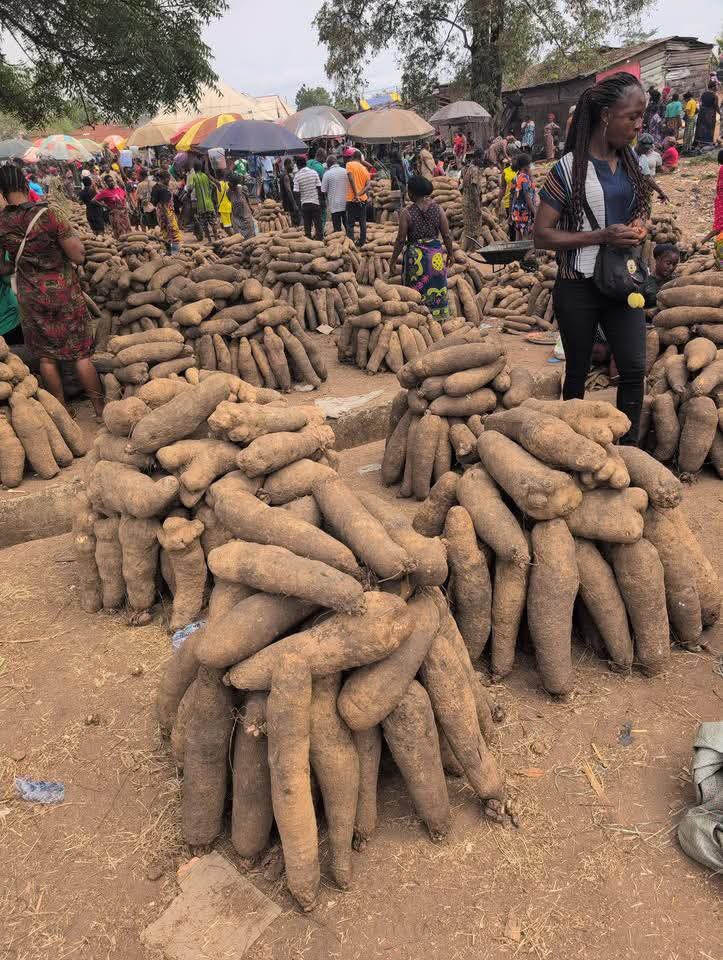
Nigeria’s primary yam production is concentrated in the Middle Belt states — specifically Benue, Kogi, Taraba, Niger, and Nasarawa — which together constitute what is nationally recognised as the Nigerian Yam Belt. The Guinea savanna ecological conditions of this zone — well-defined wet and dry seasons, fertile loamy soils with adequate organic matter, moderate altitude, and adequate rainfall of 1,000–1,500mm annually — produce the growing conditions that Dioscorea rotundata thrives in, delivering large, well-developed tubers with the dry matter content and cooking quality that buyers specify.
Significant secondary production occurs across the southwestern forest and forest-savanna transition states — particularly Oyo, Ondo, Osun, and Ekiti — where different varieties are cultivated in more humid conditions producing tubers with distinct quality profiles valued by Yoruba-area consumers and the restaurant market serving Yoruba diaspora communities.
Plateau State — Nigeria’s highland Middle Belt state — produces white yam under cool highland conditions that deliver exceptional tuber density and flavour concentration, with Plateau yam varieties commanding premium pricing in domestic and diaspora markets where quality-conscious buyers distinguish between production zone origins.
Post-Harvest Technology and the Shelf Life Challenge
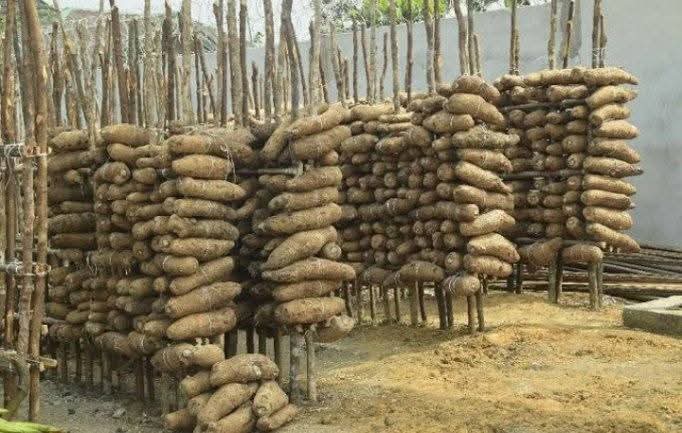
Fresh white yam’s primary commercial challenge in international export is post-harvest management — specifically the management of physiological dormancy, moisture loss, and disease development during the 3–5 month window between harvest and tuber deterioration. Traditional yam storage in Nigeria uses barn structures — elevated racks in well-ventilated sheds where individual tubers are stored vertically, allowing airflow around each tuber and preventing the moisture accumulation that promotes fungal disease.
Paradise MultiTrade works specifically with producers who apply improved post-harvest handling protocols — including waxing of cut surfaces to prevent moisture loss, dust application of appropriate fungicide where required for export compliance, and proper barn storage ventilation — to maximise the proportion of tubers that arrive at international destinations in commercially viable condition.
Research on improved yam post-harvest technology — published through IITA’s yam research programme and accessible through IITA’s online publication library — provides the technical framework for the post-harvest handling improvements that Progressive Nigerian yam exporters are implementing to close the quality gap between farm-gate yam quality and destination-market commercial requirements.
Export Documentation and Phytosanitary Compliance
Fresh yam export from Nigeria requires careful management of phytosanitary compliance — specifically the exclusion of soil-borne pests and pathogens including yam nematodes (Scutellonema bradys, Pratylenchus coffeae) that are regulated in receiving countries. Phytosanitary certification from the Nigerian Agricultural Quarantine Service (NAQS) for fresh yam export involves inspection of tubers for soil freedom, pest absence, and disease symptoms before container loading.
The European and Mediterranean Plant Protection Organization (EPPO) — which sets phytosanitary standards for plant imports into EU member states — publishes specific pest risk assessments and phytosanitary requirements for Dioscorea tubers entering European markets. Compliance with Regulation (EU) 2016/2031 on plant health is the primary regulatory framework for fresh yam import into EU markets — a framework that Paradise MultiTrade navigates actively for EU-bound fresh yam shipments.
US buyers importing fresh yam are subject to USDA APHIS phytosanitary import requirements — which may require treatment, inspection, or specific documentation for Dioscorea tubers from West African origins. Contact our export team early in the procurement planning process to discuss phytosanitary compliance requirements for your specific destination market before committing to order timelines.
Every Nigerian white yam shipment processed through Paradise MultiTrade carries phytosanitary certification from NAQS, NEPC export documentation, certificate of origin, commercial invoice, packing list, and bill of lading. Our NEPC Export Licence No. 0042385 and CAC Registration No. RC-9284647 are current and verifiable through NEPC.

Nigeria’s White Yam Export Strength and Global Market Demand
The Scale of What Nigeria Produces and What the World Consumes
To understand the commercial opportunity in Nigerian white yam export, the production numbers must be appreciated in their full scale. Nigeria produces approximately 45–50 million metric tonnes of yam annually — a figure that dwarfs every other yam-producing nation and that positions yam as Nigeria’s largest food crop by volume, ahead of cassava, maize, and rice in some years. This is not a niche crop or a specialty product — it is the single most voluminous food crop produced in the most populous country on the African continent.
Against this production backdrop, Nigeria’s formal international yam export infrastructure has historically been dramatically underdeveloped — with most international supply reaching diaspora markets through semi-informal import channels involving small volumes, inconsistent quality, limited documentation, and frequent post-harvest losses from improper handling between Nigerian farm and European or American destination. The formalisation of this supply chain — through licensed exporters with proper cold chain logistics, phytosanitary compliance infrastructure, and food safety documentation capability — is the commercial opportunity that Paradise MultiTrade is directly building.
The World Yam Market Research Report published by Mordor Intelligence values the global yam market in the billions of USD and projects continued growth driven by diaspora population expansion and growing mainstream food interest in West African cuisine. Grand View Research’s root vegetable market analysis provides complementary market sizing data within which Nigerian white yam’s commercial opportunity is positioned.
Key Export Destination Markets
The United Kingdom is the most commercially significant European market for Nigerian white yam by a considerable margin — driven by the UK’s large and well-established Nigerian diaspora community (the largest single West African national group in the UK) concentrated in London, Birmingham, Manchester, Leeds, and other major cities. UK ethnic grocery retail networks — including African food markets, Caribbean-African grocery chains, and online platforms — source fresh Nigerian yam and pounded yam flour in volumes that make yam one of the highest-turnover West African food products in British ethnic food retail.
Fresh yam import into the UK from Nigeria is managed under the UK’s post-Brexit phytosanitary import framework, overseen by Animal and Plant Health Agency (APHA) — the UK equivalent of the EU’s EPPO framework. Paradise MultiTrade coordinates phytosanitary documentation for UK-bound fresh yam shipments in compliance with this framework.
The United States — where the Nigerian diaspora is concentrated across Houston, Atlanta, New York, Washington DC, and Dallas — represents the most commercially significant non-European market for Nigerian white yam. American ethnic grocery retail operations serving the Nigerian and broader West African diaspora community import fresh yam through USDA APHIS-compliant channels with growing frequency as the diaspora population expands and purchasing power grows. The American pounded yam flour market — dominated by Nigerian brands exported from Lagos — is also a significant procurement category for American diaspora retail buyers.
Canada — particularly Toronto’s large Nigerian community concentrated in the Greater Toronto Area — is an active fresh yam import market, with Nigerian yam arriving through both direct export from Nigeria and redistribution from UK and US import hubs. Canada Border Services Agency (CBSA) and the Canadian Food Inspection Agency (CFIA) oversee phytosanitary import requirements for fresh yam entering Canada.
France — home to significant West African diaspora communities from Francophone West Africa alongside a growing Nigerian community particularly in Paris — imports Nigerian yam through ethnic food retail channels serving communities whose food traditions include yam consumption comparable to the Nigerian pattern.
Germany and the Netherlands import Nigerian yam primarily through Rotterdam and Hamburg entry ports, supplying growing West African diaspora communities across German cities and the broader European distribution network. The German Umweltbundesamt (UBA) and Netherlands Food and Consumer Product Safety Authority (NVWA) oversee food import safety standards relevant to Nigerian yam entering the German and Dutch markets respectively.
The UAE and Middle East — where significant Nigerian expatriate professional communities in Dubai, Abu Dhabi, and Riyadh create consistent diaspora demand — are growing markets for both fresh Nigerian yam and processed pounded yam flour products. UAE-based African food importers supply the Gulf region’s West African community through established distribution networks.
The New Yam Harvest Calendar and Its Commercial Implications
Understanding Nigeria’s yam harvest calendar is commercially essential for buyers building supply chains around fresh tuber import — because the harvest seasonality directly determines supply availability, pricing, and logistical planning requirements:
Early Yam (Isu Ọhụrụ) — the early crop, harvested from June through August, primarily from early-maturing varieties planted in January-February. Early yam commands premium prices in Nigerian domestic markets during the hunger season before the main harvest and is available in smaller volumes than the main crop.
Main Harvest — the primary commercial yam season, running from September through December across most Middle Belt producing states. This is when the largest volumes of the most commercially significant varieties reach market — the period of maximum supply availability and minimum farmgate prices.
Storage Yam — properly stored tubers from the main harvest remain available for sale and export through March-April of the following year, with availability and quality declining progressively as storage duration increases and physiological ageing reduces tuber vitality.
Buyers planning fresh yam import programmes should time their orders to align with the October-January peak availability window — when the best combination of variety choice, quality, volume, and price exists at the Nigerian farmgate. For dried yam chips and pounded yam flour — products produced from fresh yam and available year-round — the harvest seasonality has less direct impact on procurement planning. Contact our team to plan your procurement cycle around the Nigerian yam harvest calendar.
Why Choose Paradise MultiTrade International Limited?
Yam Belt Direct Sourcing. Our fresh yam is sourced from established farmer networks and primary market aggregators in Benue, Kogi, Taraba, and Niger states — the heart of Nigeria’s primary yam production zone where the best commercial varieties are grown in the highest volumes. We are not purchasing through Lagos secondary markets where mixed-origin, mixed-quality, and mixed-variety yam is aggregated indiscriminately — we source from the production zone with variety awareness and quality visibility.
Multiple Product Forms Available. We supply fresh white yam tubers for diaspora retail and restaurant supply chains, dried yam chips for extended shelf life diaspora retail and food manufacturing, pounded yam flour (instant) sourced from Nigerian processors, and yam powder/starch for food manufacturing ingredient applications. Each form has distinct logistical requirements, regulatory frameworks, and pricing structures discussed at the quotation stage. Contact our team to specify your required form.
Phytosanitary Compliance Expertise. Fresh yam export’s phytosanitary complexity — specifically the EPPO-regulated pest exclusion requirements for EU-bound shipments and the USDA APHIS requirements for US-bound shipments — is the primary compliance challenge that separates capable Nigerian yam exporters from those who create problems for importers at destination port customs. We manage phytosanitary compliance proactively — coordinating NAQS inspection, ensuring soil freedom and pest exclusion at the grading stage, and preparing documentation that meets destination-country inspection requirements. Contact us to discuss phytosanitary compliance for your specific destination market.
Post-Harvest Quality Management. We work with producers applying improved post-harvest handling protocols — proper barn storage, cut surface treatment, and moisture management — to maximise the proportion of fresh tubers that arrive at destination in commercially viable condition. Reducing post-harvest losses from the farm-to-destination chain is the single most important commercial quality management challenge in fresh yam export, and it requires supply chain discipline at every stage from harvest through container loading.
Processed Yam Product Network. For buyers who need pounded yam flour rather than fresh tubers — the most commercially accessible form of Nigerian yam for diaspora retail buyers outside the fresh produce supply chain — we source from established Nigerian pounded yam flour processors and can supply branded or unbranded product in bulk or retail-ready packaging. Contact our team to discuss processed yam product specifications.
Multi-Commodity West African Food Sourcing. Yam buyers frequently source complementary Nigerian food commodities for the same diaspora or food service buyer base. Alongside Nigerian white yam, Paradise MultiTrade exports egusi melon seed, ogbono seed, crayfish, alligator pepper, red palm oil, chilli pepper, bitter kola, kola nut, hibiscus flower, sesame seeds, fresh ginger, dry split ginger, and cashew products. Explore our full range of Nigerian export commodities and consolidate your West African food and agricultural sourcing through one verified, licensed export partner.
Product Specifications
| Specification | Details |
|---|---|
| Product | Nigerian White Yam (Dioscorea rotundata) |
| Common Names | White yam, True yam, Isu (Igbo), Iyán/Ẹsụ (Yoruba), Doya (Hausa), Igname blanc (French) |
| Origin | Nigeria (Benue, Kogi, Taraba, Niger, Nasarawa, Oyo, Ondo, Plateau States) |
| Forms Available | Fresh whole tubers; dried yam chips (gbodo); pounded yam flour (instant); yam starch/powder |
| Fresh Tuber Size | Large (>3kg per tuber), Medium (1–3kg), Small (<1kg); buyer-specified grading available |
| Fresh Tuber Moisture | 70–75% at harvest |
| Dry Matter Content | 25–30% (fresh basis — variety-dependent) |
| Dried Chip Moisture | 10–12% |
| Pounded Yam Flour Moisture | 8–10% |
| Purity | 95%+ (free from pest damage, disease, soil, and foreign matter) |
| Fresh Tuber Shelf Life | 3–5 months under proper cool, dry, ventilated barn storage |
| Dried Chip Shelf Life | 12–18 months properly stored |
| Pounded Yam Flour Shelf Life | 12–18 months sealed, dry storage |
| Packaging Options — Fresh | 5kg, 10kg, 25kg jute/mesh bags; bulk pallet loading for container |
| Packaging Options — Dried/Flour | 25kg, 50kg polypropylene bags; 1kg, 2kg, 5kg retail packs on request |
| Supply Capacity | Fresh: 20–1,000+ MT per shipment; Dried/Flour: 10–500+ MT per shipment |
| MOQ | Fresh: 10 Metric Tonnes; Dried chips/Flour: 5 Metric Tonnes |
| Export Documentation | Phytosanitary Certificate (NAQS), Certificate of Origin, NEPC Export Licence, Commercial Invoice, Packing List, Bill of Lading; EPPO/APHIS compliance documentation for EU/US-bound shipments |
| Payment Terms | T/T, Letter of Credit (LC at sight), Escrow |
| Loading Port | Lagos (Apapa / Tin Can Island Port), Nigeria |
| Incoterms Available | EXW, FOB Lagos, CNF, CIF |
Packaging and Export Process
Harvesting. White yam is harvested manually — by carefully loosening the soil around the base of the vine and lifting the tuber to avoid mechanical damage that creates entry points for fungal disease and accelerates post-harvest deterioration. Harvest timing is critical: yams harvested before physiological maturity have higher moisture content and shorter storage life; yams left in the ground past optimal maturity lose dry matter. The traditional farmer knowledge of optimal harvest timing — accumulated over generations of observation — is commercially irreplaceable and one of the quality advantages of sourcing through experienced farming communities.
Initial Post-Harvest Handling. Freshly harvested tubers are cured — held in warm, humid conditions for 4–7 days to allow the skin to harden and minor surface abrasions to heal — before moving to barn storage. Properly cured tubers develop a thickened skin that resists moisture loss and pathogen entry during storage, significantly extending viable shelf life. This curing step, while time-consuming, is the single most important post-harvest quality improvement intervention available and is standard practice among quality-oriented producers who supply export supply chains.
Grading and Sorting. Cured tubers are graded by size — large, medium, and small — and inspected for pest damage, disease symptoms, mechanical injury, and physical deformity. Tubers with significant damage are separated for domestic market sale rather than export. Grade-sorted tubers for export are assembled in size-specified lots that meet buyer specification requirements.
Phytosanitary Treatment and Inspection. Soil is removed from tuber surfaces through brushing — ensuring the soil-free presentation required by importing country phytosanitary authorities. Tubers are inspected by NAQS-certified phytosanitary officers for absence of regulated pests including yam nematodes and surface fungal disease. NAQS phytosanitary certificates are issued for lots that pass inspection and meet export standards.
Packing for Fresh Export. Fresh yam for export is packed in ventilated jute or mesh bags — typically 10–25kg per bag — that allow airflow around the tubers during transit. Container loading uses appropriate dunnage and ventilation management to maintain tuber quality during the 14–25 day sea transit to European and North American destinations.
Dried Chip and Flour Production. For dried yam chip and pounded yam flour supply, fresh tubers are peeled, sliced (for chips) or cooked and pounded (for flour), then dried through sun-drying or mechanical drying to the target moisture specification. Flour is milled to the required fineness and packed in moisture-barrier bags.
Lead Times. Fresh tuber orders require 14–21 days from order confirmation to container loading. Dried chip and flour orders run 10–21 days. For large volume orders or orders requiring specific variety sourcing from Yam Belt producing zones, 21–35 days should be anticipated. Contact us early — particularly for fresh tuber orders where harvest season timing and storage position directly affect available quality and volume.
Frequently Asked Questions
What is the difference between Nigerian white yam and sweet potato — are they the same product?
No — they are completely different plants from different botanical families with different flavour, texture, nutritional profiles, and culinary applications. Nigerian white yam (Dioscorea rotundata) is a member of the Dioscoreaceae family with white, starchy, firm flesh and a mild, slightly earthy flavour. It is the specific crop used to make pounded yam — the most iconic West African staple — and it has been grown in West Africa for thousands of years. Sweet potato (Ipomoea batatas) is a member of the Convolvulaceae family with sweeter, softer flesh. In American English, the orange-fleshed sweet potato is commonly called “yam” — which creates significant confusion for international buyers. Nigerian white yam is not sweet potato, is not orange in flesh colour, and cannot substitute for sweet potato in American culinary applications any more than sweet potato can substitute for white yam in Nigerian culinary applications. They are distinct products serving distinct markets. Contact us if you need species clarification for import documentation purposes.
What are the phytosanitary requirements for importing fresh Nigerian yam into the EU?
Fresh Dioscorea tubers entering the EU are subject to phytosanitary requirements under Regulation (EU) 2016/2031 on plant health, primarily targeting the exclusion of soil-borne nematode pests (Scutellonema bradys, Pratylenchus coffeae) that are regulated in EU territory. Requirements include phytosanitary certification from NAQS confirming inspection and pest freedom, soil-free presentation of tubers, and in some cases treatment documentation. The EPPO’s phytosanitary requirements database lists specific requirements by pest and by importing country — EU buyers should review the relevant requirements with their customs broker and plant health authority alongside Paradise MultiTrade’s documentation team. Contact us to discuss EU phytosanitary compliance for fresh yam shipments.
What is pounded yam flour and how does it differ from fresh yam?
Pounded yam flour — also called instant pounded yam — is a processed product made by cooking fresh white yam, pounding or processing the cooked flesh to a smooth consistency, then drying and milling to produce a fine powder. When reconstituted with boiling water, it produces a texture approximating traditional pounded yam — the smooth, elastic, dough-like consistency that is the defining quality of iyán prepared by traditional mortar pounding. It has a shelf life of 12–18 months versus fresh yam’s 3–5 months, requires no cold chain, and is ready to prepare in minutes rather than requiring the cooking and pounding process of fresh yam. For diaspora retail buyers, pounded yam flour is the most convenient product form. For restaurants wanting the authentic pounded texture, fresh yam properly cooked and processed in-house produces the most authentic result. Contact us to discuss both fresh yam and pounded yam flour supply.
How long does fresh Nigerian yam last during sea shipping and after arrival?
Properly harvested, cured, and stored fresh white yam has a shelf life of 3–5 months from harvest under appropriate barn storage conditions (cool, dry, well-ventilated, dark). Sea shipping from Lagos to European or North American ports takes 14–25 days — well within this shelf life window when post-harvest handling is properly managed. After arrival, fresh yam should be stored in cool, dry, ventilated conditions (not refrigerated — cold temperatures below 10°C cause chilling injury in Dioscorea rotundata) and sold within 4–8 weeks of arrival for optimal commercial quality. The critical commercial variable is post-harvest handling quality between harvest and container loading — which is where Paradise MultiTrade’s sourcing quality management focus is concentrated.
Is Nigerian yam available year-round or only during harvest season?
Fresh yam is available for export during two distinct seasonal windows: the early crop from June through August (smaller volumes, premium pricing) and the main crop from September through April (highest volumes and best variety selection from September–January, declining availability and quality from February onward as storage progresses). Dried yam chips and pounded yam flour — produced from fresh yam and extended through processing — are available year-round. For buyers requiring consistent year-round supply of fresh tubers, procurement planning that coordinates between the two seasonal windows — including appropriate storage planning at destination — is essential. Contact our team to plan a year-round supply programme.
What Nigerian yam varieties are best for pounded yam preparation?
The quality of pounded yam is primarily determined by the yam variety’s dry matter content and starch structure — varieties with higher dry matter content (25–30%) produce a firmer, more elastic pounded yam with the stretchy consistency that defines quality iyán. The Puna, Alumaco, and Kpozo varieties — all widely grown in Nigeria’s Middle Belt Yam Belt states — are among the most consistently recommended commercial varieties for pounded yam quality. Regional preferences also matter: Yoruba diaspora communities may specifically request Oyo or Ondo state varieties; Igbo communities may prefer Benue or Enugu-area varieties. We discuss variety specification with diaspora retail buyers who have specific community preference requirements. Contact us to discuss variety-specific sourcing.
What transit times should I plan for from Nigeria?
Fresh yam — sea freight, refrigerated container recommended: Europe (Rotterdam, Hamburg, Felixstowe) — approximately 14–20 days. UK (Tilbury, Felixstowe) — 14–18 days. USA (East Coast — New York, Baltimore, Savannah) — 18–25 days. Canada (Halifax, Montreal) — 18–28 days. UAE (Jebel Ali) — 10–14 days. Dried chips and pounded yam flour — standard dry container, same transit times as above, no temperature control required.
Ready to Source Premium Nigerian White Yam — Fresh Tubers, Pounded Yam Flour, and Dried Yam Products for Diaspora Retail, Restaurant Supply, and Food Manufacturing?
If you are a diaspora food wholesale importer building a West African food staple supply chain, a West African restaurant supply chain buyer who needs consistent, quality-graded fresh white yam, a pounded yam flour wholesale buyer supplying diaspora retail markets, a food manufacturer investigating yam starch or yam flour as a clean-label ingredient, or a pharmaceutical ingredient company investigating Dioscorea species as diosgenin sources — Paradise MultiTrade International Limited is the licensed, NEPC-registered Nigerian exporter your supply chain needs.
We supply Nigerian white yam in fresh tuber, dried chip, pounded yam flour, and yam powder forms — sourced directly from Nigeria’s primary Yam Belt producing states, graded and post-harvest-handled to maximise export quality, phytosanitary-certified for compliance in EU, UK, USA, and Canadian markets, and exported with full regulatory documentation to buyers in every major regulated destination market.
Request a Quotation — share your required form (fresh tubers, dried chips, pounded yam flour, or yam starch/powder), volume, size grading preference for fresh tubers, destination market, and phytosanitary compliance requirements. We respond with a detailed, competitive quote within 48 hours.
Contact Our Export Team — speak directly with our export coordinators about fresh tuber phytosanitary compliance for your destination market, variety-specific sourcing for diaspora community preferences, pounded yam flour brand and bulk options, post-harvest handling quality management, cold chain logistics arrangements, and long-term supply contract structure.
Explore Our Full Product Range — alongside Nigerian white yam, Paradise MultiTrade exports egusi melon seed, ogbono seed, crayfish, alligator pepper, red palm oil, chilli pepper, Bambara nut, moringa seeds, hibiscus flower, turmeric, cloves, sesame seeds, bitter kola, kola nut, fresh ginger, cashew nut kernel, and raw cashew nuts. One licensed Nigerian exporter. One consolidated West African food and agricultural sourcing relationship. Consistent quality and documentation across every commodity.
Buy Nigerian white yam, Nigerian yam supplier bulk export, Dioscorea rotundata Nigeria wholesale, white yam Nigeria for food industry, Nigerian pounded yam flour export, yam tuber bulk buyer Africa, Nigerian yam for diaspora market, white yam exporter West Africa
Paradise MultiTrade International Limited | NEPC Export Licence No. 0042385 | CAC No. RC-9284647 | Lagos, Nigeria | www.paradisemultitrade.com
Reviews
There are no reviews yet.